Building a Partnership
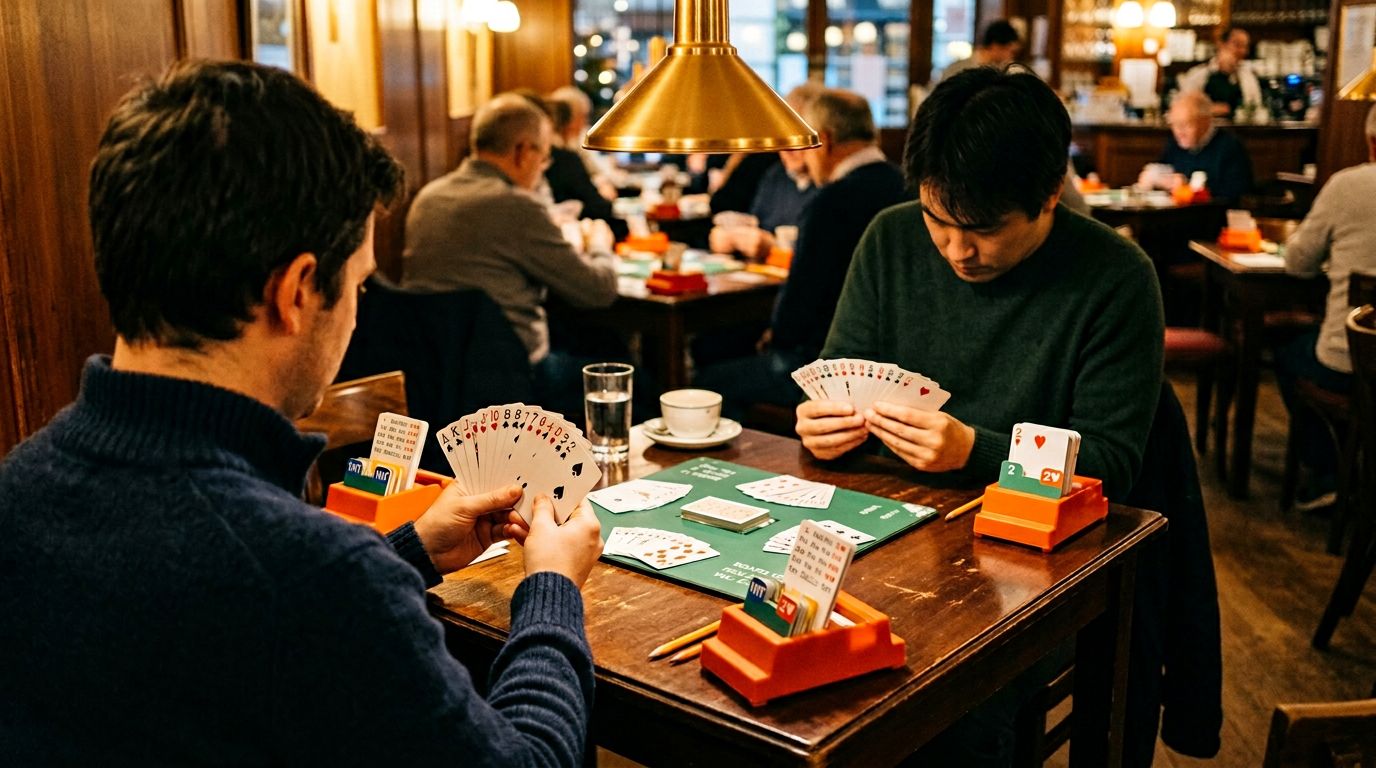
Playing with random partners at club games is fine. It’s how you learn. But at some point, you’ll want a regular partner. Someone who knows how you bid, how you think, what that 2♦ bid means in this specific auction.
Good partnerships don’t happen by accident. They’re built through clear communication, compatible goals, and deliberate practice.
Here’s how to find a partner and turn that partnership into something functional.
Finding a Partner: The Realistic Path
Where Partners Actually Come From
Club games Play with different people for a month. You’ll naturally click with someone. Similar skill level, similar temperament, similar sense of humor about disasters. After three or four sessions together, one of you suggests making it regular.
Bridge classes Everyone taking a class is looking for partners. You’re all at the same skill level, learning the same system. This is possibly the easiest path to finding a compatible partner.
Online partner searches BBO has a partner finder. ACBL has one. Bridge Winners has one. Post your details (skill level, location, goals, availability), check back weekly. Expect to message 5-10 people before you find one that clicks.
Friends and family Teaching your spouse or friend to play bridge means you get a partner who’s available when you are and won’t flake on you. The downside: if they’re not naturally interested, it won’t last.
Club announcements Most clubs have bulletin boards (physical or digital). “Looking for regular partner, Tuesday evening games, intermediate level.” You’ll get responses.
What to Look For
Similar skill level If you have 15 masterpoints and they have 1500, the skill gap is too big. They’ll be frustrated by your mistakes, you’ll be overwhelmed by their expectations. Find someone within 100-200 masterpoints of you.
Compatible goals Are you playing for fun or to win? Socially or competitively? Once a week or five times a week? These need to align. A player who wants to go to nationals every year won’t mesh with someone who plays casually once a month.
Matching temperament Some people analyze every hand afterward. Some people prefer to play and move on. Some people joke about disasters, some people brood. You need compatible emotional styles.
Reliable schedule A partner who cancels half the time isn’t a partner. You need someone who shows up consistently.
Decent human being This sounds obvious, but some people are great players and terrible partners. If they blame you for every bad result, find someone else.
Red Flags in Potential Partners
- Consistently late or canceling
- Blaming partner for every mistake
- Unwilling to discuss hands constructively
- Rigid about system (“We MUST play Inverted Minors”)
- Talks during opponents’ auctions
- Obviously better than you and impatient about it
- Obviously worse than you and not trying to improve
One or two of these might be workable. Three or more, walk away.
The First Partnership Discussion
You’ve found someone who seems compatible. Before you play your first game together, have this conversation.
System Basics
Notrump range: “I learned 15-17. Is that what you play?”
Most people play 15-17 in Standard American. Some play 16-18. Some play weak notrump (12-14). You need to match.
Major vs minor openings: “Do you open 5-card majors?” Almost everyone does, but confirm.
Two-over-one: “Are we playing 2/1 game forcing or standard responses?”
If you don’t know what 2/1 means, you’re playing standard. That’s fine. Most beginners start with standard.
Essential Conventions
Agree on the conventions you both know:
- Stayman (probably yes)
- Jacoby Transfers (probably yes)
- Blackwood (everyone plays this)
- Weak two bids (yes or no?)
- Strong 2♣ (probably yes)
Don’t try to learn 15 new conventions before your first game. Play what you both know, add more later.
What You Don’t Need to Discuss Yet
- Splinter bids
- Fourth suit forcing
- New Minor Forcing
- Inverted minors
- Unusual 2NT
- Any convention you haven’t used in a game
These are useful, but they can wait. Get the basics working first.
Partnership Agreements
How do we handle mistakes? “If one of us screws up, let’s not discuss it at the table. We can talk after the session if needed.”
What’s our default double? At low levels, is double penalty or takeout? Agree on a default so you’re not guessing.
Bidding style: Are you aggressive or conservative? “I tend to open light” or “I need full values to open” lets your partner calibrate.
Creating Your Convention Card
Convention cards look intimidating. 60+ lines, checkboxes everywhere, cryptic abbreviations.
Here’s what to actually fill out for a basic partnership.
Section 1: General Approach
- System: Standard American (or 2/1 if you both know it)
- 1NT opening: 15-17 (or whatever you agreed)
- 1NT overcall: 15-18
- 2NT opening: 20-21
Section 2: Opening Bids
- Five-card majors: Check this
- Strong 2♣: Check this
- Weak 2s: Check this (if you play them)
Section 3: Responses to 1NT
- Stayman: Check, write “Puppet?” (No)
- Jacoby Transfers: Check
- Texas Transfers: Leave blank unless you play them
Section 4: Defensive Carding
- Leads: Standard (fourth from longest and strongest)
- Signals: Standard (high encourages)
Don’t overthink this section. Standard leads and signals work fine.
Section 5: Special Stuff
Most of this stays blank for beginners. Maybe check:
- Blackwood: Yes
- Gerber: If you know it
Everything else (Inverted Minors, Splinters, Michaels, Unusual 2NT) can wait.
The Back Side
The back of the card has even more conventions. Ignore it for now. Seriously. Fill out the front, leave the back mostly blank.
Exception: If you play a specific convention regularly (maybe you both learned Weak Jump Shifts), note it. But don’t check boxes for conventions you’ve only read about.
Updating the Card
Your convention card is not permanent. When you add a convention, update the card. When you stop playing something, cross it out.
Most partnerships update their card 2-3 times a year as they refine their system.
Pre-Game Partnership Prep
Before each session, spend five minutes confirming:
“Quick system check:”
- Notrump range? (15-17)
- Stayman and transfers? (Yes)
- Weak twos? (Yes)
- Any new conventions since last time? (No)
- Anything you want to try today? (No, let’s keep it simple)
This prevents the mid-auction realization that you’re playing different systems.
“Any hands from last time we should discuss?”
If you played together before and something went wrong, now’s the time to clarify. Not during the game.
Practice Methods That Work
Playing together in club games is practice, but it’s reactive practice. You get random hands, no control over what you’re working on.
Here are ways to practice specific aspects of your partnership.
Online Practice Games
BBO Practice Tables Set up a private table, play against robots or other pairs. Free, no pressure, you can discuss hands in real-time (in chat or on the phone).
Funbridge Practice You each play the same hands separately, then compare results. Good for seeing how your partner thinks.
Hand Analysis Together
After a club session, pick 2-3 hands that were interesting. Not the disasters (unless there’s a lesson), but the close decisions.
What to discuss:
- “On board 7, would 3NT or 5♣ have been better?”
- “On board 14, should I have opened 1NT or 1♦?”
- “On board 22, what would you have led from my hand?”
This builds partnership understanding. You learn how they think, they learn how you think.
Pre-Dealt Hands
Buy or download pre-dealt hands (ACBL sells them, websites offer free ones). Play through them together.
Why this helps: You can replay the same hand multiple times, trying different approaches. “What if I bid 4♥ instead of 3♥? Does that change your response?”
Convention Practice
Learning a new convention? Deal hands specifically to practice it.
Example: Practicing Stayman One of you deals hands where opener has 15-17 balanced. Responder has 8-9 points and a 4-card major. Bid them, see if you can find the fit.
Do this 10 times. Stayman stops being theoretical and becomes automatic.
Defense Practice
Hardest part of bridge, rarely practiced deliberately.
How to practice: Play a hand, then replay it with both hands visible. “If I’d led a spade instead of a heart, could we have beaten it?”
Defensive partnerships improve faster when you can see each other’s hands and understand the logic.
Adding Conventions: The Right Way
You’ve been playing together for a month. Someone suggests adding a new convention. Maybe Jacoby 2NT, maybe splinter bids, maybe whatever.
Before adding it:
-
Do we need this? How often would it come up? If it’s once every 20 hands, maybe. If it’s once every 200 hands, skip it.
-
Do we both understand it? If one partner read about it and the other is hearing it for the first time, stop. Both partners need to understand fully.
-
Can we practice it? Deal or find hands where it applies. Bid them. Make sure you’re on the same page.
-
What happens if we forget? You’ll forget the new convention in the heat of the moment. If forgetting it causes disasters, maybe wait.
How to add it:
- Read about it together (same article or book)
- Discuss when it applies and when it doesn’t
- Update your convention card
- Practice 5-10 hands using it
- Use it in a game
- Debrief afterward: did it work?
Add one convention at a time. Get comfortable with it before adding the next one.
The Partnership Lifecycle
Months 1-3: Figuring Each Other Out
You’re learning how partner thinks. They bid 3NT on marginal hands, you’re conservative. They lead aggressively, you lead safe. You’re calibrating.
Mistakes are frequent. Misunderstandings happen. That’s fine. You’re building shared context.
Months 4-6: Getting Comfortable
You stop thinking about mechanics and start thinking about strategy. You know what partner’s 2NT rebid means. You trust their defense.
Results improve not because you’re playing better bridge, but because you’re playing better together.
Months 7-12: Solid Partnership
You have implicit understandings. When partner hesitates, you know what they were thinking. When they make an aggressive bid, you know their style.
Convention card is stable. You’ve added the conventions you need, dropped the ones that didn’t work.
Year 2+: Long-Term Partnership
Some partnerships last decades. You finish each other’s auctions. You know when to take charge and when to defer. You have shared history (“Remember that hand at the regional in 2024?”).
Or you’ve drifted apart. Goals changed, schedules changed, someone moved. That’s okay too. Partnerships end. Find a new one and start the cycle again.
When Partnerships Don’t Work
Sometimes it’s not working. You’re not improving, you’re not enjoying it, or you’re actively making each other miserable.
Fixable Problems
Communication issues: You’re not discussing hands enough, or you’re discussing them in a way that feels critical. Fix: agree on a constructive format for post-game analysis.
System mismatch: You keep forgetting conventions or bidding differently. Fix: simplify your system, practice specific sequences.
Scheduling conflicts: You’re canceling frequently. Fix: find a more realistic schedule or acknowledge this isn’t the right time for a regular partnership.
Unfixable Problems
Temperament clash: One of you is competitive, the other is casual. This won’t change.
Blame culture: Every bad result is someone’s fault and it’s always the same someone. This is toxic. End it.
No improvement: Six months in, you’re playing exactly the same as month one. Neither of you is pushing the other to improve. This partnership is stagnant.
Not enjoying it: If bridge with this partner feels like a chore, stop. Bridge should be fun.
How to End a Partnership
Be direct but kind: “I think we have different goals for bridge. I’m looking for something more casual/competitive/frequent. Let’s stay friendly but find different partners.”
Don’t ghost. Don’t make excuses. Don’t drag it out.
Most bridge friendships survive partnership endings. The person might even help you find your next partner.
Learn Bridge with Brian
New to bridge? Brian is an AI bridge coach that explains concepts in plain language and helps you practice with real hands. No judgment, infinite patience. Try Brian free →
The Best Partnerships
The best partnerships aren’t the ones that never make mistakes. They’re the ones where:
- Both partners feel heard
- Mistakes are learning opportunities, not blame opportunities
- You’re improving together
- You enjoy playing together even when results are bad
- You trust each other at the table
Find a partner who meets those criteria and you’ve found something rare.
Build the partnership through clear communication, deliberate practice, and mutual respect, and you’ll have a partner for years.
Show up. Play bridge. Talk about bridge. Practice together. Everything else follows from that.
Welcome to partnership bridge. It’s where the game gets really good.