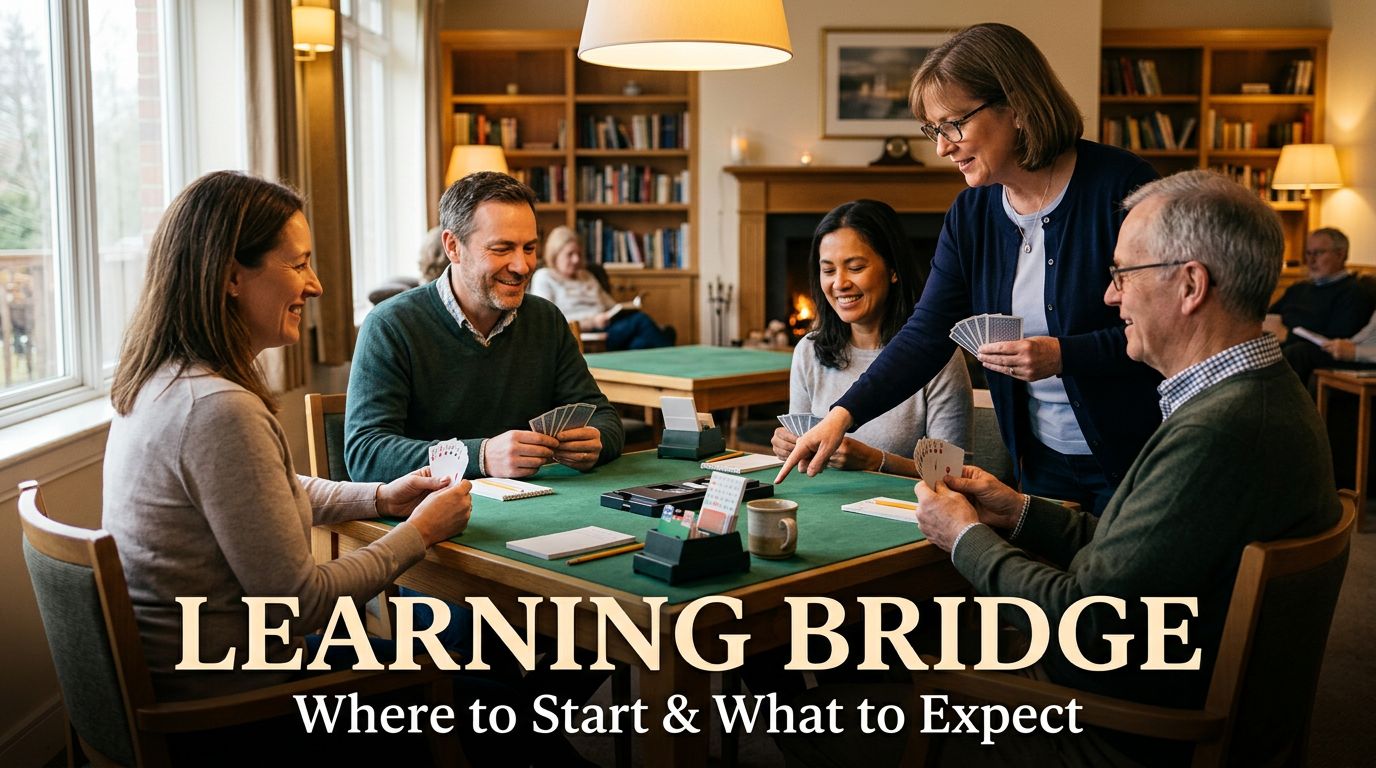
Learning Bridge: Where to Start, What to Study and How to...
You’ve decided to learn bridge. Good choice. It’s the best card game ever invented, and you’re about to understand why millions of people are obsessed with it.
But let’s be honest upfront: bridge has a learning curve. Not an insurmountable one, but it’s real. You can’t pick it up in an afternoon like poker or gin rummy. The good news? Every step of learning is fun, and the resources available today are better than they’ve ever been.
Here’s your realistic roadmap for learning bridge, from zero to competent.
The Three Stages of Learning
Most beginners go through three distinct phases:
Stage 1: The Basics (2-4 weeks) You’re learning the mechanics. How bidding works, how tricks work, what trump means. You’ll play practice hands and probably feel overwhelmed by the 35 possible bids you could make.
Stage 2: Standard Systems (3-6 months) You’re playing real bridge now. You know Standard American or 2/1, you understand the common conventions, and you can get through most hands without major disasters. You’re still making mistakes, but you know what went wrong.
Stage 3: Actual Skill (Years, Honestly) You stop thinking about the mechanics and start thinking about the game. Reading the opponents, making inferences, counting points and distribution. This phase never really ends. That’s what makes bridge interesting.
Don’t let Stage 3 scare you off. You’ll have fun in Stage 2, and even Stage 1 has its moments.
Best Resources for Absolute Beginners
Apps That Actually Work
Funbridge (iOS/Android) Start here. Seriously. Funbridge teaches you the rules, walks you through bidding, and lets you play real hands against reasonable AI. The free version is fine for beginners. You can see what other players bid on the same hand, which is incredibly useful when you’re not sure if your 3♥ bid was sensible or insane.
Bridge Base Online (BBO) (Web/iOS/Android) This is where everyone plays online, and it has a decent teaching section. The interface looks like it was designed in 2003 (it was), but don’t let that fool you. BBO is essential. Create a free account and explore the “Practice” section. The robot games are good for building confidence.
Easy Bridge (iOS/Android) If Funbridge feels too fast-paced, try this. It’s slower, more methodical, and color-codes everything so you can see what’s happening. Some people find it too hand-holdy, but if you’re truly starting from zero, it’s helpful.
Books Worth Reading
“The Complete Idiot’s Guide to Bridge” by H. Anthony Medley Ignore the condescending title. This is the best book for absolute beginners. Medley explains things clearly, includes practice hands, and doesn’t assume you already know what “responding to an opening bid” means.
“25 Bridge Conventions You Should Know” by Barbara Seagram and Marc Smith Buy this after you’ve learned the basics. It covers Stayman, Jacoby Transfers, Blackwood, and the other conventions everyone uses. Well-written, practical examples, not too theoretical.
“The Finesse and How It Works” (ACBL booklet) Free if you join the ACBL, which you should. This little booklet explains the most common play technique in bridge. Read it once you understand how trick-taking works.
Websites and Online Learning
Learn Bridge in 5 Days (ACBL) Free, well-structured, and you can go at your own pace. The ACBL (American Contract Bridge League) isn’t going to win any awards for web design, but their teaching materials are solid.
BridgeHands.com Massive collection of articles, quizzes, and hand analyses. The site is overwhelming if you’re brand new, but once you understand the basics, it’s a goldmine. Their “Novice” section is actually aimed at novices, unlike some sites.
Larry Cohen’s Website Larry Cohen is one of the best bridge teachers in the world. His site has articles, tips, and a blog that explains concepts clearly. Don’t start here (it’s not structured for total beginners), but bookmark it for later.
YouTube: “Learn to Play Bridge” by Grant If you learn better by video, Grant’s series is thorough and well-paced. He covers everything from how to hold your cards to complex bidding sequences. The production quality is basic, but the teaching is excellent.
What Actually Works: A Learning Plan
Here’s a realistic 90-day plan to get you from zero to functional:
Weeks 1-2: Learn the mechanics
- Download Funbridge
- Read the first 5 chapters of “Complete Idiot’s Guide”
- Play 10-20 practice hands
- Goal: Understand bidding basics, know how trump works, can count tricks
Weeks 3-4: Play actual hands
- Play 3-4 hands per day on Funbridge or BBO
- Don’t worry about conventions yet
- Focus on opening bids and responses
- Goal: Comfortable with the flow of a bridge hand
Weeks 5-8: Add basic conventions
- Learn Stayman
- Learn Jacoby Transfers
- Read “25 Bridge Conventions” (first 8 conventions)
- Keep playing daily hands
- Goal: Use Stayman and transfers without thinking too hard
Weeks 9-12: Play against humans
- Find a local club or play online with real people
- You’ll make mistakes. That’s fine.
- Ask questions after the hand
- Goal: Get through a session without panicking
The Timeline Reality Check
People always ask, “How long until I’m good at bridge?”
Wrong question. Here’s what you should ask instead:
“How long until I can enjoy playing?” About 3-4 weeks. Once you understand the basics, playing hands is fun even when you’re making mistakes.
“How long until I stop feeling lost?” 3-6 months. You’ll still make errors, but you’ll understand what’s happening and why.
“How long until I’m competitive?” 1-2 years of regular play. You’ll win some, lose some, and know enough to analyze what went wrong.
“How long until I’m actually good?” This depends on how you define “good.” Club champion? Maybe 5 years. Regional wins? 10+ years. World-class? You either have the talent or you don’t, and even with talent it takes decades.
But here’s the thing: you don’t need to be world-class to enjoy bridge. Most people play for decades without winning major tournaments, and they love every minute of it.
Common Beginner Fears (And Why They’re Wrong)
“Everyone will judge me for my mistakes” Bridge players are generally kind to beginners, especially at teaching games. The grumpy old experts you’re worried about? They were terrible once too, and most of them remember it.
“The bidding system is too complicated” It looks complicated because you’re seeing all 40 conventions at once. You need maybe 8 conventions to play competent bridge. Learn them one at a time.
“I’m too old/young to learn” People learn bridge at 12 and at 82. Your age doesn’t matter. Your willingness to practice does.
“I need a regular partner” Not for learning. You can play with random partners online or at clubs. Having a regular partner is great, but it’s not a requirement for getting started.
“I don’t have time to practice every day” Three hands per week is enough to maintain skills. Five or six hands per week is enough to improve steadily. You don’t need to dedicate your life to bridge unless you want to.
What to Expect (Real Talk)
Your first 20 hands will be confusing. You’ll forget if 2♣ is strong or weak, you’ll trump your partner’s ace by accident, you’ll open 1NT with 14 points and realize too late you needed 15.
This is normal.
Around hand 50, something clicks. You stop thinking about the mechanics and start thinking about the strategy. You’ll make a good lead and know it was good. You’ll finesse correctly and feel like a genius.
Around hand 200, you’ll play a session where everything works. Your bids make sense, your play is solid, and you’ll understand why bridge players get hooked.
That’s when you stop being a beginner and start being a bridge player.
The Best Advice Nobody Tells You
Play more, study less. Books are great, but you learn bridge by playing hands. If you’re spending more time reading about bridge than playing it, flip that ratio.
Find a mentor, not a critic. Some experienced players love to tell you every mistake you made. That’s not helpful. Find someone who explains why something didn’t work and what to do instead.
Focus on one thing per session. Don’t try to fix your bidding and your play and your defense all at once. Pick one area, work on it, then move to the next.
Celebrate the good hands, forget the disasters. You’ll butcher some hands. Everyone does. Don’t dwell on them. Remember the ones you played well, because that’s the version of you you’re becoming.
Learn Bridge with Brian
New to bridge? Brian is an AI bridge coach that explains concepts in plain language and helps you practice with real hands. No judgment, infinite patience. Try Brian free →
Your Next Steps
If you’re reading this and haven’t started yet, go download Funbridge right now. Not tomorrow, not next week. Now. Play two practice hands. That’s it.
If you’ve already started learning, pick one resource from this article you haven’t tried yet. Maybe it’s BBO, maybe it’s the Larry Cohen website, maybe it’s joining the ACBL. Do the thing that moves you forward.
Bridge rewards consistency more than intensity. Twenty minutes, three times a week, for six months will teach you more than one weekend binge-learning session.
You’re going to love this game. Welcome to bridge.