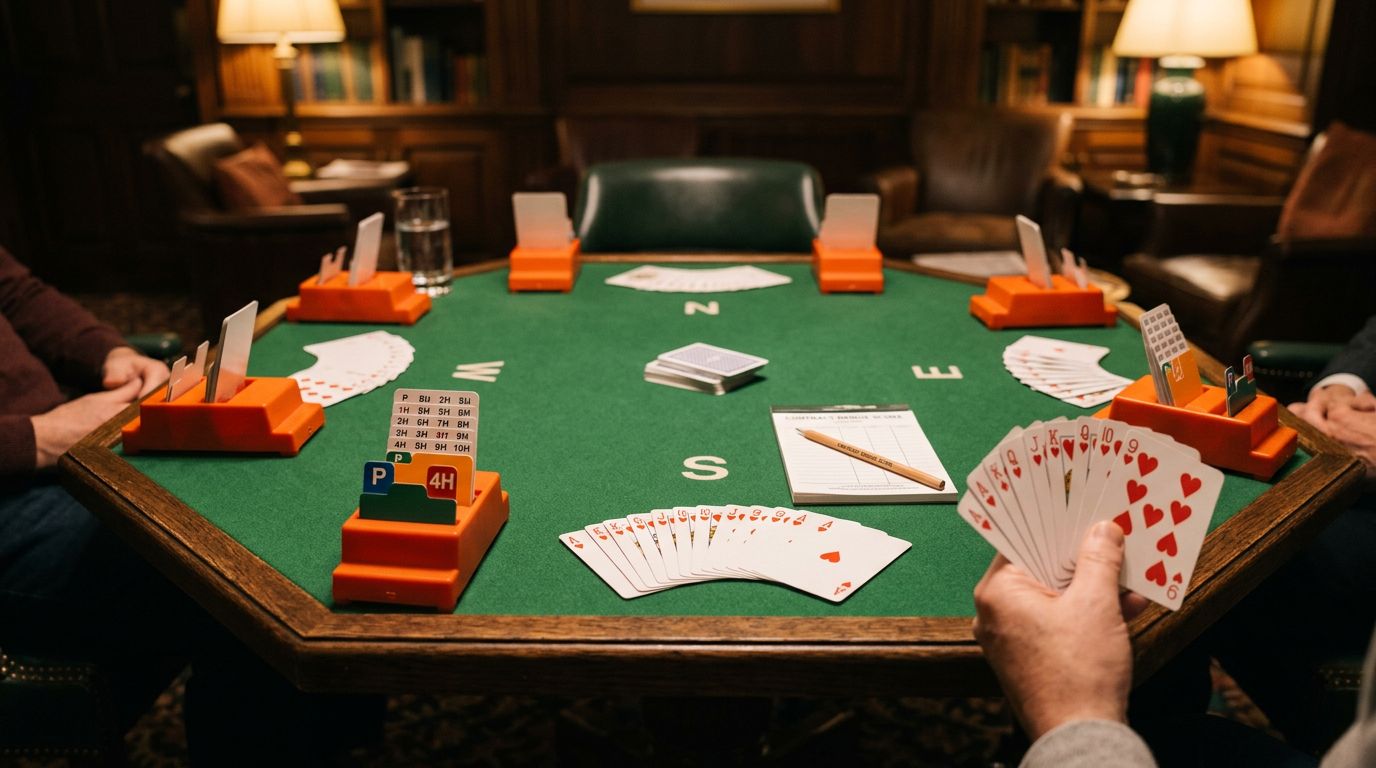
Bidding Systems Comparison
Walk into any bridge club and you’ll hear the question: “What system do you play?” The answer determines how your partnership communicates point count, distribution, and whether you’re forcing to game or just inviting.
This guide breaks down the three most common systems in North American bridge: Standard American Yellow Card (SAYC), Standard American, and 2/1 Game Force. You’ll learn what makes each one different, when to use each system, and how to transition if you’re switching.
What Makes a Bidding System?
A bidding system is the set of agreements that define what your bids mean. It covers:
- Opening bid requirements (how many points for 1NT? What about 1♣?)
- Response structure (does 1NT force for one round?)
- Game-forcing sequences (is 2/1 forcing to game?)
- Competitive agreements (what does a double mean in this auction?)
The system you choose affects every auction. Pick the wrong one for your skill level and you’ll struggle. Pick the right one and bidding gets clearer.
Standard American: The Foundation
Standard American is the baseline. It’s what most people learn first, and it works fine for casual play. The core principles:
Opening Bids
- 1NT: 15-17 HCP, balanced
- 2NT: 20-21 HCP, balanced
- 1 of a suit: 12+ HCP (can be light in third seat)
- Five-card majors: Open 1♥ or 1♠ with 5+ cards
- Better minor: With 4-4 in the minors, open 1♦
Responses
- 1NT response: 6-10 HCP, not forcing
- 2/1 response: 10+ HCP, forcing for one round (not game-forcing)
- Jump shift: 17+ HCP, game-forcing
- Limit raise: 10-12 HCP with support
Why People Start Here
Standard American is simple. 1NT isn’t forcing, so you can stop low with weak hands. 2/1 responses aren’t game-forcing, so you don’t overcommit. It’s forgiving when you’re learning.
The downside? You don’t always know if you’re in a game-forcing auction. Partner bids 2♣ over your 1♠ opening. Are they just showing 10 points and clubs, or are they strong enough for game? You have to wait and see.
Example Auction (Standard American)
You open 1♠ with:
♠ AKJ84 ♥ K7 ♦ Q95 ♣ J83
Partner responds 2♣. They have 10+ HCP and clubs, but are they game-forcing? Not necessarily. You rebid 2♠ (showing six spades or a minimum). If partner bids again, you’ll know more about their strength.
This ambiguity slows down auctions. You spend extra bids clarifying strength instead of describing shape.
SAYC: Standard American Gets Standardized
SAYC (Standard American Yellow Card) is Standard American with agreements filled in. The ACBL created it so pickup partnerships could play together without lengthy discussions. It’s Standard American plus:
Key SAYC Agreements
- Weak two bids: 2♦, 2♥, 2♠ show 6-10 HCP and a six-card suit
- Limit raises: Jump raise shows 10-12 HCP (3♠ over 1♠)
- Negative doubles: Through 3♠
- Jacoby 2NT: After major opening, 2NT shows game-forcing raise
- Ogust responses: Over weak two bids, 2NT asks about quality
- 1NT forcing: After major opening, 1NT response is forcing for one round
That last one is big. In Standard American, 1NT isn’t forcing. In SAYC, it is. This helps opener describe their hand without worrying responder will pass.
Why SAYC Exists
Before SAYC, you’d sit down with a stranger and spend 10 minutes hammering out agreements. With SAYC, you just say “SAYC okay?” and you’re ready to play. It’s the default system for online bridge and tournaments where you might not know your partner.
SAYC Limitations
SAYC is designed for pickup games, not optimized partnerships. The agreements are middle-of-the-road. You won’t find advanced treatments. But that’s the point, it’s reliable and predictable.
Example Auction (SAYC)
You open 1♠ with the same hand:
♠ AKJ84 ♥ K7 ♦ Q95 ♣ J83
Partner responds 1NT (forcing). You rebid 2♠. Partner now knows you have six spades or a minimum opener. Partner passes with a minimum, invites with 10-11, or bids game with 12+.
The forcing 1NT helped. You got to show your spades without worrying partner would pass and leave you in 1NT with a singleton.
2/1 Game Force: The Modern Standard
2/1 Game Force (Two-Over-One) changes one thing with massive ripple effects: when you respond at the two-level to a one-level opening, you’re forcing to game.
The Core Principle
Opener bids 1♠, you respond 2♣. In Standard American or SAYC, that shows 10+ HCP and is forcing for one round. In 2/1, it shows 13+ HCP and you’re going to game no matter what.
Why This Matters
Once you’re in a game-forcing auction, you can slow down and describe your hand. You don’t need to jump around showing strength. You can bid naturally, showing shape and controls.
You hold:
♠ K7 ♥ A84 ♦ KJ ♣ AQ10742
Partner opens 1♠. In Standard American, you bid 3♣ (jump shift) to force to game. That uses up bidding space.
In 2/1, you bid 2♣. Partner knows you’re going to game. Now you can bid 3♣ next (showing six clubs), 3NT (suggesting notrump), or 3♠ (showing spade support). You have room to explore.
Requirements for 2/1 Response
You need:
- 13+ HCP (some play 12+ in perfect shape)
- A good suit or support for partner
- No better bid available
If you have four-card support for partner’s major, use Jacoby 2NT or a limit raise instead. Save the 2/1 response for when you’re showing a new suit.
After the 2/1
The auction is forcing to game, so:
- Bid naturally to show shape
- Don’t jump (you’re already in a game force)
- Three of a major shows six cards
- Rebidding 1NT shows a balanced minimum
1NT Response in 2/1
Because 2/1 responses need 13+ HCP, the 1NT response covers a wider range: 6-12 HCP. It’s forcing for one round (semi-forcing in some partnerships after a minor opening).
What About Invitational Hands?
In Standard American, you respond 2♣ with 10-12 HCP. In 2/1, you need 13+. So what do you do with invitational hands (10-12 HCP) and a new suit?
You bid 1NT first, then bid your suit. This shows 10-12 HCP and wasn’t strong enough for an immediate 2/1.
You hold:
♠ 84 ♥ K7 ♦ AJ ♣ KJ97532
Partner opens 1♠. You have 11 HCP and clubs, but not enough for 2♣ (which would be game-forcing). Respond 1NT, then bid 3♣ next. This shows a good club suit and invitational values.
Side-by-Side Comparison
| Feature | Standard American | SAYC | 2/1 Game Force |
|---|---|---|---|
| 1NT opening | 15-17 HCP | 15-17 HCP | 15-17 HCP |
| 1NT response | 6-10, NF | 6-10, forcing | 6-12, forcing |
| 2/1 response | 10+, one-round force | 10+, one-round force | 13+, game force |
| Limit raise | 10-12 | 10-12 | 10-12 |
| Jump shift | 17+, GF | 17+, GF | Rare (use 2/1 instead) |
| Weak twos | Varies | 6-10, six-card suit | 6-10, six-card suit |
| Negative doubles | Varies | Through 3♠ | Through 3♠ or higher |
When to Use Each System
Standard American
Use Standard American when:
- You’re learning bridge
- You’re playing casually with friends
- Your partner isn’t familiar with SAYC or 2/1
- You want maximum flexibility
Standard American is forgiving. You won’t get into as much trouble because you’re not committed to game as early.
SAYC
Use SAYC when:
- You’re playing with a pickup partner
- You’re playing online and need standard agreements
- You’re in a tournament that requires a “card” (convention card)
- You want something between Standard American and 2/1
SAYC gives you the reliability of predefined agreements without the learning curve of 2/1.
2/1 Game Force
Use 2/1 when:
- You have a regular partnership
- You’re serious about improving
- You want to play in clubs or tournaments competitively
- You’re comfortable with forcing auctions
2/1 is the standard among serious players. It’s more efficient than Standard American and gives you better slam bidding. But it requires partnership trust, you’re committing to game early.
Making the Switch to 2/1
If you’re moving from Standard American or SAYC to 2/1, here’s what changes:
Mental Shift #1: 2/1 Is Game-Forcing
Get comfortable with committing to game. In Standard American, you could bid 2♣ with 10 points and stop in 3NT if partner showed a minimum. In 2/1, you’re going to game no matter what.
This means:
- Don’t bid 2/1 with 10-12 HCP (use 1NT instead)
- Once you’re in a game force, relax and describe
- Don’t jump (you’re already forcing)
Mental Shift #2: 1NT Response Is Wider
In Standard American, 1NT shows 6-10 HCP. In 2/1, it shows 6-12 HCP. This changes how opener rebids.
If you open 1♠ and partner responds 1NT, they might have 6 HCP or they might have 12. You can’t assume they’re weak.
Mental Shift #3: Invitational Hands Go Through 1NT
In Standard American, you bid 2♣ with 10-12 HCP and clubs. In 2/1, you bid 1NT first, then show clubs. This “slow shows” invitational values.
Practice Auctions
Here’s how the same hand plays in each system.
Your hand:
♠ 84 ♥ K95 ♦ AJ7 ♣ KQ1074
Partner opens 1♠. You have 11 HCP.
Standard American:
- You: 2♣ (10+ HCP, forcing one round)
- Partner: 2♠ (minimum, six spades)
- You: 2NT (invitational)
- Partner: Pass or 3NT
2/1 Game Force:
- You: 1NT (6-12 HCP, forcing)
- Partner: 2♠ (six spades or minimum)
- You: 3♣ (invitational, good clubs)
- Partner: 3NT or pass
Same result, different path.
Common Mistakes When Switching Systems
Mistake #1: Bidding 2/1 with 11 HCP
You’ve played Standard American for years. Partner opens 1♠, you have 11 HCP and clubs, and you reflexively bid 2♣. Oops. In 2/1, that’s game-forcing. Partner will bid past 3NT expecting you to have 13+.
Fix: Pause before bidding 2/1. Ask yourself, “Do I have 13+ HCP?” If not, bid 1NT first.
Mistake #2: Jumping in a Game Force
You’re in a 2/1 auction. Partner opened 1♠, you bid 2♣, and now you want to show a good six-card suit. So you jump to 4♣.
Don’t. You’re already in a game force. Jumping wastes space. Just bid 3♣ (six clubs). Partner will know you’re strong because you bid 2♣ in the first place.
Mistake #3: Treating 1NT Response as Weak
Partner responds 1NT to your 1♠ opening. You rebid 2♠ with a minimum and partner jumps to 4♠. You’re surprised — didn’t they just show 6-10 HCP?
Not in 2/1. The 1NT response is 6-12 HCP. Partner could have an invitational hand. Don’t shut down the auction too quickly.
Partnership Discussion Points
Before playing any system, agree on these:
1. What’s Your 1NT Range?
Most people play 15-17, but some play 16-18 or 12-14. Know your range.
2. Are Weak Twos On?
Do you play weak two-bids (2♦/2♥/2♠ = 6-10 HCP, six-card suit)? Or strong twos? This matters for your opening structure.
3. How High Are Negative Doubles On?
Do you play negative doubles through 2♠? 3♠? 4♠? Higher levels change meaning.
4. What About 2NT After Major Opening?
In SAYC and 2/1, 2NT after a major opening is Jacoby (game-forcing raise). In Standard American, it might be natural (balanced, invitational). Agree on this.
5. Is 1NT Forcing?
In SAYC and 2/1, yes. In Standard American, usually not. But some partnerships play “1NT semi-forcing” after a minor opening. Clarify.
Advanced Variations
Once you’re comfortable with 2/1, you might explore:
Forcing 1NT Variations
Some pairs play 1NT as forcing only after a major, semi-forcing after a minor. Others play it forcing after any opening.
Bergen Raises
Instead of limit raises, you can play Bergen raises:
- 3♣ = 7-10 HCP, four-card support
- 3♦ = 10-12 HCP, four-card support
This shows distribution and strength more precisely.
Reverse Drury
If partner opens a major in third or fourth seat, 2♣ asks if they have a full opener. Helps avoid games when partner is light.
Which System Is “Best”?
There’s no best system. There’s only the best system for your situation.
For beginners: Start with Standard American. It’s simple and forgiving.
For pickup games: Use SAYC. It’s standardized and predictable.
For regular partnerships: Play 2/1 Game Force. It’s more efficient and handles strong hands better.
The system matters less than understanding it. A pair playing Standard American with solid agreements will beat a pair playing 2/1 with misunderstandings. Pick a system, learn it thoroughly, and stick with it.
Real-World Examples: Same Hand, Different Systems
Let’s see how the same hands play out in each system.
Example 1: Invitational Hand with Long Minor
Your hand:
♠ 84 ♥ K95 ♦ AJ7 ♣ KQ1074
Partner opens 1♠. You have 11 HCP and want to invite game.
Standard American:
- Opener: 1♠
- You: 2♣ (10+ HCP, forcing one round)
- Opener: 2♠ (six spades or minimum)
- You: 2NT (invitational, 11-12 HCP)
- Opener: 3NT or Pass
SAYC:
- Opener: 1♠
- You: 2♣ (10+ HCP, forcing one round)
- Opener: 2♠ (six spades or minimum)
- You: 2NT (invitational)
- Opener: 3NT or Pass
2/1 Game Force:
- Opener: 1♠
- You: 1NT (forcing, 6-12 HCP)
- Opener: 2♠ (six spades or minimum)
- You: 3♣ (invitational, good clubs)
- Opener: 3NT or Pass
The 2/1 auction shows your club suit more clearly because you bid it naturally after showing invitational values with 1NT.
Example 2: Strong Hand Looking for Slam
Your hand:
♠ K7 ♥ A84 ♦ KJ ♣ AKJ1074
Partner opens 1♠. You have 19 HCP and a great club suit.
Standard American:
- Opener: 1♠
- You: 3♣ (jump shift, 17+ HCP, game-forcing)
- Opener: 3♠ (six spades)
- You: 4♣ (showing six clubs)
- Opener: 4♠ (minimum, no slam interest)
The jump to 3♣ uses up space, making it harder to explore.
2/1 Game Force:
- Opener: 1♠
- You: 2♣ (13+ HCP, game-forcing)
- Opener: 2♠ (six spades or minimum)
- You: 3♣ (six clubs)
- Opener: 3♠ (no fit, showing more spades)
- You: 3NT or 4♣ (still exploring)
The 2/1 auction has more room. You can show six clubs without jumping, leaving space for cue-bids or other descriptive bids.
Example 3: Weak Hand After Major Opening
Your hand:
♠ 84 ♥ J975 ♦ K9532 ♣ 73
Partner opens 1♠. You have 4 HCP.
Standard American:
- Opener: 1♠
- You: 1NT (6-10 HCP, not forcing)
- Opener: Pass or 2♠
You might get passed out in 1NT when 2♠ is better.
SAYC:
- Opener: 1♠
- You: 1NT (forcing)
- Opener: 2♦ or 2♠ (forced to bid)
- You: Pass
The forcing 1NT makes opener describe their hand. You get a better contract.
2/1 Game Force:
- Opener: 1♠
- You: 1NT (forcing, 6-12 HCP)
- Opener: 2♦ or 2♠
- You: Pass (with only 4 HCP)
Same as SAYC in this case.
Understanding the Evolution of Systems
Bridge bidding systems evolved to solve specific problems.
Standard American was the original. It worked, but had ambiguities. When you responded 2♣, partner didn’t know if you had 10 HCP or 16 HCP. You spent bids clarifying strength.
SAYC standardized Standard American for pickup partnerships. It didn’t revolutionize the system, just filled in the gaps. Now everyone knew what 1NT forcing meant, whether you played weak twos, and how negative doubles worked.
2/1 Game Force was the real innovation. By making 2/1 responses game-forcing, it freed up bidding space. No more jumping to show strength. You could bid naturally and describe shape, knowing you’d get to game.
Each system built on the last. Standard American taught the basics. SAYC standardized them. 2/1 optimized them.
Why Some Experts Still Play Standard American
Not everyone switched to 2/1. Some experts still prefer Standard American or play a hybrid. Why?
Flexibility
Standard American lets you stop in a part-score more easily. 2/1 commits you to game early. If you’re playing against weaker opposition, flexibility can be valuable.
Partnership Styles
Some partnerships have played Standard American for decades. They have intricate agreements and understandings. Switching to 2/1 would mean rebuilding those agreements.
Personal Preference
Bridge is a game. Play what you enjoy. If you love the flexibility of non-forcing 2/1 responses, stick with it.
The Role of Convention Cards
When you play in tournaments, you fill out a convention card listing your agreements. This helps opponents understand what your bids mean.
Convention cards vary by system:
Standard American card:
- 1NT range: 15-17
- 2/1 responses: 10+ HCP, one-round force
- Weak twos: Optional
- Negative doubles: Through 2♠ (typical)
SAYC card:
- Preprinted agreements
- Just check boxes
- Standardized for pickup games
2/1 card:
- 1NT range: 15-17
- 2/1 responses: 13+ HCP, game-forcing
- 1NT response: Forcing
- Negative doubles: Through 3♠ or higher
The convention card makes your agreements transparent. It also forces you to discuss them with your partner before playing.
Transition Timeline
If you’re switching from Standard American to 2/1:
Week 1: Read about the differences. Understand what 2/1 responses mean.
Week 2-4: Play practice hands. Use an online platform or deal out hands with your partner.
Month 2: Start playing 2/1 in casual games. Expect mistakes. Discuss auctions afterward.
Month 3-6: Play regularly. Your muscle memory will adjust. You’ll stop reflexively bidding 2/1 with 11 HCP.
Month 6+: You’re comfortable. Now you can start adding advanced agreements.
Give yourself time. Switching systems isn’t instant. But once you’ve made the transition, you’ll have better tools for tough auctions.
Try Brian, Your AI Bridge Coach
Have questions about bridge? Brian is an AI bridge coach that can analyze hands, explain conventions, and help you improve your game. Try Brian free →
Final Thoughts: System Matters Less Than Partnership
The dirty secret about bidding systems: the difference between Standard American and 2/1 is smaller than you think.
What matters more:
- Clear partnership agreements
- Discussing auctions after the hand
- Understanding why you bid what you did
- Trust between partners
A pair playing Standard American with solid agreements will beat a pair playing 2/1 with frequent misunderstandings. The system provides the framework, but partnership quality determines results.
Choose a system that fits your situation (pickup game vs regular partner, casual vs competitive). Learn it thoroughly. Play it consistently. That’s how you get better results, not by switching systems every six months.
And remember: even the best system won’t fix poor judgment. If you’re bidding slams missing two aces or stopping in part-scores with 28 combined HCP, the system isn’t your problem. Work on hand evaluation and decision-making first. Then worry about optimizing your system.