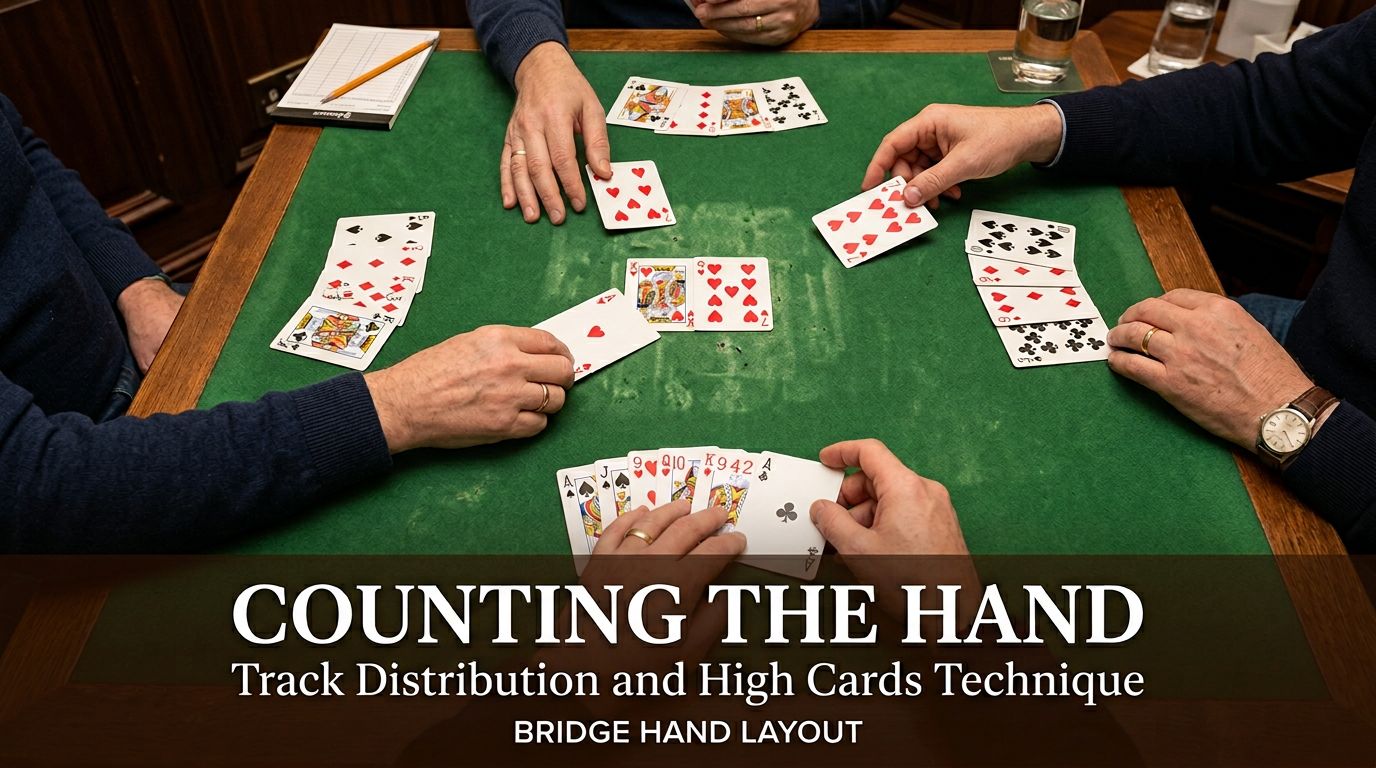
Counting the Hand: Track Distribution and High Cards
You’ve probably heard someone at the bridge table say, “Once you count the hand, the rest plays itself.” Here’s the truth: counting transforms bridge from guessing to logic. Instead of hoping you’re right about where the cards sit, you know.
Every deal has exactly 52 cards. You can see 26 of them (your hand plus dummy). That leaves 26 hidden between the defenders. Counting means keeping track of what you’ve learned about those hidden cards, then making the play that matches reality.
The best part? You don’t need to be a math genius. You just need to pay attention.
Why Counting Matters
Bridge isn’t poker. You’re not playing blind. Every card played gives you information. Every bid your opponents make narrows down what they hold. Every discard tells a story.
When you count, you stop making plays that feel right and start making plays that are right. You’ll finesse with confidence because you know the queen is onside. You’ll duck at the right moment because you counted out the suit.
Beginning players play one trick at a time. Intermediate players have a plan. Advanced players count the hand, and adjust when the count reveals something unexpected.
Counting Distribution: The Foundation
Distribution means suit lengths. Each defender was dealt 13 cards divided among four suits. If you know someone started with 5 ♠, 3 ♥, 3 ♦, and 2 ♣, you’ve counted their distribution: 5-3-3-2.
You build the picture suit by suit. Watch what gets played. When someone shows out (can’t follow suit), you know exactly how many cards they started with in that suit.
Let’s say you’re in 4♥ and you’re tracking ♠. You play ace, king, and a small ♠ from dummy. West follows all three times but East shows out on the third round, pitching a ♦. Now you know: West started with at least four ♠ (maybe more), and East started with exactly two ♠.
Keep a running count as each suit gets played. Mental scorekeeping like “West: 4+ ♠, 2 ♥ so far…” adds up fast. By trick five or six, you often know a defender’s complete shape.
Using the Bidding to Count
Smart counting starts before the opening lead. The auction gives you clues that narrow down distributions and point ranges before you see a single card played.
If your right-hand opponent opens 1NT showing 15-17 HCP, you immediately know three things: their shape is probably balanced (no singleton or void), they have 15-17 points, and they don’t have a five-card major. That’s huge.
When an opponent opens 1♠ and rebids 2♠, you place them with a six-card suit. If they open 1♥ and jump to 3♥, they’re showing a good seven-card suit and extra values. Preempts are even easier—a weak 3♦ opening promises seven diamonds and not much else.
Negative inferences matter too. If West passes as dealer and later shows up with a king and queen, you know East holds most of the missing high cards. West didn’t have an opening hand, so they can’t have two aces and a king.
Let’s say the auction went 1♥ by West, pass, 2♥ by East, pass. West isn’t jumping to game, so maybe 15-17 points. East raised with probably 6-9 points. If you need a missing ♠ queen to make your contract, the odds just shifted toward East—who passed initially and likely has fewer points than their partner.
Every pass, every bid, every invitation tells you something. Add it to your count.
Counting High Card Points
You start with 40 HCP in the deck. You can see how many you hold (your hand plus dummy). Subtract that from 40, and you know how many the opponents share.
If you have 26 HCP between your hand and dummy, the defenders split 14 points somehow. Now watch what they play. When West shows up with the ♠A, ♥K, and ♦Q, that’s 4+3+2 = 9 HCP. East can have at most 5 points remaining.
This becomes powerful when you need to guess a finesse. If East already showed 13 points and they opened the bidding with 12-14, they can’t possibly hold the missing ♣K. West must have it.
Point counting pairs beautifully with distribution. If West is known to have 5-4-3-1 shape and has already shown 11 HCP, you can work out whether they have room for one more queen or if that card must sit with East.
Experienced players track points automatically. “That’s the ace… and the king… West has shown 11 so far, they opened, probably 13-14 total, so one or two points left.” It becomes second nature.
Inferences From What Wasn’t Bid
Sometimes what your opponents don’t say matters more than what they do.
If East opened 1♣ and bypassed a ♠ suit, they don’t have four spades. They might have three, but definitely not four—because with 4♠ and 4+♣, they would’ve opened 1♠ playing standard methods.
If West didn’t overcall 1♠ after your 1♥ opening, they probably don’t have a good five-card spade suit. When you later need to guess whether West or East holds ♠KQxx, think back to that pass. East is more likely.
When an opponent opens a weak two bid showing six cards and modest values, they’ve defined their hand tightly. They don’t have a second suit worth mentioning. They don’t have 15 HCP. They don’t have a seventh card (or they would’ve opened three). This kind of precision makes counting easier.
Stayman auctions give away shape. If responder bids 2♣ Stayman after partner’s 1NT opening and then signs off in 2NT after a 2♦ denial, responder doesn’t have a four-card major. You know their shape must be balanced without four hearts or spades.
Listen to the whole auction, not just the final contract. Those early bids contain gold.
Counting During the Play: Watch the Discards
The opening lead has been made. Now you start gathering information with every trick.
When defenders follow suit, note it. When they show out, write it in your mental ledger. When they have a choice of what to discard, that choice tells you volumes.
Let’s say you’re in 3NT and running a long ♦ suit. West discards two small ♠ on your diamond tricks. West had at least two spades they could afford to throw, probably three or four to start. If West later discards a ♣, you’re building their picture: 2 ♦, maybe 3-4 ♠, and shortness somewhere.
East’s discards matter too. If East is pitching ♥ cards uncomfortably, they might’ve started with five hearts. If they pitch one ♥ smoothly and then switch to throwing ♣, maybe they started with three or four hearts.
When a defender has to discard from a suit they want to protect, that reluctant discard often pinpoints where their values sit.
Your job: keep track. “West threw two ♠, one ♥, now a ♣. West started 2 ♦, followed three times in ♠ so 5 ♠, threw one ♥ so at least 2 ♥, showed two ♣… wait, that’s 2+5+2+2 = 11 cards shown. West has two cards left.”
Once you know West has two cards remaining and you need to guess the position of the ♣J, you can often work out whether those two cards include it.
Example Hands Where Counting Finds the Right Play
Example 1: The Marked Finesse
You’re in 6♠ with:
Dummy (North):
♠ KJ32
♥ A84
♦ K65
♣ A87
Your Hand (South):
♠ AQ1098
♥ K3
♦ A84
♣ K96
You have eleven tricks on top: five spade tricks (finesse or drop), three top hearts, two top diamonds, two top clubs. You need one more.
The opening lead is the ♦Q. You win the ♦A, draw trumps in three rounds (♠ split 2-2), and cash your winners. West showed three ♠, three ♦, and follows to three rounds of ♥. That’s nine cards. West has four ♣ left.
East had two ♠, two ♦ (showed out), and three ♥. That’s seven cards. East must have six ♣.
Your twelfth trick needs to come from ♣. The ♣Q is missing. With West holding four clubs and East holding six, the odds are roughly 60-40 that East has the ♣Q simply by length. You finesse through East by leading small to the ♣K, then small toward dummy’s ♣A87. When East plays low, you play the ♣7, finessing. It wins. Contract made, thanks to counting distribution.
Example 2: The Distribution Count
You’re in 3NT with eight top tricks, needing one from ♦. West leads ♠Q (five-card suit). You hold up until the third round.
You cash ♣AKQ. East shows out on the third ♣, pitching a ♠. East had two ♣, three ♠.
You run three ♥ winners. Both defenders follow. West has shown 5 ♠, 3 ♥, 3 ♣ = 11 cards, so two ♦. East has shown 3 ♠, 3 ♥, 2 ♣ = 8 cards, so five ♦.
You need the ♦Q. With East holding five diamonds and West holding two, you finesse through East by leading toward dummy’s ♦AKJ and playing the ♦J when East plays low. Your count made a guess into a certainty.
Example 3: The Endplay
You’re in 4♥:
Dummy:
♠ 83
♥ KJ104
♦ AK5
♣ 9732
Your Hand:
♠ AK4
♥ AQ9765
♦ 82
♣ A6
West leads ♣K. You take the ♣A. You have nine tricks on top, need one more. The question: do you finesse ♥Q, or play for the drop?
You start by cashing ♠AK to see what happens. West follows twice, East shows out on the second ♠, pitching a ♣. West started with at least four ♠.
You cash ♦AK. East follows twice, West follows once and pitches a ♠ on the second ♦. East had four ♦, West had one ♦.
Now count: West has 4+ ♠, 1 ♦, and overcalled 2♣ showing five or six clubs. That’s 10-11 cards before hearts. West can have at most two or three ♥.
With East holding most of the hearts, playing for the drop (♥A, ♥K) is wrong. You finesse the ♥Q through East, it wins, and you claim ten tricks.
Example 4: The Show-Out
You’re in 6♦. After winning the opening lead with ♠A, you play ♦K (both follow) then ♦J—West shows out. East started with four trumps.
You can’t pull all the trumps immediately without losing control. Instead, you cash side winners and count: ♥AKQ (everyone follows), ♣A, ruff a ♣. East followed to three ♥, has four ♦, one ♣. West showed one ♥, one ♦, two ♣.
After counting, you work out East has 1-3-4-5 shape. You play a fourth ♥ from hand and pitch a ♠ from dummy. East must ruff with ♦2. You overruff with ♦9, draw East’s last trump, and claim. Counting let you navigate a 4-1 trump split.
Common Mistakes in Counting
Starting too late. Begin counting at trick one, not trick nine. Even tracking one suit early helps.
Forgetting to use the bidding. An opponent who opened 1NT doesn’t have a singleton. A 3♥ preemptor has seven hearts. Use these clues.
Not writing it down mentally. Use mental shorthand: “West 5-2, East 3-5 so far.”
Counting only one suit. You need at least two suits to make meaningful inferences.
Ignoring spot cards. When East plays ♠9 and ♠8, then West plays ♠7 and ♠6, East likely has more length.
Not recounting when surprised. If your count says West should have one ♥ left and they show out, you miscounted. Fix it. A wrong count is worse than no count.
Practice Your Card Play with Brian
Ready to apply these techniques at the table? Brian can walk you through hands that test your card play skills. Try Brian free →
Practice Tips for Learning to Count
Start with one suit. Pick trumps or the suit that matters most. Track that one suit all the way through. Once that feels automatic, add a second suit.
Count out loud (at home). When playing casually, say your count aloud. “Three spades from West, two from East.” Verbalizing builds the habit.
Replay hands. After a session, look back at interesting deals. Count out the hidden hands slowly.
Use the “13-card check.” When you’ve counted a defender’s shape, add up the suits. They should total 13. If you get 14 or 12, you miscounted.
Focus on declarer play first. Counting as declarer is easier because you see dummy. Once comfortable, start counting on defense.
Set small goals. “Today I’ll count trumps every hand.” Then, “This week I’ll count two suits.” Build gradually.
Counting the hand isn’t magic. It’s just paying attention, adding up what you see, and thinking through what it means. The difference between “I think the queen is on my left” and “I know the queen is on my left because West showed out in two suits and can’t have more than two cards in this one” is the difference between guessing and playing bridge.
Start simple. Count one suit today. Count two tomorrow. Inside a month, you’ll find yourself knowing things you used to guess at, and your results will show it.