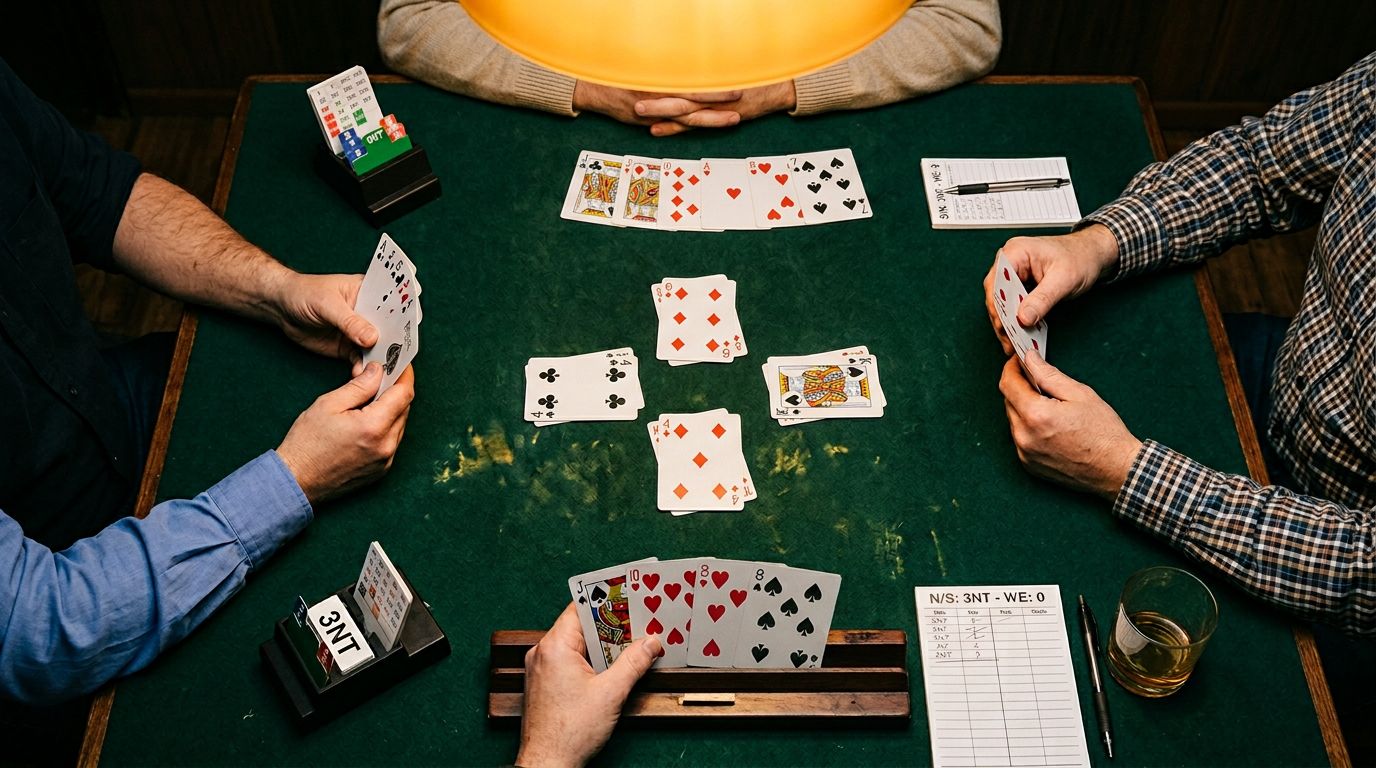
Safety Plays: When to Sacrifice a Trick to Guarantee Your...
A safety play is when you deliberately give up your best chance at maximum tricks to improve your odds of making a specific number of tricks. Think of it as insurance. You’re paying a small premium (one potential trick) to protect against a bad break that would sink your contract.
The classic example: You hold A-K-Q-J-x in dummy opposite x-x in your hand. Playing for five tricks means cashing the ace and continuing with the king. But if you need only four tricks to make your contract, the safety play is to cash the ace first, then lead low toward dummy’s honors. This guards against a 4-0 break in either hand.
What Exactly Is a Safety Play?
A safety play is not about maximizing tricks. It’s about maximizing your chance of making a specific number of tricks, usually the number you need for your contract.
Let’s say you’re in 3NT and need four tricks from ♦A-K-J-x-x opposite ♦x-x. If you lead low to the jack (finessing), you’ll take five tricks half the time when the queen is onside. But you’ll take only three tricks when the queen is offside.
The safety play? Cash the ace and king. You guarantee four tricks regardless of how the suit breaks, as long as it’s not worse than 4-1. You’ve given up the chance at a fifth trick to lock in the four you actually need.
When to Use Safety Plays (Scoring Matters)
Not all bridge is created equal. The scoring format changes everything about when you should use safety plays.
IMPs and Rubber Bridge: Safety plays shine here. Making your contract matters way more than overtricks. Going down in 3NT costs 10-11 IMPs compared to making it. That one overtrick you gave up? Worth maybe 1 IMP. The math is obvious. Use safety plays religiously at IMPs.
Matchpoints: Trickier decision. Every trick is a battle. If you’re in the same contract as everyone else at your level, the safety play might still be right if the contract is at all close. But if you’re in a normal contract that should make easily, playing for overtricks can be correct. You need to read the room. Is this a 50% game or a 75% game?
Here’s the guideline: At matchpoints, use safety plays when you’re in a close contract (like a thin game or slam). Skip them when you’re in a comfortable contract where the field will also make it and you need overtricks to score well.
Teams (IMPs): Always use the safety play if it meaningfully improves your chance of making the contract. Your teammates might pick up an overtrick at the other table. But if you go down and they make it, you’ve given away a huge swing.
The Cost-Benefit Calculation
Before making a safety play, you need to weigh what you’re giving up against what you’re protecting.
Ask yourself three questions:
- What’s the real risk I’m guarding against?
- How likely is that bad break?
- What am I giving up?
If you’re protecting against only a 5-0 break (less than 4% chance), you’re probably overthinking it. But if you’re guarding against a 4-1 or 3-2 with the queen offside (more like 28-35% combined), that’s worth considering.
The other factor: How many tricks are you giving up? If the safety play costs you two potential tricks to guard against a 10% chance of failure, that’s probably not worth it. But if it costs you one trick to guard against a 30% chance? Take the insurance.
Common Safety Play Positions
Some suit combinations come up constantly. Here are the ones you should know cold.
A-K-x-x-x opposite x-x (need four tricks): Cash the ace, then lead low from your hand toward the king. If West shows out on the second round, you can finesse against East’s queen-jack. This guarantees four tricks unless the suit breaks 5-0. If you cash ace-king, a 4-0 break in either direction kills you.
A-Q-10-x-x opposite x-x (need four tricks): Lead low from dummy toward your ace. If East plays low, put in the ten. Then cash the ace. You’ll make four tricks any time the suit breaks 3-2, and you’ll still make four tricks when West has K-J-x-x. The only time you fail is when East has K-J-x-x (about 6% of the time).
A-J-10-x opposite x-x-x (need three tricks): Lead toward the jack. If it loses to the king or queen, you still have the ace and ten sitting over the remaining honor. This guarantees three tricks unless someone has K-Q-x-x (about 12% of the time).
K-J-x-x-x opposite A-x (need four tricks in notrump): Cash the ace first, then lead toward the king-jack. If either opponent shows out on the first round, you can pick up the suit. If you lead the king from the long hand first, you can’t handle queen-fourth in the wrong hand.
Safety Plays in Trump Suits
Trump suits deserve special attention because going down in a contract due to bad trump breaks is embarrassing and costly.
A-K-Q-x-x opposite x-x-x (need to lose no trump tricks): You might think you just cash the top honors. But what if trumps are 4-0? The safety play is to cash the ace, then lead low from your hand. If West shows out, you can finesse against East’s J-10-x-x. If East shows out, you can pick up West’s J-10-x-x by leading toward dummy’s remaining honors.
This safety play costs you nothing when trumps are 3-1 or better. It only looks silly when trumps are 4-0 and you couldn’t have picked them up anyway (like when the jack is singleton offside).
A-Q-x-x-x opposite K-x-x (eight-card trump fit): If you need to avoid losing more than one trump trick, cash the ace first. If both opponents follow low, lead toward the king-queen. This picks up J-10-x-x in either hand. The alternative (leading toward the queen on the first round) gains when trumps are 2-2 with the jack onside, but it loses to J-10-x-x offside.
The percentage play for no losers with eight trumps is normally to finesse. But if you can afford one loser, the safety play is to play for the drop.
Safety Plays in Side Suits
Side suits at notrump often present safety play opportunities. You’re trying to develop enough tricks to make 3NT without letting the opponents in too often.
♠A-K-J-x-x opposite ♠x-x in notrump (need four tricks): You might be tempted to cash the ace and finesse the jack. But that fails when West has Q-x-x-x. The safety play is to cash the ace and king. If both follow, you’ve guaranteed four tricks. If someone shows out on the second round, you can finesse against the other opponent’s queen.
♥A-Q-J-x opposite ♥x-x-x (need three tricks): Lead low to the queen. If it loses to the king, you still have ace-jack sitting over any remaining honor. This guarantees three tricks unless someone has K-10-x-x (about 14%). The alternative of leading low to the jack picks up more holdings, but it fails when West has the king and East has 10-x-x.
♦A-K-10-x-x opposite ♦x-x (need four tricks): Cash the ace. If both follow, continue with the king. If someone shows out under the ace, you can finesse through the opponent who has length. Cashing ace-king off the top fails when someone has Q-J-x-x.
Four Example Hands
Let’s look at complete deals where safety plays make the difference.
Example 1: The Classic Trump Safety
North (Dummy)
♠ A K Q 6 5
♥ 8 3
♦ A 7 4
♣ 9 6 2

South (You)
♠ 7 2
♥ A K Q 4
♦ K Q 3
♣ A K 8 5
You’re in 6NT. You have 11 top tricks and need one spade trick to make twelve. The normal play is to cash the ace and king, hoping for 3-3 or the jack dropping in three rounds. But that’s only about 36%.
The safety play: Cash the ♠A, then lead low from dummy. If East shows out, you were always going down. If West shows out, you can finesse against East’s J-10-x-x. This gains when spades are 4-0 with either opponent (about 10% combined), costing nothing when they’re 3-1 or better.
Example 2: Notrump Side Suit Development
North (Dummy)
♠ K 4
♥ A 7 6
♦ A K J 8 5
♣ 9 7 2

South (You)
♠ A 8 3
♥ K 5 2
♦ 7 4
♣ A K Q 6 3
Contract: 3NT. You have eight top tricks and need one diamond trick. The percentage play is to finesse the ♦J, which works 50% of the time for five diamond tricks.
But you only need one diamond trick. The safety play is to cash the ♦A and ♦K. This guarantees your ninth trick unless diamonds are 5-1 or worse (about 15%). You’ve given up four diamond tricks to lock in the one you need. At IMPs, this is automatic.
Example 3: Matchpoint Dilemma
North (Dummy)
♠ 9 6 3
♥ A Q 10 8 5
♦ K 4
♣ A 7 2

South (You)
♠ A K 4
♥ 6 3
♦ A Q J 10
♣ K Q 6 3
You’re in 3NT at matchpoints. You have eight top tricks and can develop a ninth in either hearts or diamonds. In hearts, leading low to the queen makes four tricks when West has the king. In diamonds, finessing works when East has the king.
The safety play is to lead a low heart to the ten. If it loses to the jack, you still have ace-queen sitting over the king. This guarantees three heart tricks (and your contract) about 88% of the time.
But at matchpoints, most of the field is in 3NT. You might need to risk the contract to score well. If you think the field will take the heart finesse (and make five when it works), you probably should too. The safety play gets you a bottom when everyone else makes eleven tricks.
Example 4: Trump Control in a Suit Contract
North (Dummy)
♠ 8 3
♥ A K Q 7 5
♦ K 8 4
♣ A 7 2

South (You)
♠ A K Q 6 2
♥ 6 4
♦ A 7 3
♣ K 6 3
Contract: 6♥. You need to avoid losing a trump trick. With nine trumps missing the jack, the percentage play is to cash the ace and king, playing for the jack to drop (52%).
But there’s a safety play. Cash the ace. If both follow, lead low from dummy toward your remaining honors. Wait, you don’t have remaining honors in hand. Actually, with A-K-Q-x-x in dummy and x-x in hand, you should cash the ace and then lead low from your hand. If West shows out, you can finesse East’s J-10-x. If East shows out, lead toward dummy’s remaining K-Q.
This costs nothing when trumps are 2-1 or 3-0 with the jack singleton. It gains when trumps are 4-0.
Practice Your Card Play with Brian
Ready to apply these techniques at the table? Brian can walk you through hands that test your card play skills. Try Brian free →
Common Mistakes
The biggest mistake? Not recognizing when a safety play exists. Players get in the habit of taking finesses and playing for maximum tricks. They forget to count their tricks and ask, “How many do I actually need?”
Playing for maximum out of habit: You’re in 3NT with nine cold tricks. You have a side suit where you could finesse for an overtrick. At IMPs, why risk it? Just take your nine tricks and move on.
Not counting the risks: Players make safety plays that guard against 5-0 breaks while giving up tricks against normal breaks. If you’re protecting against something that happens 4% of the time but costing yourself tricks 50% of the time, that’s not insurance. That’s paranoia.
Using safety plays at matchpoints when you shouldn’t: If everyone is in the same contract and it’s making easily, you need overtricks. The safety play that guarantees nine tricks when you need ten for an average board is a recipe for bottoms.
Ignoring safety plays at IMPs: This is the flip side. At teams, making your contract is everything. That extra 30 points for an overtrick is worth maybe 1 IMP. Going down instead of making it? That’s 10-14 IMPs depending on the contract. Don’t be a hero.
Forgetting entries: Some safety plays require specific entries. You plan the safety play but then realize you don’t have the entry to execute it. Always count your entries before committing to a line of play.
The key to safety plays is knowing they exist, understanding when to use them, and having the discipline to give up potential tricks when the situation calls for it. At IMPs and rubber bridge, they’re your best friend. At matchpoints, they’re a tool to use selectively. Master the common positions, and you’ll make more contracts while losing fewer IMPs to bad breaks.