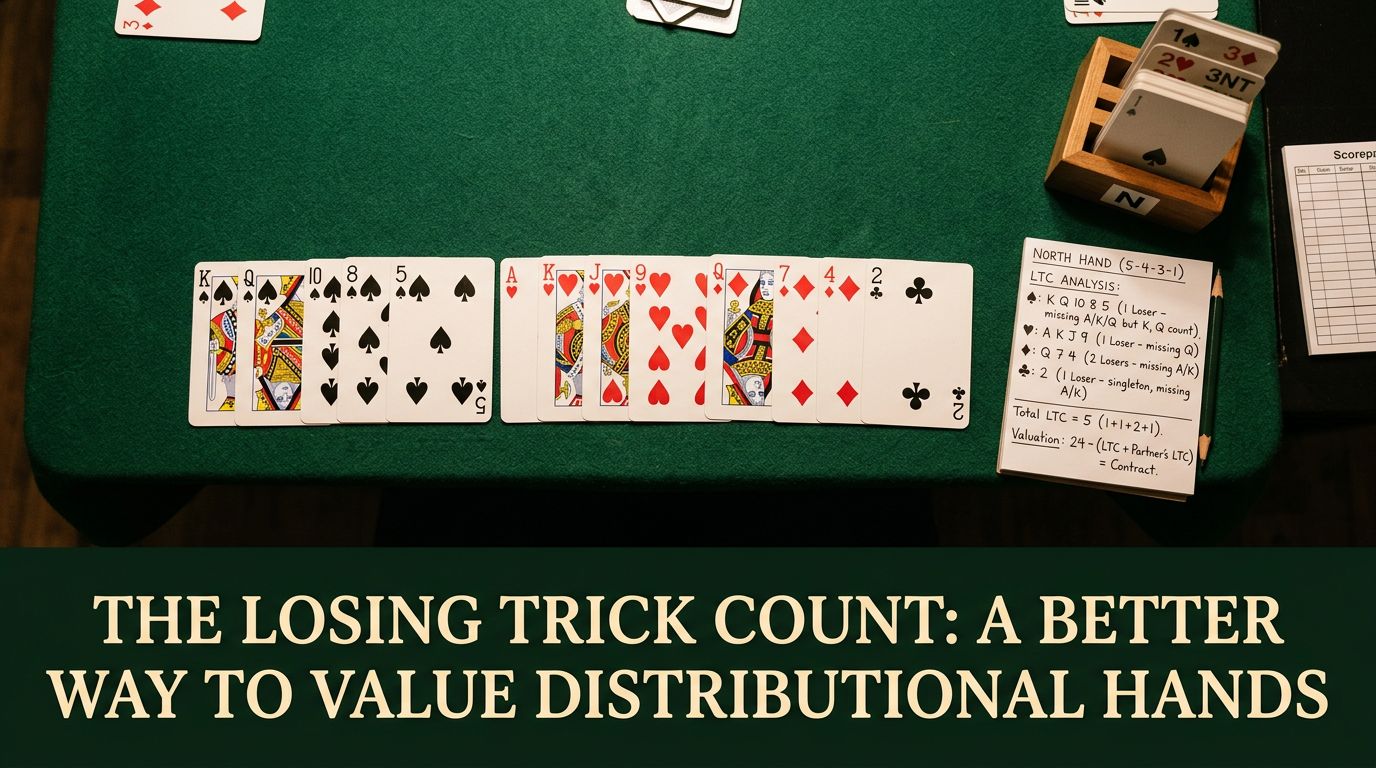
Losing Trick Count: Evaluate Suit Contract Tricks
High card points work great for balanced hands, but they don’t tell you everything. When you pick up a hand with 5-4 shape and find a fit, those 12 HCP might be worth way more than the flat 15-count sitting across from you. That’s where the Losing Trick Count comes in.
What Is the Losing Trick Count?
The Losing Trick Count (LTC) flips traditional hand evaluation on its head. Instead of counting what you have, you count what you’re missing. Specifically, you count the number of tricks you expect to lose in your longest suits.
Think about it this way: when you have a trump fit, you don’t care as much about total points. You care about whether your hands mesh. Do your honors cover partner’s gaps? Does your shortness sit opposite partner’s length?
LTC answers these questions by counting losers, then using a simple formula to predict how many tricks you can take.
How to Count Losers
Here’s the method:
Count a maximum of three losers per suit. Look only at your three longest cards in each suit.
- Ace = covers one loser
- King = covers one loser
- Queen = covers one loser
- Anything else = loser
Let’s walk through each holding type:
Three-card suits:
- A-K-Q = 0 losers (all covered)
- A-K-x = 1 loser (the x)
- A-Q-x = 1.5 losers (purists say 1, but the queen might not pull its weight)
- K-Q-x = 1 loser
- A-x-x = 2 losers
- K-x-x = 2 losers
- Q-x-x = 2.5 losers (or just count it as 2)
- x-x-x = 3 losers
Two-card suits:
- A-K = 0 losers
- A-x = 1 loser
- K-x = 1 loser
- x-x = 2 losers
Singletons:
- Ace = 0 losers
- Any other = 1 loser
Voids:
- 0 losers (you’re ruffing)
The key: only count your top three cards. If you have ♠A-K-x-x-x, that’s still one loser. The fourth and fifth spades don’t add losers because you’re only counting the top three.
The Basic Formula
Once you’ve counted your losers and partner’s losers, use this formula:
Your losers + Partner’s losers - 24 = Tricks you can take
Or flip it around:
24 - (Your losers + Partner’s losers) = Tricks
Let’s say you have 7 losers and partner opens showing 6.5 losers. That’s 7 + 6.5 = 13.5 total losers. Subtract from 24 and you get 10.5 tricks. Round down to 10 tricks, which is game in a major.
Why 24? It’s derived from experience and probability. Two perfectly fitting hands with 18 losers combined (9 each, which is typical for opening hands) will take about 6 tricks. The math works out that 24 is your baseline constant.
When to Use LTC
LTC shines in specific situations:
Use LTC when you have a fit. The method assumes you’re playing in a trump contract where you can ruff losers. It falls apart in notrump.
Use LTC with distributional hands. Hands with 5-4, 6-4, or weirder shapes benefit from LTC because HCP undervalues shortness and long suits.
Use LTC for competitive decisions. When opponents are bidding and you need to decide whether to compete to 3♠, LTC tells you if you have the tricks.
Use LTC after you find a fit. Before you know about the fit, stick with HCP. Once partner raises your suit or you find an eight-card fit, switch to LTC thinking.
Here’s when NOT to use it:
Don’t use LTC for balanced hands. A 4-3-3-3 hand with 15 HCP might have 7 losers, but it doesn’t have the ruffing potential LTC assumes.
Don’t use LTC in notrump. Without trumps, you can’t ruff losers, and the formula breaks down.
Don’t use LTC with misfits. If you have six spades and partner has one, LTC will lie to you.
LTC vs. High Card Points
So which is better?
HCP is better for:
- Opening the bidding (you don’t know fit yet)
- Notrump contracts
- Balanced hands
- First and second round bidding
LTC is better for:
- Evaluating after you find a fit
- Deciding whether to bid game
- Hands with singletons and voids
- Competitive bidding decisions
The best players use both. HCP to start the auction, LTC once you find your fit.
Adjustments for Shape and Fit
The basic LTC formula is just the start. Good players adjust based on these factors:
Add a loser for:
- Flat 4-3-3-3 shape
- No aces (aces pull their weight)
- Duplicate honors in short suits (K-Q doubleton isn’t great)
Subtract a loser for:
- Each void (after the first)
- Side four-card suit when you have a primary fit
- Double fit with partner (two eight-card fits)
Quality matters. A-K-x is better than K-Q-J even though both count as one loser. The ace-king combination guarantees control. When you’re on the borderline, lean toward bidding if your losers are high-quality.
Fit matters more than anything. If partner opens 1♥ and you have four hearts, your hand just got better. Subtract a loser. If you have a singleton in partner’s suit, add a loser. Fits multiply value.
Example Hands
Let’s look at four hands to see LTC in action.
Example 1: The Fitting 9-Count
You hold:
♠K-J-7-6-4
♥A-8-6-3-2
♦5
♣Q-4
Count losers:
- Spades: K-J-7 = 2 losers
- Hearts: A-8-6 = 2 losers
- Diamonds: 5 = 1 loser
- Clubs: Q-4 = 2 losers
Total: 7 losers
You have 9 HCP, barely an opening hand. But partner opens 1♥. You have five hearts and 7 losers. If partner has a typical opening hand (6-7 losers), you’re looking at 24 - 13 = 11 tricks. That’s a slam.
Make a jump shift or use whatever methods you have to explore slam. HCP says “bid 2♥ and be happy.” LTC says “this hand is enormous.”
Example 2: The Flat 16-Count
You hold:
♠A-Q-4
♥K-J-5
♦K-Q-3
♣Q-J-6-2
Count losers:
- Spades: A-Q-4 = 1 loser
- Hearts: K-J-5 = 1 loser
- Diamonds: K-Q-3 = 1 loser
- Clubs: Q-J-6 = 2 losers
Total: 5 losers (but add one for flat shape) = 6 losers
Partner opens 1♠ showing maybe 7 losers. You have 16 HCP, which screams game. But LTC says 24 - 13 = 11 tricks if partner is minimum. That’s not a slam. Just bid game and move on.
LTC confirms what you feel: this is a boring 16-count.
Example 3: The Competitive Decision
You hold:
♠Q-10-8-6-3
♥6
♦K-J-9-4
♣A-7-2
Partner opens 1♠, RHO overcalls 2♥. What now?
Count losers:
- Spades: Q-10-8 = 2 losers
- Hearts: 6 = 1 loser
- Diamonds: K-J-9 = 1.5 losers
- Clubs: A-7-2 = 2 losers
Total: 6.5 losers
If partner has 7 losers (typical), you have 24 - 13.5 = 10.5 tricks, which rounds to 10. That’s game. Bid 4♠ right now. Don’t give them room to find their fit or sacrifice.
Example 4: The Misfit
You hold:
♠A-K-Q-J-7-4
♥8
♦K-Q-4
♣9-7-3
That’s 5 losers, looks great. Partner opens 1♥. You bid 1♠, partner rebids 2♥. Now partner bids 3♥ over your 2♠, showing six hearts.
The formula says 24 - (5 + 6) = 13 tricks. Grand slam territory.
Not happening.
This is a misfit. You have one heart, partner has six. Your singleton is worthless. LTC assumes fits. When the hands don’t mesh, abandon LTC and trust your judgment. This hand might not make game.
Common Mistakes
Mistake 1: Using LTC too early. Don’t count losers on your opening bid. You don’t know if you have a fit yet. Wait until partner supports your suit or you support theirs.
Mistake 2: Forgetting about controls. LTC tells you how many tricks, not whether you can make them. Two quick losers in a suit means the opponents cash and beat you. Check for aces and kings before slamming based on loser count.
Mistake 3: Using LTC in notrump. This is the biggest error. LTC assumes you’re ruffing losers in the short hand. In notrump, you can’t ruff anything. The formula produces nonsense.
Mistake 4: Counting all four (or more) cards. Remember: maximum three losers per suit. Your six-card suit only counts three cards for loser purposes.
Mistake 5: Ignoring hand quality. A-K-Q-x-x is way better than Q-J-10-x-x even if both show 1 loser in the suit. Adjust your decisions for honor quality and location.
Mistake 6: Not adjusting for shape. Flat hands overperform in defense but underperform in offense. If you’re 4-3-3-3, add a loser. If you have a void, subtract one.
Related Articles
Explore This Concept with Brian
Want to see this concept in action? Brian can deal you hands that illustrate key bridge ideas and explain the theory behind the right plays. Try Brian free →
Putting It Together
The Losing Trick Count isn’t perfect, but it’s a powerful tool when you use it right. After you find a fit, count your losers, estimate partner’s, and do the math. The formula gives you a target.
Want to bid game in a major? You need 10 tricks, so you need 14 total losers or fewer.
Want to bid slam? You need 12 tricks, so you need 12 total losers or fewer.
Use LTC alongside other methods. Check for controls, think about whether hands fit, and don’t override your judgment when something feels wrong. But when the auction is competitive and you need to know if you should push to 4♠, LTC gives you the answer faster than anything else.
Count losers, run the formula, and trust the math. Your results will improve.