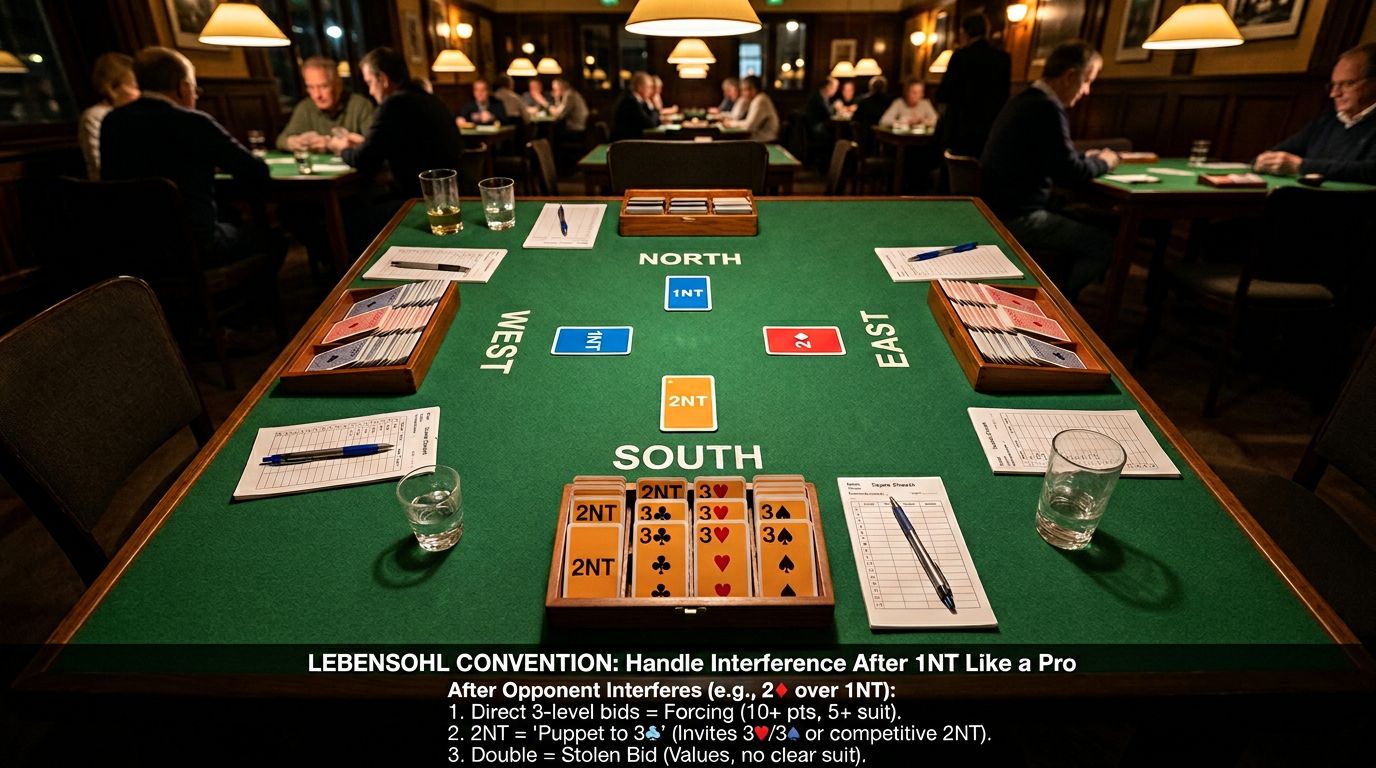
Lebensohl Convention: Respond to 1NT Overcall & Weak 2 Op...
You open 1NT with a nice balanced 16-count. Your partner is about to respond when left-hand opponent sticks in 2♥. Now what?
All your carefully planned Stayman and Jacoby transfer sequences just evaporated. You need to show whether you’re weak and competing, invitational, or game-forcing. You need to find a 4-4 spade fit if one exists. You need to figure out if anyone has a heart stopper for 3NT.
Without a system, you’re guessing. With Lebensohl, you have answers.
Lebensohl is a convention that uses an artificial 2NT bid as a relay after the opponents interfere over your 1NT opening. It creates structure where there would otherwise be chaos, letting you distinguish between weak competitive hands and game-forcing hands while also showing or denying stoppers in the enemy suit.
What Is Lebensohl?
Lebensohl is built around one key concept: two paths to the three level.
After partner opens 1NT and opponents overcall at the two level, you can bid a new suit at the three level in two different ways:
- Directly (immediate three-level bid)
- Through the 2NT relay (bid 2NT first, forcing partner to bid 3♣, then bid your suit)
These two paths mean completely different things. Direct bids are strong and forcing. Relay bids are weak and competitive.
The 2NT bid itself is artificial—it’s a puppet bid that forces opener to bid 3♣. It doesn’t promise a balanced hand or notrump values. Think of 2NT as hitting the pause button, creating an extra step so you can clarify your hand type and strength.
When Does Lebensohl Apply?
Lebensohl applies in one specific situation:
Partner opens 1NT → RHO overcalls a natural suit at the two level → You bid
Classic sequences:
- 1NT - (2♥) - ?
- 1NT - (2♠) - ?
- 1NT - (2♦) - ?
The overcall must be natural (showing that suit). If they bid 2♥ to show hearts, Lebensohl applies.
When Lebensohl doesn’t apply:
- After artificial overcalls: If they bid 2♣ Cappelletti or 2♦ Landy, you need a different system
- After doubles: If they double 1NT, that requires different agreements
- After three-level overcalls: Most pairs don’t use Lebensohl after 1NT - (3♣)—you’re too high
The bread-and-butter application is defending against natural 2♥ and 2♠ overcalls.
The 2NT Relay Mechanism
Here’s how the relay works:
After 1NT - (2♥) - 2NT:
Opener must bid 3♣. Not 3♦, not 3♥, not 3NT. Always 3♣.
This is a forced bid. Opener has no choice, no matter what their hand looks like. Even with a void in clubs and seven diamonds, they bid 3♣.
After opener dutifully bids 3♣, responder clarifies what they really want:
- Pass = To play 3♣, weak hand with clubs
- 3♦/3♥ = To play, weak hand with that suit (competitive only)
- 3♠ = Game-forcing with 4+ spades
- 3♥ (cue bid) = Game-forcing, asking for a stopper, shows four spades
- 3NT = Game values, denies a heart stopper
The beauty of this system is separation. By using the relay, you can compete at the three level with garbage hands while keeping direct three-level bids for strong hands.
Direct Bids vs. Lebensohl Bids
This is the heart of Lebensohl. After 1NT - (2♥) - ?:
Direct Three-Level Bids (Strong)
3♣, 3♦, or 3♠ = Game-forcing, showing 4+ cards in that suit, 8+ HCP
3♥ (cue bid) = Game-forcing, asking for a heart stopper, denies four spades
3NT = To play, game values, shows a heart stopper
Relay Bids Through 2NT
2NT → 3♣ → Pass/3♦/3♥ = Weak competitive, 0-7 HCP, to play
2NT → 3♣ → 3♠ = Game-forcing with 4+ spades
2NT → 3♣ → 3♥ (cue bid) = Game-forcing, asking for a stopper, shows four spades
2NT → 3♣ → 3NT = Game values, denies a heart stopper
Slow Shows, Fast Denies
This phrase—“slow shows, fast denies”—causes more confusion than almost anything in bridge. Here’s what it actually means:
For Cue Bids: It’s About Spades
After 1NT - (2♥) - ?, the cue bid differences aren’t about stoppers. They’re about whether you have four spades:
- Fast cue (direct 3♥) = Game-forcing, asks for stopper, denies four spades
- Slow cue (2NT then 3♥) = Game-forcing, asks for stopper, shows four spades
Why does this matter? Because if both of you have four spades, you want to play 4♠, not 3NT. By showing your four spades through the slow cue, you let partner choose the right game.
For 3NT Bids: It’s About Stoppers
Here’s where “slow shows, fast denies” actually refers to stoppers:
- Fast 3NT (direct) = Game values with a stopper
- Slow 3NT (2NT then 3NT) = Game values without a stopper
Think of it as “slow shows the problem.” When you bid 3NT fast, you have no problem, you have the stopper. When you go slow, you’re showing you have a problem, no stopper, and need partner to cover it.
Example Hands and Auctions
Example 1: Weak Competition
You hold: ♠85 ♥J4 ♦Q108642 ♣973
Auction:
Partner    RHO    You      LHO
1NT        2♥     2NT      Pass
3♣         Pass   3♦       All Pass
You have a terrible hand but six diamonds. The 2NT relay is the only way to show this weak hand. If you bid 3♦ directly, that would be game-forcing.
Example 2: Game Force with Four Spades
You hold: ♠KJ94 ♥83 ♦AQ62 ♣K105
Auction:
Partner    RHO    You      LHO
1NT        2♥     2NT      Pass
3♣         Pass   3♥       Pass
3♠         Pass   4♠       All Pass
You have 13 HCP and four spades. By bidding 2NT then cueing 3♥, you show game values and specifically promise four spades. Partner bids 3♠, showing four spades. Perfect! You raise to 4♠.
Example 3: Game Force Without Four Spades
You hold: ♠J7 ♥Q10 ♦AKJ85 ♣A964
Auction:
Partner    RHO    You      LHO
1NT        2♥     3♥       Pass
3NT        All Pass
You have 14 HCP but only two spades. By bidding 3♥ directly (not through 2NT), you deny four spades. This tells partner: “I’m game-forcing, I need a stopper, and we’re not playing 4♠.”
Example 4: You Have the Stopper
You hold: ♠K42 ♥AJ8 ♦Q1063 ♣K74
Auction:
Partner    RHO    You      LHO
1NT        2♥     3NT      All Pass
You have 12 HCP and hearts well-stopped with AJ8. Just bid 3NT. This is the “fast” 3NT, showing you have the stopper.
Example 5: You Need Partner’s Stopper
You hold: ♠K3 ♥854 ♦AQJ6 ♣KQ105
Auction:
Partner    RHO    You      LHO
1NT        2♥     2NT      Pass
3♣         Pass   3NT      Pass
Pass       Pass
You have 14 HCP but nothing in hearts. By going slow (2NT then 3NT), you tell partner: “I have game values but no heart stopper. You better have it.” If partner doesn’t have a stopper, they can pull to a minor.
Continuations After the Relay
After the 2NT - 3♣ relay:
If responder passes or corrects to 3♦/3♥: Opener passes. Responder showed weakness.
If responder bids 3♠: Game-forcing. Opener can bid 3NT (no fit), 4♠ (four spades), or a minor (strong suit, slam interest).
If responder cue-bids 3♥: Responder showed four spades and asked about a stopper. Opener can bid 3♠ (four spades), 3NT (stopper, 2-3 spades), or 4♠ (four spades and stopper).
If responder bids 3NT: Responder has game values but no stopper. Opener should pass (with stopper) or pull to a minor (no stopper, with fit).
Common Mistakes and Misunderstandings
1. Treating 2NT as Natural
The biggest mistake: thinking 2NT shows a balanced hand with points. Wrong. After 1NT - (2♥) - 2NT, opener must bid 3♣. Always. No exceptions. The 2NT bid is artificial, a relay, a puppet.
2. Bidding Slow 3NT with a Stopper
Some players think “slow shows” means showing a stopper. It’s the opposite!
- Fast 3NT = You have the stopper
- Slow 3NT = You DON’T have the stopper
3. Using the Relay with Game-Forcing Suits
If you have 10 HCP and a good six-card diamond suit, bid 3♦ directly. The relay is for weak hands with minors or for specific game-forcing sequences involving spades or cue bids.
4. Forgetting What Double Means
After 1NT - (2♥) - Double, what does that show? Common treatments include penalty (most common), negative/takeout, or stolen bid. Discuss this before it matters.
5. Extending Lebensohl Too Far
Lebensohl applies after natural two-level suit overcalls. If they bid 2♣ Cappelletti (artificial), Lebensohl is usually off. If they double, Lebensohl is off. Know when the convention applies and when it doesn’t.
Partnership Agreements You Need
Before playing Lebensohl, nail down these agreements:
1. What Does Double Show?
After 1NT - (2♥) - Dbl, is it penalty, negative, or something else? Most tournament pairs play penalty-oriented.
2. On After 2♣?
If opponents overcall 2♣ (natural), is Lebensohl on? Many pairs say yes. If they bid 2♣ artificial (Cappelletti, Landy), most pairs say no.
3. Lebensohl After Weak Twos?
Some pairs extend Lebensohl to auctions like (2♥) - Dbl - (Pass) - ?, where partner’s double is takeout. This is called “Lebensohl After They Open a Weak Two” and requires discussion.
4. Three-Level Overcalls?
After 1NT - (3♣), do you play Lebensohl? Most don’t. You’re too high.
5. Rubensohl?
Some pairs play Rubensohl, which reverses the meanings: “fast shows, slow denies.” Less common but gaining popularity. Make absolutely sure you and partner are on the same page.
Why Lebensohl Works
Without Lebensohl, chaos reigns. After 1NT - (2♥) - 3♣, what does that mean? Forcing? Weak? Who knows?
Lebensohl creates order:
- Weak hands (0-7 HCP) go through 2NT, then stop at the three level
- Game-forcing hands (8+ HCP) bid directly or use specific relay sequences
- Stoppers are clarified through fast/slow 3NT and cue bids
- Four-card spade fits are found through fast/slow cue bids
The convention has been around since the 1970s. It’s standard for tournament players and most serious duplicate partnerships.
Is it the simplest convention? No. But once you understand the logic, direct vs. relay, fast vs. slow, it becomes automatic.
Summary: Your Lebensohl Cheat Sheet
After 1NT - (2♥) - ?:
Direct bids (strong):
- 3♣/3♦/3♠ = Game-forcing, 4+ cards
- 3♥ (cue) = Game-forcing, asks for stopper, denies four spades
- 3NT = Game values, shows stopper
Through 2NT relay (weak or specific):
- 2NT → 3♣ → Pass/3♦/3♥ = Weak, to play
- 2NT → 3♣ → 3♠ = Game-forcing, 4+ spades
- 2NT → 3♣ → 3♥ (cue) = Game-forcing, asks for stopper, shows four spades
- 2NT → 3♣ → 3NT = Game values, denies stopper
Key concepts:
- 2NT is always a relay to 3♣ (not natural)
- Fast 3NT = have stopper | Slow 3NT = need stopper
- Fast cue = no four spades | Slow cue = four spades
- Direct = strong | Through relay = weak (except specific game-forcing sequences)
Practice This Convention with Brian
Want to test your understanding of this convention in realistic hands? Brian, the Bridgetastic AI, can deal you practice hands, walk you through the bidding, and explain when this convention applies, and when it doesn’t. Try Brian free →
Practice Makes Permanent
Lebensohl takes practice. The good news is you’ll face interference over 1NT constantly. Start by getting the basics down:
- 2NT forces 3♣
- Weak hands relay then pass or correct
- Direct three-level bids are game-forcing
- Fast 3NT shows a stopper, slow 3NT denies one
Once those are automatic, add the cue bid logic (fast denies four spades, slow shows four spades).
Practice with your partner. Discuss your agreements. Write them on your convention card. The opponents can interfere all they want, you’re ready.