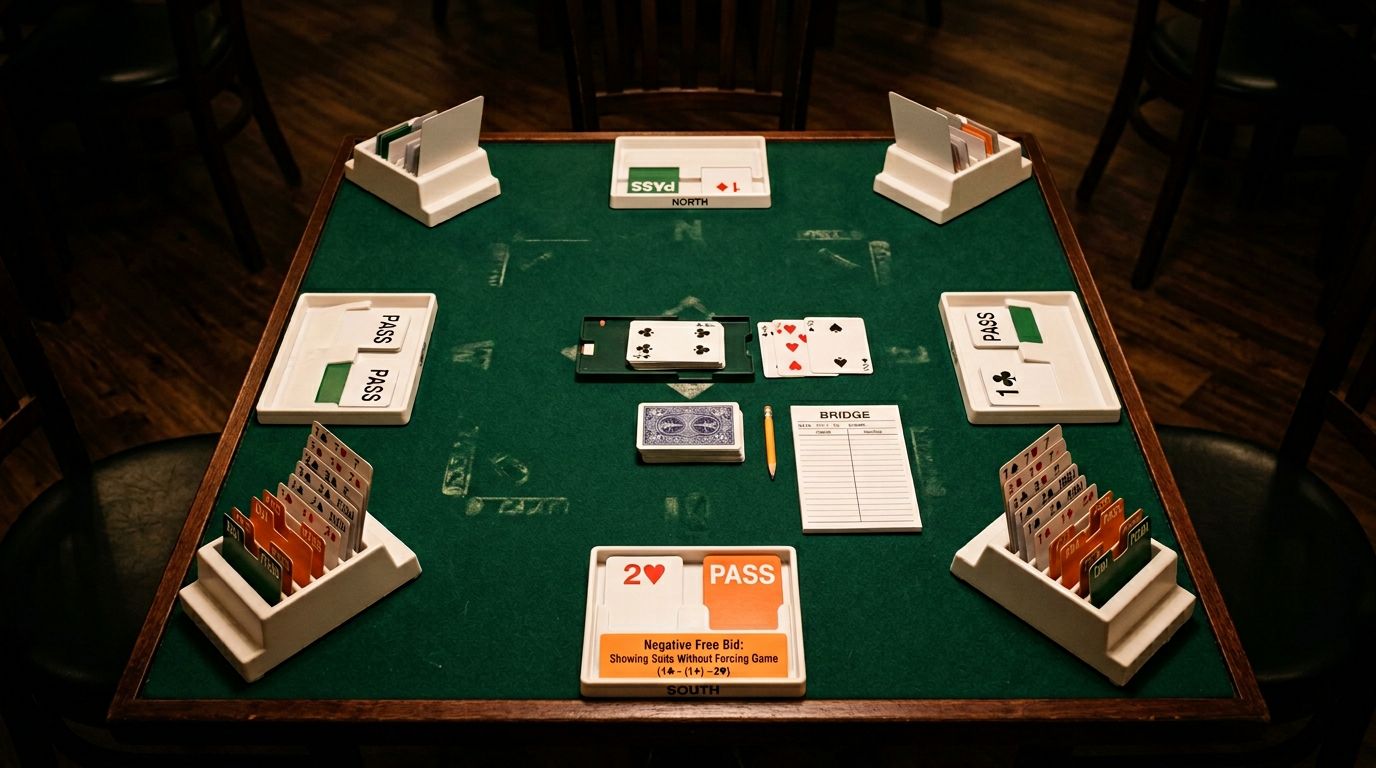
Negative Free Bids: Showing Suits Without Forcing Game
A negative free bid is a non-forcing new suit response after your right-hand opponent overcalls partner’s opening bid. Instead of promising 10+ points like traditional free bids, you can show your suit with as little as 7-11 points and a decent five-card suit.
The auction looks like this:
Partner - RHO - You
1♦ - 1♠ - 2♥
Playing negative free bids, that 2♥ call shows 7-11 points with five hearts. You’re not forcing partner to bid again. If they have a minimum opener with no fit, they can pass.
Why the Shift from Traditional Free Bids?
For decades, bridge teachers drilled the same principle: after an overcall, any new suit from responder was forcing. You needed 10+ points to bid at all. With 6-9 points, you passed or raised partner’s suit. That was it.
The problem? You couldn’t show your suits when you had a playable hand but not quite enough for a forcing bid. Say you hold:
♠ 7 4
♥ K J 9 6 3
♦ Q 8 2
♣ A 5 4
Partner opens 1♦, RHO overcalls 1♠. You’ve got 9 HCP and a nice five-card heart suit. Playing traditional methods, you have to pass. Your hand isn’t strong enough for a forcing 2♥ bid, and you don’t have diamond support.
But hearts might be your best spot. Partner could have:
♠ A 6
♥ A Q 4 2
♦ K J 7 6 3
♣ 8 2
With four hearts and 13 HCP, they’d pass after your forced silence. You miss a cold 4♥ contract and probably don’t even find your 4-4 heart fit.
Negative free bids solve this. You bid 2♥ with your 9-count, partner raises to 4♥, and you make game.
How Strong Do You Need to Be?
The typical range for a negative free bid is 7-11 HCP with a good five-card suit. The suit quality matters. You want at least two of the top three honors or three of the top five. This isn’t the time to bid a weak suit hoping partner has all the honors.
Good suits for negative free bids:
- K Q 10 7 3
- A J 9 6 2
- K J 10 8 4
- Q J 9 7 3
Too weak to bid:
- 10 8 6 4 2
- J 9 7 5 3
- Q 8 7 4 3
With 12+ points, you’re too strong for a negative free bid. Those hands need forcing bids to make sure you reach game. More on that in a moment.
When Negative Free Bids Apply
Negative free bids are on in these situations:
-
After a one-level overcall of partner’s minor
1♣ - (1♥) - 1♠
1♦ - (1♠) - 2♥ -
After a simple overcall at the two-level over a minor
1♦ - (2♣) - 2♥
Negative free bids are off in these situations:
-
After partner opens a major
When partner opens 1♥ or 1♠, you’re focused on supporting their major or showing your own. Different structure applies here, often using negative doubles instead.
-
After a jump overcall
1♦ - (2♠) - 3♥
This needs to be forcing. You’re already at the three-level.
-
When you’ve already passed
Pass - (1♦) - Pass - (1♠)
2♥ - ???As a passed hand, different rules apply. Your free bids can be lighter because you’ve already limited your hand.
How Opener Should Respond
When partner makes a negative free bid, opener knows they have 7-11 points with five cards in the suit. That makes your next bid pretty straightforward.
With a minimum opening (12-14 HCP) and no fit: Pass. They didn’t force you to bid. If you have 13 balanced with three small in their suit, passing is fine.
With a minimum and three-card support: Raise to the two-level. Simple support showing minimum values.
1♦ - (1♠) - 2♥ - (Pass)
3♥ = 12-14 HCP, three hearts
With four-card support: Jump raise to show the extra trump. Even with a minimum, that fourth trump is worth showing.
1♦ - (1♠) - 2♥ - (Pass)
4♥ = 12-14 HCP, four hearts
With 15-17 HCP: Make a game try or bid game. Partner has shown 7-11. Add your 15-17, and you’re in game range.
With 18+ HCP: You’re driving to game regardless of partner’s strength within their range.
The key point: opener is now captain. Responder has narrowly defined their hand (7-11 points, five-card suit). Opener knows the combined strength and places the contract.
What About 12+ Point Hands?
When you have 12 or more points after an overcall, you can’t use a negative free bid. You need to force to game. Most partnerships use one of these approaches:
Cue bid the opponent’s suit:
1♦ - (1♠) - 2♠
This shows 12+ points and is forcing to game. You’ll show your suit next.
Jump shift:
1♦ - (1♠) - 3♥
Some play this as forcing to game with a good suit.
Negative double then bid your suit:
1♦ - (1♠) - Double - (Pass)
2♥ - (Pass) - 3♥
The double keeps the auction alive, then you bid your suit with force.
Your partnership needs to agree on which method you prefer. The cue bid approach is most common with negative free bids.
The Main Advantages
Why play negative free bids? Three big reasons:
You find more fits. Those 8-10 point hands with five-card suits can now speak up. You’ll reach games and partscores you’d miss playing traditional methods.
Opener knows responder’s range immediately. Instead of wondering if responder has 10 or 15 points, you know right away they’re in the 7-11 range. Makes your rebid decisions easier.
You can compete more effectively. When opponents interfere, you don’t have to stay silent with marginal hands. You can push them higher or find your own fit.
Example Auctions
Let’s see negative free bids in action:
Example 1: Finding the Game
You hold:
♠ K 4
♥ Q J 10 7 3
♦ A 6 2
♣ 8 5 4
Auction:
Partner - RHO - You - LHO
1♦ - 1♠ - 2♥ - Pass
4♥ - All Pass
You show your 10 HCP and five hearts with a negative free bid. Partner has four hearts and enough to accept game. Easy auction, good result.
Example 2: Stopping in Partscore
You hold:
♠ 9 3
♥ A J 9 6 2
♦ K 7 4
♣ 10 8 3
Auction:
Partner - RHO - You - LHO
1♣ - 1♠ - 2♥ - Pass
Pass - All Pass
Partner has a minimum with no heart fit. They pass. You play 2♥ and make it. Better than defending 1♠ or letting them buy it cheap.
Example 3: Invitational Raise
You hold:
♠ 7 2
♥ K Q 8 6 3
♦ Q 10 4
♣ A 7 2
Auction:
Partner - RHO - You - LHO
1♦ - 1♠ - 2♥ - Pass
3♥ - Pass - 4♥ - All Pass
You make a negative free bid with 11 HCP. Partner raises to 3♥ showing three-card support and extras. You accept with your maximum and make game.
Example 4: Two-Level Overcall
You hold:
♠ A 10 8 6 3
♥ K 4
♦ 9 7 2
♣ Q 6 3
Auction:
Partner - RHO - You - LHO
1♦ - 2♣ - 2♠ - Pass
2NT - Pass - 3NT - All Pass
Your 2♠ bid shows 7-11 with five spades. Partner bids 2NT showing extras and a club stopper. You raise to 3NT with your maximum and club help.
Common Partnership Agreements
Before you play negative free bids, discuss these points with your partner:
1. Which auctions use negative free bids? Most play them after minor suit openings only. Be clear about whether you’re on after major suit openings too.
2. How do you force to game? Agree whether you cue bid, jump shift, or double then bid. The cue bid is standard, but make sure you’re on the same page.
3. What’s the upper limit? Most play 11 HCP as the maximum. Some use 10. Don’t assume.
4. Do you need five cards? Almost everyone requires five. But if you play four-card suits, say so.
5. What about passed hands? Negative free bids typically don’t apply when you’ve already passed. As a passed hand, your free bids can be even lighter.
6. Can you have three-card support? Some players make negative free bids with three good cards in partner’s minor and a four-card major. Discuss this.
7. Competitive vs. constructive? Are you bidding to find your own contract or to push opponents higher? Sometimes it’s both, but knowing partner’s style helps.
Practice This Convention with Brian
Want to test your understanding of this convention in realistic hands? Brian, the Bridgetastic AI, can deal you practice hands, walk you through the bidding, and explain when this convention applies, and when it doesn’t. Try Brian free →
The Bottom Line
Negative free bids give you more bidding room in competitive auctions. You can show your suits without the crushing strength requirement of traditional forcing free bids. The tradeoff is that opener has to be ready to pass when holding a minimum with no fit.
Most modern pairs play negative free bids in some form. The exact details vary, but the concept stays the same: show your suit with 7-11 points and let opener decide where the hand belongs.
Just make sure you and partner are on the same page about when they apply and how you show stronger hands. Write it on your convention card, discuss it before you play, and you’ll compete more effectively in contested auctions.