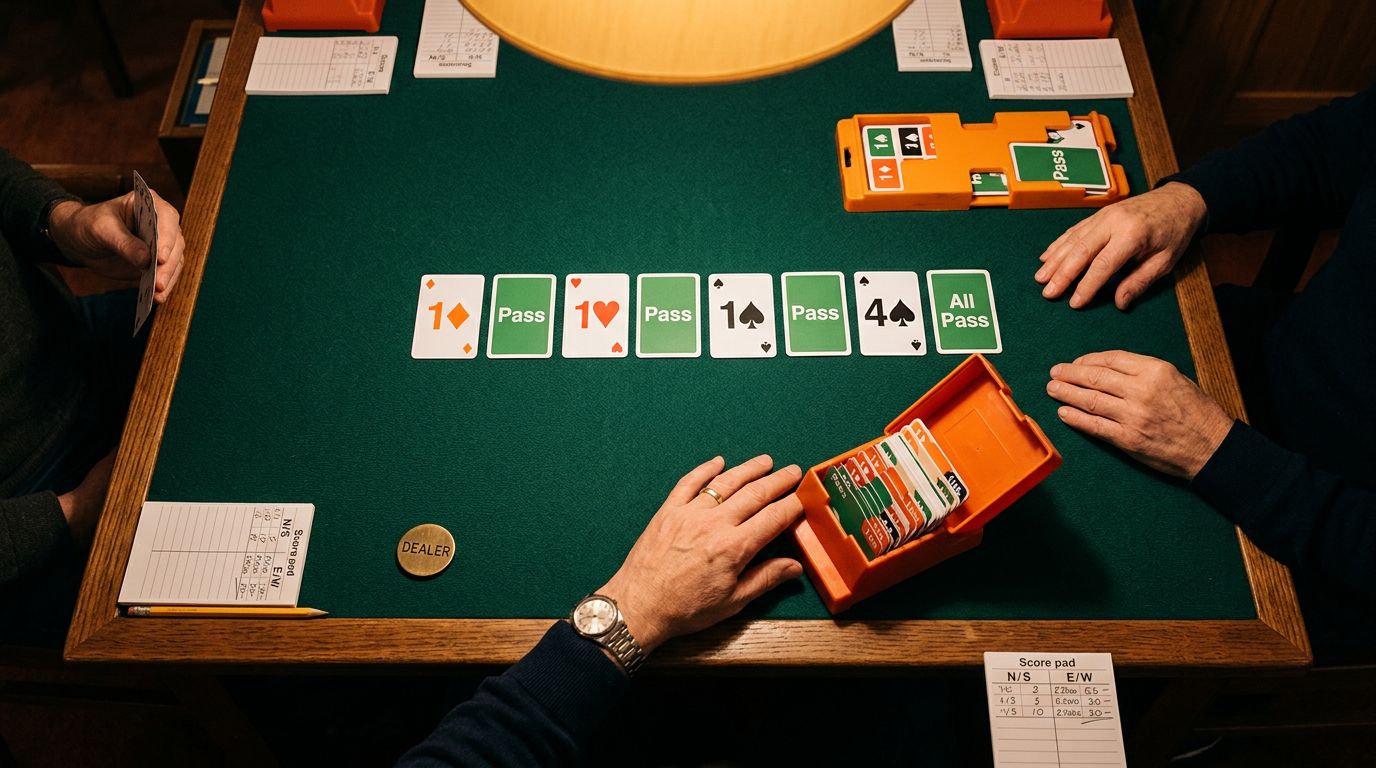
Responsive Double, Compete After Partner's Takeout Double
When your partner makes a takeout double and your right-hand opponent raises, you’re often faced with a difficult decision. You have values and want to compete, but which suit should you bid? The responsive double solves this problem by asking partner to choose the best contract.
What Is a Responsive Double?
A responsive double occurs in this specific auction sequence:
LHO opens 1♥
Partner doubles (takeout)
RHO raises to 2♥
You double (responsive)
Your double is not for penalty. Instead, it shows:
- Competitive values (typically 8+ points)
- No clear suit to bid on your own
- Support for the unbid suits
- A request for partner to pick the best suit
The responsive double is a cooperative tool that lets the doubler, who has already described their hand, make the final decision about where to play.
When Does the Responsive Double Apply?
Most partnerships use responsive doubles through 3♠. Here’s the standard agreement:
✅ Responsive doubles apply:
- After partner’s takeout double
- When RHO raises opener’s suit
- Through the 3♠ level
- In both major and minor suit auctions
❌ NOT responsive (these are penalty):
- After the 3♠ level (4♣ and higher)
- When RHO makes a different bid (new suit, 1NT, etc.)
- When you’ve already passed initially
Partnership Agreement Required
You and your partner must agree on the upper limit. Common agreements:
- Through 2♠ (conservative)
- Through 3♦ (common)
- Through 3♠ (modern standard)
Discuss this before you play together! There’s nothing worse than playing a double for penalty when partner thinks it’s responsive, or vice versa.
What the Responsive Double Shows
Point Requirements
The responsive double typically shows:
At the 2-level: 8+ points
At the 3-level: 10+ points (you’re forcing to the three-level)
With fewer points, simply pass and let partner decide whether to compete further.
Shape Requirements
The responsive double promises:
- No five-card suit you can bid naturally
- Usually 4-4 or better in the unbid suits
- No strong preference between the unbid suits
After 1♥ - Dbl - 2♥ - Dbl: You should have tolerance for spades, clubs, and diamonds. Typically:
- 4+ spades
- 3+ cards in both minors
- OR 4-4 in the minors with 3 spades
After 1♠ - Dbl - 2♠ - Dbl: You promise:
- 4+ hearts
- 4+ cards in at least one minor
- Tolerance for all unbid suits
Responsive Double vs. Penalty Double
How do you tell the difference?
After RHO Raises (Responsive)
1♥ - Dbl - 2♥ - Dbl = Responsive
Shows: Values and support for unbid suits
Meaning: “Partner, please pick a suit”
After 3♠ (Usually Penalty)
1♥ - Dbl - 4♥ - Dbl = Penalty
Shows: Defensive values, expecting to set the contract
Meaning: “Let’s defend for plus 500”
The key difference: At low levels (through 3♠), you’re still searching for your best fit. At high levels (4-level and up), you’re making a final decision about defending versus bidding on.
Example Hands and Auctions
Example 1: Classic Responsive Double
Auction:
LHO    Partner   RHO    You
1♠     Dbl       2♠     ?
Your hand:
♠ 7 5
♥ K 10 6 4
♦ A 9 5 3
♣ Q 8 2
Bid: Double (responsive)
You have 9 HCP and support for all unbid suits. You’re happy to play 3♣, 3♦, or 3♥ depending on partner’s preference. Bidding 3♥ would show five hearts; you only have four.
Partner’s likely action: With five hearts, partner bids 3♥. With longer diamonds than hearts, partner might bid 3♦. With equal length, partner typically chooses the higher-ranking suit (hearts).
Example 2: Bid Your Suit Instead
Auction:
LHO    Partner   RHO    You
1♦     Dbl       2♦     ?
Your hand:
♠ K J 10 7 5
♥ 8 4
♦ 9 3
♣ A 8 6 2
Bid: 2♠ (NOT double)
You have a five-card spade suit. Bid it naturally! The responsive double specifically denies a five-card suit. Showing your suit directly gives partner better information for subsequent decisions.
Example 3: Responsive at the Three-Level
Auction:
LHO    Partner   RHO    You
1♥     Dbl       3♥     ?
Your hand:
♠ K Q 6 4
♥ 7 2
♦ A 10 8 5
♣ Q 6 3
Bid: Double (responsive)
You have 11 HCP and excellent support for the unbid suits. The 3-level responsive double shows extras (10+) since you’re forcing partner to the three-level. Partner can now choose between 3♠, 4♣, or 4♦ with confidence.
Example 4: When NOT to Use Responsive Double
Auction:
LHO    Partner   RHO    You
1♣     Dbl       2♣     ?
Your hand:
♠ 9 7 3
♥ Q 8 4
♦ 10 6 5 2
♣ A 8 3
Bid: Pass
You only have 6 HCP. While you have tolerance for the unbid suits, you don’t have enough values for a responsive double. Pass and let partner make the decision about whether to compete further. If the opponents buy it at 2♣, that’s fine—you don’t have enough to push higher.
Common Mistakes to Avoid
Mistake #1: Doubling with a Five-Card Suit
Wrong:
1♠ - Dbl - 2♠ - Dbl with ♠ 7 3 ♥ K J 10 7 5 ♦ A 8 4 ♣ 9 6 2
Right:
Bid 3♥. Show your five-card suit directly.
Mistake #2: Doubling Without Values
Wrong:
1♦ - Dbl - 2♦ - Dbl with ♠ K 9 6 4 ♥ 10 7 5 3 ♦ 8 2 ♣ Q 6 3 (only 5 HCP)
Right:
Pass. You don’t have enough to force partner to bid at the three-level.
Mistake #3: Forgetting Your Partnership Agreement
Wrong:
Playing double as responsive through 3♦ only, then doubling 3♠ for takeout when partner expects penalty.
Right:
Know your agreements! If you haven’t discussed it, assume responsive doubles through 3♦ and penalty thereafter.
Mistake #4: Not Tolerating All Unbid Suits
Wrong:
1♥ - Dbl - 2♥ - Dbl with ♠ K Q 10 4 ♥ 7 3 ♦ 9 2 ♣ A J 8 6 5
You have a clear choice: bid 3♣. You have a five-card suit and poor diamond support.
Right:
Only use responsive double when you’re genuinely flexible about which unbid suit to play.
When to Bid Naturally Instead
Choose a natural bid over responsive double when you have:
A Five-Card or Longer Suit
Always bid your five-card suit directly rather than doubling. This gives partner more precise information.
A Strong Four-Card Suit and Clear Preference
1♦ - Dbl - 2♦ - 2♠ with ♠ A Q J 10 ♥ 8 4 3 ♦ 7 5 ♣ K 9 6 2
Even though you have club support, your strong spade suit makes 2♠ a better description.
An Unbalanced Hand
1♥ - Dbl - 2♥ - 3♣ with ♠ 8 ♥ 6 4 ♦ A 10 8 5 ♣ K Q J 7 6 3
With 6-4 shape, show your six-card suit. Don’t disguise distribution with a responsive double.
Strong Hands Suitable for Notrump
1♠ - Dbl - 2♠ - 2NT with ♠ K 10 7 ♥ A Q 8 ♦ K J 6 3 ♣ 10 5 4
With 11-12 HCP and a stopper, 2NT is more descriptive than a responsive double.
Partnership Agreements Checklist
Before your next session, confirm these agreements with your partner:
✅ Upper limit: Through what level are doubles responsive? (2♠? 3♦? 3♠?)
✅ Point range: What’s the minimum at the 2-level? At the 3-level?
✅ After 1NT doubled: Are responsive doubles “on” if RHO raises opener’s 1NT?
✅ In balancing seat: Can the doubler use responsive doubles in pass-out position?
✅ Over preempts: Do responsive doubles apply if they open with a weak two-bid?
Most of these situations are rare, but discussing them prevents costly misunderstandings.
Practice This Convention with Brian
Want to test your understanding of this convention in realistic hands? Brian, the Bridgetastic AI, can deal you practice hands, walk you through the bidding, and explain when this convention applies, and when it doesn’t. Try Brian free →
Putting It All Together
The responsive double is a valuable competitive tool that solves a common problem: you have values after partner’s takeout double, but no clear suit to bid. By doubling, you show:
- 8+ points (more at higher levels)
- No five-card suit to bid
- Tolerance for the unbid suits
- A request for partner to choose
Master this convention and you’ll compete more effectively in contested auctions. You’ll stay in the bidding with marginal hands while still finding your best fit, and your results in competitive auctions will improve dramatically.
Remember: When in doubt, have the discussion with your partner. A clear agreement about when doubles are responsive versus penalty is worth its weight in gold.
Quick Reference:
Responsive Double Shows:
- 8+ points (10+ at the 3-level)
- Support for unbid suits
- No five-card suit to bid
- “Partner, please choose”
NOT Responsive (Penalty):
- Above agreed level (typically 3♠)
- RHO didn’t raise
- You have a clear alternative bid
Golden Rule: When you have a five-card suit, bid it naturally. Save the responsive double for when you truly need partner’s help choosing the best contract.