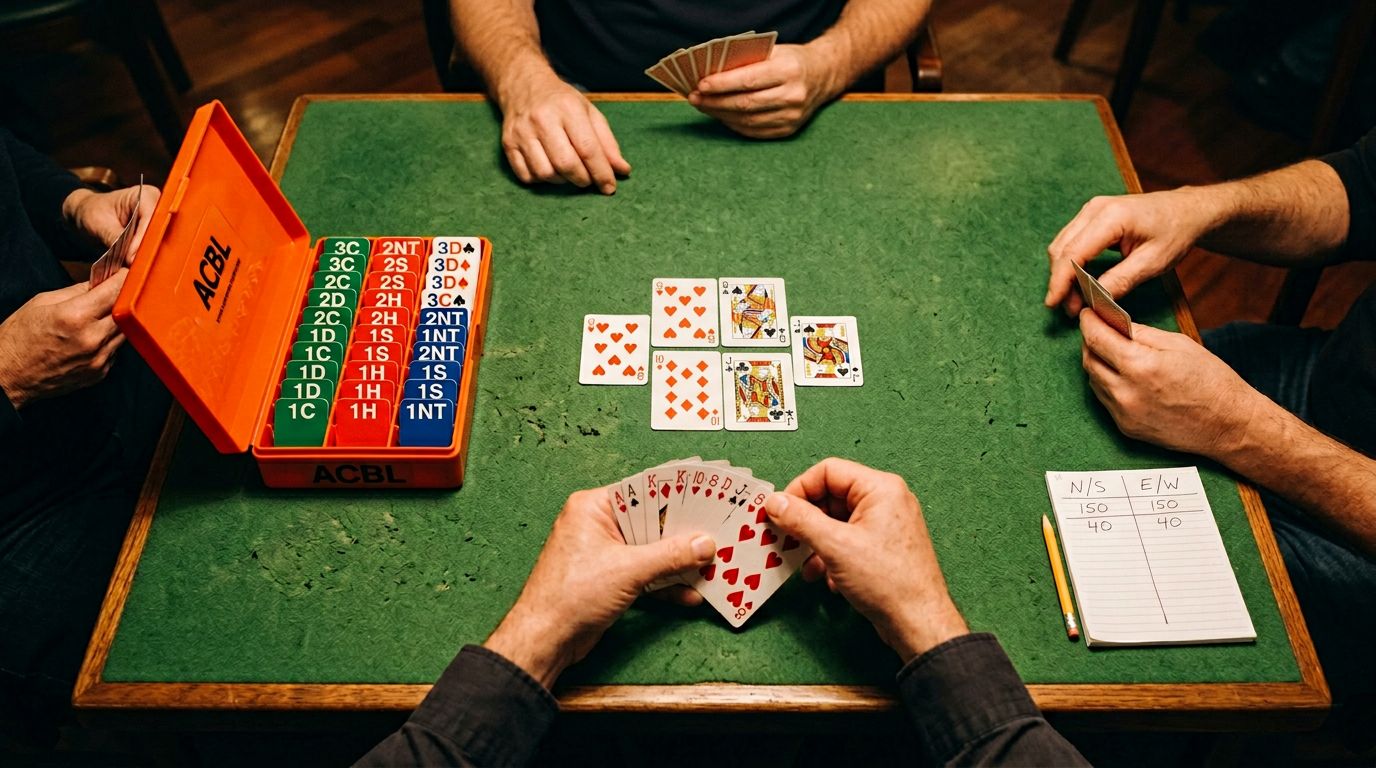
Transfers After 1NT: Guide to Jacoby and Texas Transfers
You’ve got a five-card major and partner opened 1NT. You could just blast to game, but there’s a better way. Transfers let you become declarer, protect partner’s honors from the opening lead, and give you room to explore game versus partscore. If you’re not using transfers after 1NT, you’re giving up tricks before the opening lead even hits the table.
What Are Jacoby Transfers?
Jacoby transfers (named after Oswald Jacoby, who popularized them in the 1950s) use artificial bids to tell opener about your five-card or longer major suit. The mechanic is simple:
- Bid 2♦ to show five or more ♥
- Bid 2♥ to show five or more ♠
Opener must “accept” the transfer by bidding the suit you’ve shown. After 1NT - 2♦, opener bids 2♥. After 1NT - 2♥, opener bids 2♠. Think of it as a command: “Partner, bid my suit.”
This isn’t optional. Opener doesn’t get to evaluate their hand and decide whether they like hearts. They accept the transfer automatically, then responder describes their hand further.
The transfer bid itself says almost nothing about your strength. You could have 0 points or 18. You might have exactly five hearts or you might have seven. All the 2♦ bid says is “I have at least five hearts.” Your next bid will clarify everything.
Why Transfers Work
There are three big reasons to transfer instead of bidding your suit directly.
Right-Siding the Contract
When you transfer, opener becomes declarer. Their 15-17 HCP and concentration of honors stay hidden behind responder’s hand. The opening lead comes around to the strong hand, not through it.
Say opener has K-x-x in a side suit. If responder declares, that king is exposed to the opening lead and might get captured immediately. If opener declares, the lead comes to that king, and it’s protected.
This matters most in notrump and suit contracts where entries are tight. You want opener’s tenaces and kings sitting over the opening leader, not under them.
Preserving Bidding Space
After 1NT - 2♥ (transfer to spades), if opener bids 2♠, you’re still at the two-level. Responder can pass with a weak hand, invite with a medium hand, or bid game with a strong hand.
Compare this to bidding spades directly. If responder bid 2♠ naturally (without transfers), that would show a weak hand and opener would pass. You’d have no way to show an invitational hand with five spades.
Transfers give you room to describe your strength after showing your shape.
Flexibility for Responder
After transferring and hearing opener accept, responder can:
- Pass (weak hand, wants to play partscore in the major)
- Invite game (raise to 3-level)
- Bid game (jump to 4-level or 3NT)
- Show a second suit (forcing, looking for the best game or slam)
None of these options exist if you bid your major directly or just blast to game immediately.
Opener’s Super-Accept
Here’s where it gets interesting. When opener has four-card support for responder’s major AND a maximum (16-17 HCP or a good 15 with honors in partner’s suit), they can “super-accept” by jumping to the three-level instead of just accepting at the two-level.
After 1NT - 2♦ (transfer to hearts):
- Normal accept: 2♥ (any 1NT opening, including only 2-3 hearts)
- Super-accept: 3♥ (16-17 HCP with four hearts)
After 1NT - 2♥ (transfer to spades):
- Normal accept: 2♠
- Super-accept: 3♠ (16-17 HCP with four spades)
Why does this matter? Because it lets responder bid game with hands that would only invite opposite a minimum or three-card support. If you hold ♠ Q-J-8-6-5 ♥ K-4-2 ♦ 8-6 ♣ Q-J-3 (9 HCP), you’d normally just invite. But opposite a super-accept showing four spades and a maximum, you can confidently bid 4♠.
Some partnerships use different super-accept structures. The basic version just jumps to three of the major. Advanced versions bid in-between suits to show specific features, but the simple jump is standard and works fine.
Responder’s Rebids After Transfer
After you transfer and opener accepts, you need to describe your strength. Here’s the menu of options:
Pass (0-7 HCP, five-card suit)
1NT - 2♥ (transfer to spades)
2♠ - Pass
You have a weak hand with five spades. Playing in 2♠ is better than 1NT when you have a weak hand with a long suit. Even with just 3 points, you’d rather declare 2♠ than let opener struggle in 1NT.
Raise to Three-Level (8-9 HCP, invitational)
1NT - 2♥
2♠ - 3♠
This invites game. You have 8-9 points and at least five spades. Opener passes with a minimum (15-16) and bids 4♠ with a maximum (17) or a good 16. If opener super-accepted to 3♠, you just bid 4♠ with this strength.
Bid 3NT (8-9 HCP, exactly five-card suit, no slam interest)
1NT - 2♥
2♠ - 3NT
This shows invitational values but suggests playing notrump instead of the major. Usually you have exactly five spades (not six) and scattered values. You’re saying “I have enough for game, but I think 3NT might be easier than 5♠, and I don’t have six spades to insist on 4♠.”
Opener can “correct” to 4♠ with four-card support or pass with only two or three.
Jump to Game (10+ HCP)
1NT - 2♥
2♠ - 4♠
You have game values (10+ HCP) and at least five spades. Just bid it. No need to invite when you have the points for game.
Bid a New Suit (forcing, showing 5-4 or longer distribution)
1NT - 2♥
2♠ - 3♥
This shows five spades, four hearts, and game-forcing values (usually 10+ HCP). You’re looking for the best game. Maybe 4♠, maybe 4♥, maybe even 3NT. Opener picks based on their hand.
Bidding a minor after transferring works the same way:
1NT - 2♦
2♥ - 3♣
This shows five hearts, four clubs, game-forcing. Could be looking for 3NT, 4♥, or even 5♣ with a distributional hand.
Six-Card Suits
With six cards in your major, you can show it by bidding 3NT after transferring. After 1NT - 2♥ - 2♠, bidding 3NT says “I have six spades and enough for game, but I think 3NT might score better than 4♠.” Opener corrects to 4♠ with a doubleton (since your six plus their two equals eight-card fit) or passes with three-card support (figuring 3NT is fine with nine trumps).
Some pairs reverse this: 3NT shows five and wants to play notrump, while jumping to four of the major shows six. Discuss this with your partner.
Texas Transfers
When you know you want to be in game in a major (no interest in slam, no interest in 3NT), Texas transfers get you there immediately.
- 4♦ transfers to 4♥
- 4♥ transfers to 4♠
The pattern is the same as Jacoby: bid the suit below your major. Opener must accept by bidding the major game.
Why use Texas instead of Jacoby? Speed and clarity. If you hold ♠ K-Q-10-8-6-2 ♥ 7-3 ♦ K-8 ♣ J-6-2, you know you want to play 4♠. No exploration needed. Bid 1NT - 4♥ and opener bids 4♠. Done.
The other reason is that it keeps the bidding lower if you want to show slam interest. With a hand worth exploring slam, you transfer at the two-level (Jacoby), then make a slam try. If you used Jacoby and bid 1NT - 2♥ - 2♠ - 4♠, that’s a signoff with no slam interest. But 1NT - 2♥ - 2♠ - 4♣ could show a control and slam interest (depending on your methods).
Texas is “I know we belong in game in this major, just put me there.”
Minor Suit Transfers
Not every partnership uses minor suit transfers after 1NT, but they’re becoming more popular. The standard structure:
- 2♠ transfers to 3♣
- 2NT transfers to 3♦
These are less common than major-suit transfers because minor-suit games are harder to make (you need 11 tricks instead of 10). Usually you transfer to a minor with one of three hand types:
-
Weak with a long minor: You have 0-7 HCP and six or more clubs/diamonds. You’d rather play 3♣ or 3♦ than let opener struggle in 1NT.
-
Slam interest: You have 15+ HCP, a good six-card minor, and want to explore slam. Transferring shows the suit and keeps the bidding low for investigation.
-
Looking for 3NT from the right side: You have a weak minor suit (like Q-J-10-x-x-x) and want opener to declare 3NT so their honors are protected.
After opener accepts the minor transfer (1NT - 2♠ - 3♣), responder can pass with a weak hand or continue exploring with a strong hand.
Warning: not all players use minor transfers. Some use 2♠ for other purposes (like showing both minors). Check with your partner before the session starts.
Example Auctions
Let’s walk through four real sequences to see how transfers work in practice.
Example 1: Weak Hand with Five-Card Major
Opener: ♠ A-J-3 ♥ K-Q-7 ♦ A-Q-10-4 ♣ K-6-2 (16 HCP)
Responder: ♠ 8-6-5-4-2 ♥ 8-3 ♦ 7-6 ♣ Q-J-4-3 (3 HCP)
Bidding:
1NT - 2♥ (transfer to spades)
2♠ - Pass
Responder has garbage but five spades. Playing in 2♠ gives you a chance to make eight tricks with trumps, while 1NT would probably go down. Opener has a nice hand, but responder’s pass says “don’t bid again.”
Example 2: Invitational Hand
Opener: ♠ K-10-4 ♥ A-Q-3 ♦ K-J-8-2 ♣ A-7-6 (16 HCP)
Responder: ♠ 7-2 ♥ K-J-8-6-5 ♦ Q-9-3 ♣ Q-10-4 (8 HCP)
Bidding:
1NT - 2♦ (transfer to hearts)
2♥ - 3♥ (invitational)
4♥ - Pass
Responder has 8 HCP and five hearts, perfect for an invitation. Opener has 16 HCP and three-card support, enough to accept. The nine-card fit and combined 24 HCP make 4♥ a good contract.
Example 3: Super-Accept
Opener: ♠ A-Q-7-2 ♥ K-J-3 ♦ A-Q-4 ♣ K-10-6 (17 HCP)
Responder: ♠ K-10-8-6-3 ♥ 7-4 ♦ J-8-2 ♣ Q-8-3 (7 HCP)
Bidding:
1NT - 2♥ (transfer to spades)
3♠ (super-accept!) - 4♠
Pass
Opener has 17 HCP and four spades, perfect for a super-accept. Responder only has 7 HCP (would normally pass 2♠), but the super-accept shows enough extras that game is likely. The ten-card fit and combined values make 4♠ solid.
Example 4: Showing a Second Suit
Opener: ♠ A-8-3 ♥ K-Q-7-2 ♦ A-J-4 ♣ K-10-6 (16 HCP)
Responder: ♠ K-Q-9-6-4 ♥ A-J-8-3 ♦ 7-2 ♣ 8-4 (10 HCP)
Bidding:
1NT - 2♥ (transfer to spades)
2♠ - 3♥ (game-forcing, showing 5-4 in the majors)
4♥ - Pass
Responder shows five spades and four hearts with game values. Opener has four hearts and only three spades, so 4♥ is the right game. The eight-card heart fit plays better than the seven-card spade fit.
Practice This Convention with Brian
Want to test your understanding of this convention in realistic hands? Brian, the Bridgetastic AI, can deal you practice hands, walk you through the bidding, and explain when this convention applies, and when it doesn’t. Try Brian free →
Common Mistakes and Partnership Agreements
Mistake 1: Forgetting to Transfer with Weak Hands
New players sometimes bid 1NT - 2♠ naturally to show a weak hand with spades. But if you’re playing transfers, 2♠ means something else (often minor transfers or “range ask”). Always transfer first, even with weak hands.
Mistake 2: Super-Accepting with Three-Card Support
The super-accept promises four-card support. Don’t jump to 3♥ with only three hearts, even if you have 17 HCP. Responder is counting on the four-card fit when evaluating whether to bid game.
Mistake 3: Transferring with Four-Card Majors
Transfers show five or more cards. With exactly four cards in a major, use Stayman (2♣) instead. Don’t transfer to a four-card suit.
Mistake 4: Assuming Minor Transfers Are On
Always discuss whether you’re using minor suit transfers. It’s not universal. Some pairs use 2♠ and 2NT for different purposes.
Partnership Agreement: What Does 3NT Mean After Transfer?
You need to agree whether bidding 3NT after transferring shows five cards or six cards in your major. Most modern pairs play that 3NT shows six cards (offering opener a choice between 3NT and 4M), while jumping straight to game in the major shows exactly five cards and no slam interest.
Partnership Agreement: Interference Over Transfers
What happens when opponents interfere? If RHO doubles your transfer, most pairs play that:
- Pass = suggests playing 2♥ doubled (rare)
- Redouble = three-card support, good hand
- Bidding the major = two-card support, completing the transfer
- Pass then bidding shows extras and three-card support
Discuss this before it comes up at the table.
Partnership Agreement: Breaking the Transfer
Can opener ever refuse to accept the transfer? In standard methods, no. Opener always accepts. But some advanced pairs allow opener to bid 2NT or 3NT with a super-maximum and only two-card support, suggesting that notrump might play better. This is not standard. Don’t do it unless you’ve discussed it.
Transfers after 1NT aren’t fancy or complicated. They’re fundamental. You show your shape, preserve bidding space, and make sure the strong hand declares. Master the basics (Jacoby transfers, super-accepts, responder rebids) and you’ll immediately improve your 1NT auctions. Add Texas and minor transfers when you’re comfortable, but the core idea works at every level: tell partner what you have, let them become declarer, and find the right contract together.