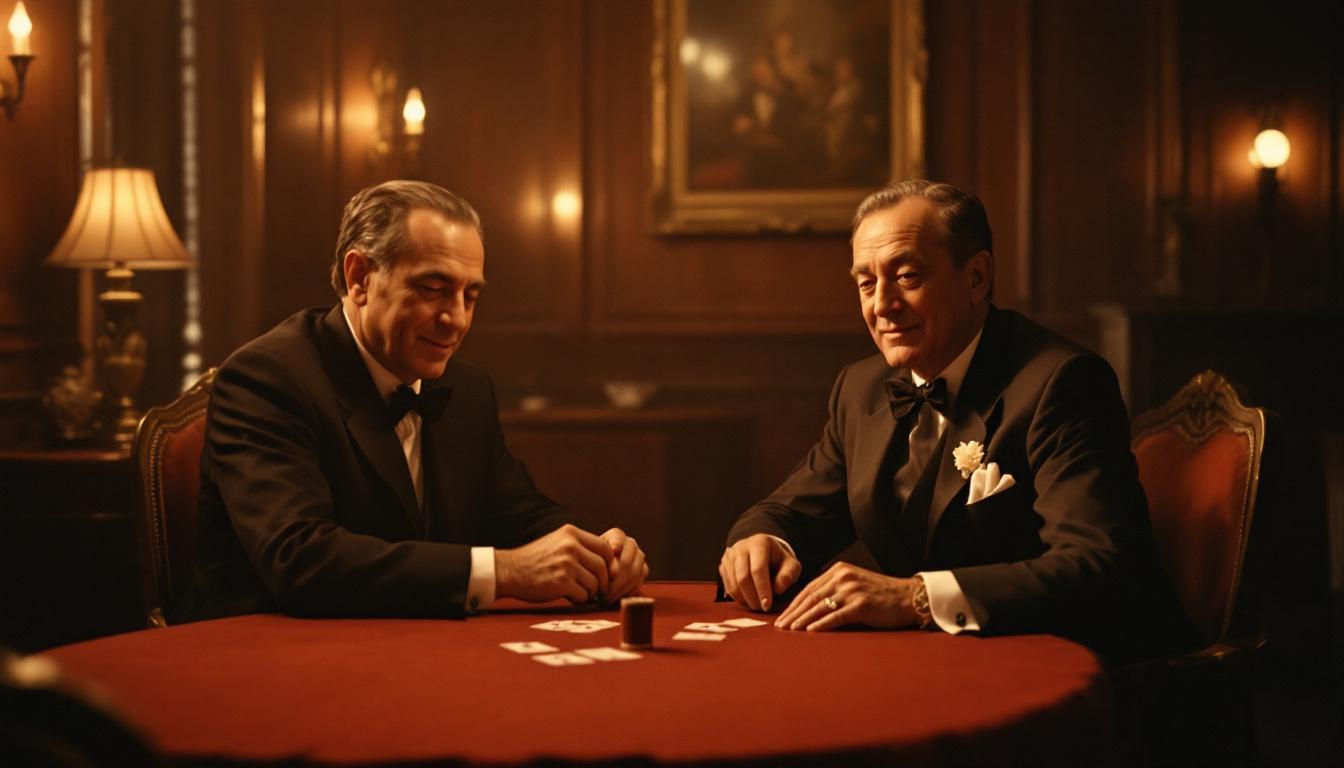
The Blue Team Dynasty
Imagine a team so dominant that they win the world championship not once, not twice, but sixteen times in a row. A team so far ahead of the competition that other countries start scouting their methods like they’re studying enemy battle plans. A team that fundamentally changes how the game is played.
That was the Blue Team.
From 1957 to 1975, Italy’s Blue Team was essentially unbeatable in world championship play. They won the Bermuda Bowl (bridge’s world championship) ten times and the World Team Olympiad three times. They revolutionized bidding theory. They introduced methods that seemed like black magic to opponents but were actually the result of systematic thinking and rigorous partnership agreements.
And then, at the peak of their powers, they quit.
The Birth of a Dynasty
The story starts with Carl’Alberto Perroux, an Italian bridge enthusiast with money and vision. In the mid-1950s, Italy had good bridge players but no real presence on the world stage. America dominated, as America tended to do at everything in the 1950s.
Perroux decided to change that. He essentially hired the best Italian players, gave them financial support so they could focus on bridge, and created an environment where they could practice and develop systems together. This was revolutionary. Professional bridge players didn’t really exist yet. Perroux invented them.
The core of the team that emerged included:
Walter Avarelli and Giorgio Belladonna - The partnership that would become legendary. Belladonna had mathematical brilliance and an almost supernatural card sense. Avarelli was methodical, precise, a perfect complement.
Pietro Forquet and Benito Garozzo - Another world-class partnership. Garozzo was the theorist, always developing new treatments and methods. Forquet was the practical master, able to execute complex plans at the table.
Massimo D’Alelio and Camillo Pabis-Ticci - The elder statesmen, already established players who brought experience.
The team captain was Carl’Alberto Perroux initially, later replaced by Sandro Salvetti. But the real architect of the team’s methods was Benito Garozzo, whose mind constantly worked on improving their systems.
The Roman Club and Neapolitan Club
What made the Blue Team different wasn’t just that they were good players (though they were). It was that they developed bidding systems that were fundamentally different from what everyone else played.
American players in the 1950s played “Standard American,” which was straightforward: natural bidding, showing your suits and strength in obvious ways. The Blue Team thought this was inefficient.
They developed the Roman Club system and later the Neapolitan Club, which used artificial and forcing club openings, multi-way bids, and complex relay sequences. A 1♣ opening didn’t promise clubs. It promised strength and started a series of asking bids that could pinpoint exactly what you held.
To American players used to natural bidding, this seemed like cheating. How could you have a 1♣ opening that said nothing about clubs? What kind of nonsense was this?
The Blue Team called it science. They had methods to describe hand types and distributions precisely. They could find the best contract while revealing minimal information to opponents. Their system was efficient, accurate, and brutally effective.
Critics claimed it was too complex, that bidding should be natural and understandable. The Blue Team responded by winning everything in sight.
The Bermuda Bowl Dominance
The Blue Team first won the Bermuda Bowl in 1957, defeating America. They won again in 1958 and 1959. At this point, people assumed it was a fluke or a hot streak that would end.
It didn’t end.
1961: Blue Team wins.
1962: Blue Team wins.
1963: Blue Team wins.
By now, it’s not a streak. It’s dominance. Other countries started studying the Italian methods. American experts scrambled to understand what they were doing. Bridge theorists analyzed their system cards.
The Blue Team kept winning: 1965, 1966, 1967, 1969.
They took a break in 1968 (finished second), which only proved they were human. Then they came back stronger: 1973, 1974, 1975.
Ten Bermuda Bowl victories between 1957 and 1975. Add in their World Team Olympiad wins (1964, 1968, 1972), and you’ve got sixteen world championships in eighteen years.
This wasn’t dominance. This was tyranny.
What Made Them Unbeatable
The systems were important, sure. But plenty of teams tried copying the Roman Club or Neapolitan Club and didn’t become the Blue Team. The systems were tools. The Blue Team’s advantage ran deeper.
First: Partnership continuity. The same pairs played together for years, even decades. Belladonna and Avarelli, Garozzo and Forquet. They knew each other’s style, judgment, tendency to stretch or be conservative. They could make hair-raising decisions because they trusted their partner implicitly.
Second: Practice. The team practiced constantly. They analyzed their errors. They developed new methods to handle situations where they’d had problems. They treated bridge like serious athletes treat training.
Third: Card play. Everyone focused on their complex systems, but the Blue Team members were also superb card players. Belladonna in particular had an almost mystical ability to read the cards. He’d find plays that seemed impossible until you reconstructed the hand afterward and realized it was the only thing that worked.
Fourth: Temperament. They didn’t crack under pressure. They didn’t panic when behind. They played with the calm certainty of people who knew they were better than the opposition.
Fifth: Garozzo’s mind. Benito Garozzo was constantly improving the system. Every problem they encountered became a project. How do we bid slams more accurately? How do we handle interference better? How do we maximize the information exchange while minimizing what opponents learn? Garozzo would work out solutions, they’d test them in practice, and the system would evolve.
The result was a team that stayed ahead of the competition year after year.
The Famous Hands
Every dynasty has its legendary moments. The Blue Team had dozens, but a few stand out:
In the 1975 Bermuda Bowl final against America, Belladonna had to find a way to make an impossible contract. The textbook play was to finesse for a queen. Belladonna rejected the finesse, played for a completely different distribution, and made the contract. When asked afterward how he knew to play that way, he allegedly said, “It was obvious.” To him, maybe. To everyone else, it looked like magic.
Or the hand where Garozzo and Forquet bid to 7♦ on a combined 25 high-card points because their system allowed them to determine they had perfect distribution fit. The grand slam made easily while other teams struggled to reach even the small slam.
These weren’t lucky guesses. They were the result of systematic methods applied by players who understood their tools completely.
The Resentment
Not everyone loved the Blue Team. Some of it was sour grapes from losing to them repeatedly. But some criticism was legitimate.
Their systems were complex enough that opponents sometimes couldn’t understand what was going on. Bridge has an obligation of full disclosure: you’re supposed to tell opponents what your bids mean. The Blue Team did explain their methods, but when your system has seventeen different meanings for a 2♣ response depending on context, explanations only go so far.
American players, in particular, grumbled that the Italians were getting away with things American pairs couldn’t. There were accusations of improper signaling, though nothing was ever proven during the dynasty years. (That came later, with different players, which we’ll get to in the cheating scandals article.)
There was also resentment about the professional nature of the team. American players were amateurs who squeezed in bridge around their jobs. The Blue Team was essentially professional, backed by Perroux’s money and Italian bridge federation support. Was that fair?
The Blue Team didn’t care. They kept winning.
1975: The End of an Era
In 1975, the Blue Team won the Bermuda Bowl in Bermuda, defeating America in the final. It was their tenth Bermuda Bowl victory, their sixteenth world championship overall.
And then they retired.
All of them. Garozzo, Belladonna, Forquet, the entire core of the team walked away at the top. They’d proven everything there was to prove. They’d won every title multiple times. They’d changed how bridge was played.
Why keep going?
The retirement shocked the bridge world. Teams had been gearing up to finally dethrone the Blue Team. New methods were being developed specifically to counter Italian systems. Countries were pouring resources into their teams.
And the Blue Team just… left.
It was the most dominant team in bridge history going out on top, undefeated in their final championship. You have to respect that.
The Legacy
The Blue Team’s influence on modern bridge can’t be overstated. Almost every advanced bidding system used today has roots in ideas the Blue Team pioneered:
Forcing club systems - Now standard among experts worldwide.
Relay methods - Asking bids that allow one partner to describe their hand precisely.
Scientific approach to system design - The idea that you should engineer your bidding methods to maximize efficiency.
Professional preparation - Top teams now practice, analyze, and prepare like the Blue Team did.
Even Standard American players who claim to hate artificial methods have incorporated Blue Team ideas. That 2♣ strong bid? That’s artificial. Fourth suit forcing? That’s a Blue Team concept. Negative doubles? Italian innovation.
The Blue Team proved that bridge could be studied scientifically, that systems could be engineered rather than evolved, that practice and preparation mattered as much as natural talent.
The Players’ Later Years
After retirement, the Blue Team members went their separate ways. Some kept playing occasionally. Garozzo continued to develop bidding theory and wrote several books. Belladonna became a beloved elder statesman of bridge, playing in exhibitions and teaching.
In 1975, there was a brief scandal when some accused Blue Team pairs of having improper signals during the championships. An investigation found some irregularities in how they positioned their pencils and cards, but nothing definitive. The accusations stung, particularly since they came after the retirement.
In the 2000s, a more serious scandal emerged involving different Italian players (which we’ll cover in the cheating scandals article). That tarnished Italy’s reputation in bridge, but it’s important to note: that was a different generation, different players, different team. The Blue Team dynasty of 1957-1975 should be judged on its own merits.
Sixteen and Out
The Blue Team’s record stands: sixteen world championships in eighteen years. No bridge team has come close to matching it. The Netherlands won several in the 1990s and 2000s. America has had periods of dominance. But nothing like the Blue Team’s two-decade run.
Modern bridge is too competitive, too global, for any team to dominate like that again. Too many countries have strong programs. Information spreads too quickly. Methods are analyzed and countered too efficiently.
The Blue Team existed in a perfect storm: exceptional players, revolutionary methods, a system that gave them an edge before others understood it, and the time to perfect their partnerships. That combination won’t happen again.
What We Remember
When old-timers talk about the greatest bridge players ever, the Blue Team names always come up. Belladonna, Garozzo, Forquet. They were giants. They changed the game. They won everything.
They also showed that bridge could be approached scientifically, that systems mattered, that practice and preparation could overcome raw talent. These ideas seem obvious now. In 1957, they were revolutionary.
Next time you open 1♣ as an artificial strong bid, remember: you’re playing a descendant of systems the Blue Team pioneered. Next time you use a relay or asking bid, that’s Blue Team technology. Next time your partnership has a complex agreement that gives you an edge, you’re following in their footsteps.
The Blue Team dominated bridge for twenty years. Then they retired, undefeated, on top of the world.
Sixteen world championships.
Nobody’s touched that record.
Nobody will.