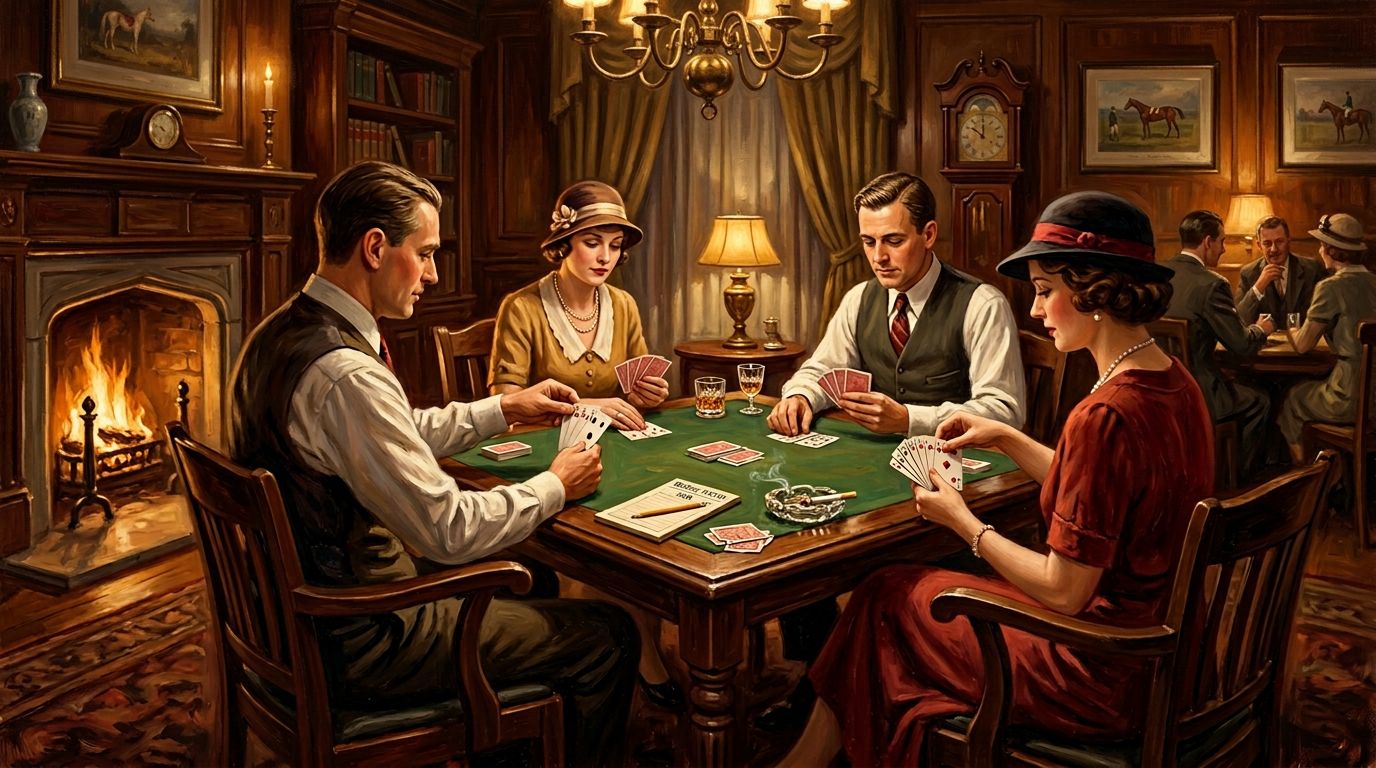
The Hand That Made Bridge History: Culbertson vs. Lenz
In December 1931, two men sat down to play 150 rubbers of contract bridge. The stakes weren’t just money (though there was plenty of that). They were playing for the soul of the game.
Ely Culbertson, a flamboyant showman and bridge theorist, had published a system he claimed anyone could learn. Sidney Lenz, a wealthy businessman and bridge expert, thought Culbertson was a fraud. The match would settle it.
For six weeks, they played at the Chatham Hotel in New York. Newspapers covered every session. Radio announcers gave updates. Millions of people followed along. Bridge had never seen anything like it.
And then came Board 76. The hand that ended the match.
The Setup
By early January 1932, Culbertson was crushing Lenz. The score was lopsided. Lenz’s partner, Oswald Jacoby (one of the best players in America), had quit after three weeks. Lenz brought in Commander Winfield Liggett Jr. to replace him.
It didn’t help. Culbertson and his wife Josephine kept winning. The match was essentially over. But nobody had quit yet.
Then this hand appeared:
        North (Josephine Culbertson)
        ♠ 10 8 6
        ♥ J 6
        ♦ A K Q 7 4
        ♣ Q 10 3

West (Lenz)              East (Liggett)
♠ A K 5                 ♠ Q 9 4 3
♥ 10 8 3                ♥ 7 4
♦ J 10 8 3              ♦ 9 6 2
♣ K 7 2                 ♣ J 9 6 5

        South (Ely Culbertson)
        ♠ J 7 2
        ♥ A K Q 9 5 2
        ♦ 5
        ♣ A 8 4
Dealer: North
Vulnerability: Both vulnerable
The Bidding
This wasn’t a simple auction. This was 1931, and bidding theory was still developing. Here’s how it went:
North (Josephine): Pass
East (Liggett): Pass
South (Ely): 1♥
West (Lenz): Double
Lenz’s double was aggressive. He had only 10 high-card points and three small hearts. In 2025, you’d never double this hand. But this was 1931. Takeout doubles were less defined.
North (Josephine): Redouble
Josephine’s redouble showed strength. With 13 points and a good diamond suit, she told Ely she had a fit or values.
East (Liggett): Pass
South (Ely): 2♥
West (Lenz): Pass
North (Josephine): 4♥
All Pass
Josephine jumped to game. She had diamond tricks, a doubleton heart, and the ♣Q. That was enough.
The final contract: 4♥ by South, doubled and redoubled. Doubled because Lenz doubled 1♥. Redoubled because Josephine redoubled.
In 1931 scoring, a doubled and redoubled game was worth 480 points just for tricks. Add the game bonus and the overtrick potential, and this board was worth 1000+ points. Rubber bridge scoring made every trick massive.
The Lead
Lenz led the ♠K.
Standard lead. Top of a sequence. Nothing fancy.
But it sealed his fate.
The Play
Lenz cashed the ♠K and ♠A. Ely ruffed the third spade in dummy with the ♥J.
Now Ely led a diamond to his hand, ruffing with the ♥2 (wait, he couldn’t ruff in his own hand… let me correct this).
Actually, Ely led the ♥J from dummy. Liggett played low. Ely played low. Lenz won the ♥10.
Lenz was stuck. If he led a diamond, Ely would win in dummy and draw trumps. If he led a club, Ely would win the ♣A and draw trumps. If he led a spade, Ely would ruff in dummy and draw trumps.
Lenz led a diamond. Ely won the ♦A in dummy, drew the remaining trumps, and claimed.
Result: 4♥ doubled and redoubled, making four. Culbertson scored 1240 points.
What Went Wrong
Lenz’s double was terrible. With three small hearts and only 10 HCP, he had no business doubling. But he was desperate. He was losing badly. He needed a big swing.
He got one. Just in the wrong direction.
Josephine’s redouble was bold. She trusted Ely to make the contract, and she was right.
Ely’s play was straightforward. With six solid hearts and diamond tricks in dummy, he couldn’t lose. The only danger was if trumps broke 4-0, and they didn’t.
Lenz’s defense didn’t matter. Once the hand was doubled and redoubled, the contract was making. The only question was by how much.
Why It Ended the Match
After this hand, Lenz stood up and forfeited. He didn’t finish the 150 rubbers. He didn’t try to come back. He quit.
The newspapers reported that Lenz “couldn’t take the pressure.” That’s partly true. But the real reason was simpler: the match was over.
Culbertson had proved his point. His system worked. His methods were sound. And he had crushed one of America’s best players on the biggest stage bridge had ever seen.
Lenz could have played out the remaining rubbers. But why? He was down over 15,000 points (roughly $150,000 in today’s money). Continuing would just add to the embarrassment.
So he quit. And Culbertson won.
What It Meant for Bridge
This match made contract bridge mainstream.
Before Culbertson-Lenz, bridge was a game for wealthy socialites and card experts. Most people played auction bridge or whist. Contract bridge, invented in 1925, was still new and complicated.
Culbertson promised that anyone could learn his system. Lenz, representing the old guard, said that was nonsense. Bridge was for smart people, not the masses.
The match settled it. Culbertson’s system worked. Average players could learn it, use it, and win with it. Bridge wasn’t just for experts anymore.
After the match, bridge exploded. Culbertson’s books sold millions of copies. Bridge clubs opened across America. Newspapers added bridge columns. By 1940, bridge was the most popular card game in the world.
All because of this match. And this hand.
The Historical Quirk
Here’s the funny part: Hand 76 wasn’t the best-played hand in the match. It wasn’t the most instructive. It wasn’t even close.
Other hands showed brilliant defense, creative bidding, or amazing card play. This hand was just a straightforward 4♥ contract that Lenz doubled for no good reason.
But it’s the famous one. Because it broke Lenz. Because it ended the match. Because it was doubled and redoubled and worth over 1000 points.
Bridge history isn’t always about the best hands. Sometimes it’s about the dramatic ones.
Modern Analysis
If this hand appeared today, here’s what would happen:
Lenz wouldn’t double. With 10 HCP and three small hearts, no modern player would double 1♥. You’d pass and defend quietly.
The auction would be simpler. Ely opens 1♥, Josephine bids 2♦, Ely rebids 2♥, Josephine raises to 4♥. Normal game auction.
The play would be the same. Ely draws trumps, pitches losers on diamonds, makes 4♥.
The result would be boring. 4♥ making four is worth 620 at IMPs, maybe a small swing at matchpoints. Nobody would remember it.
But in 1931, with the match on the line and both sides vulnerable, this hand was worth 1240 points. It was a knockout blow. And it made history.
Lessons for Today
What can modern players learn from this hand?
Don’t double out of desperation. Lenz doubled because he was losing and needed a miracle. That’s not bridge. That’s panic. If your hand doesn’t qualify for a double, don’t double.
Trust your partner. Josephine redoubled because she trusted Ely to make the contract. That confidence matters. If you can’t trust your partner to make a contract you redouble, why are you playing with them?
Simple hands win matches. This wasn’t a squeeze or a coup. It was a basic game contract. But it decided the most important match in bridge history.
Pressure matters. Lenz was a great player. He didn’t suddenly forget how to bid. But under pressure, with the whole world watching, he made a terrible call. Mental toughness matters.
History remembers drama. This hand is famous not because of brilliant play, but because of the stakes. Sometimes that’s enough.
The Aftermath
After the match, Culbertson became the face of bridge. His books, his magazine (The Bridge World), his system, all became the standard. He appeared on magazine covers, radio shows, and newsreels. He was a celebrity.
Lenz faded into the background. He kept playing bridge (he was still a strong player), but he never recovered his reputation. The match defined him, and not in a good way.
Josephine Culbertson, Ely’s partner and wife, became the most famous female bridge player in the world. She wrote books, taught classes, and proved that women could play bridge at the highest level.
And Hand 76? It got written up in every bridge book published in the 1930s. Players analyzed it, debated it, and learned from it. Not because it was complex, but because it mattered.
The Bottom Line
This hand didn’t require genius to play. It didn’t involve exotic squeezes or brilliant defense. It was a straightforward game contract that went doubled and redoubled because one player panicked.
But it changed bridge forever.
It proved that contract bridge was the future. It made Culbertson a household name. It brought millions of new players to the game. And it gave us a story that’s still told 90+ years later.
That’s why it’s famous. Not because of the cards, but because of what it represented.
Every bridge player should know this hand. Not because you’ll ever face this exact situation, but because it reminds you that bridge is more than cards. It’s history, drama, psychology, and pressure.
Ely Culbertson understood that. He built a career on it. And on one December night in 1931, he doubled down (literally) and won.
Key Takeaways
Never double out of desperation. Bad doubles lose matches.
Confidence matters. Josephine’s redouble showed trust. It paid off.
Straightforward play wins. Ely didn’t try anything fancy. He drew trumps and claimed.
Pressure reveals weaknesses. Lenz was a great player. The pressure got to him anyway.
Drama makes history. This hand is famous because of the stakes, not the play.
The Culbertson-Lenz match made bridge what it is today. And Hand 76 is why we remember it.
Every serious player should know this deal. Now you do.