History of the ACBL: From Regional Clubs to 160,000+ Members
The American Contract Bridge League is bridge’s largest governing body, representing over 160,000 members across North America. But it started with a mess, competing organizations, fragmented leadership, and bridge players who couldn’t agree on much beyond the fact that they all loved the game. How that chaos became the ACBL is a story of egos, compromise, and the realization that maybe organizing beats fighting.
Before the ACBL: Bridge Chaos (1920s-1930s)
In the 1920s and early 1930s, American bridge was a battlefield. Not metaphorically, actually contentious, with competing organizations, rival bidding systems, and personality conflicts that made modern social media feuds look civilized.
The Whist Club of New York considered itself the authority on bridge. The United States Bridge Association claimed national jurisdiction. The American Bridge League represented a different faction. Regional organizations operated independently. Everyone had their own rules, their own championships, their own vision of what bridge should be.
And then there was Ely Culbertson.
Culbertson was bridge’s first celebrity, brilliant, egotistical, and convinced that he alone understood how to organize and market the game. He published books, promoted his bidding system, and feuded publicly with anyone who disagreed with him. His 1931-1932 match against Sidney Lenz made front-page news and proved that bridge could be big business.
But Culbertson’s dominance came with a price: resentment. Other top players, other organizations, and other regions wanted a voice. By the mid-1930s, the fragmentation was hurting bridge. Tournaments used incompatible rules. Championships had questionable legitimacy. The game was growing, but organizational chaos was holding it back.
Formation of the ACBL (1937)
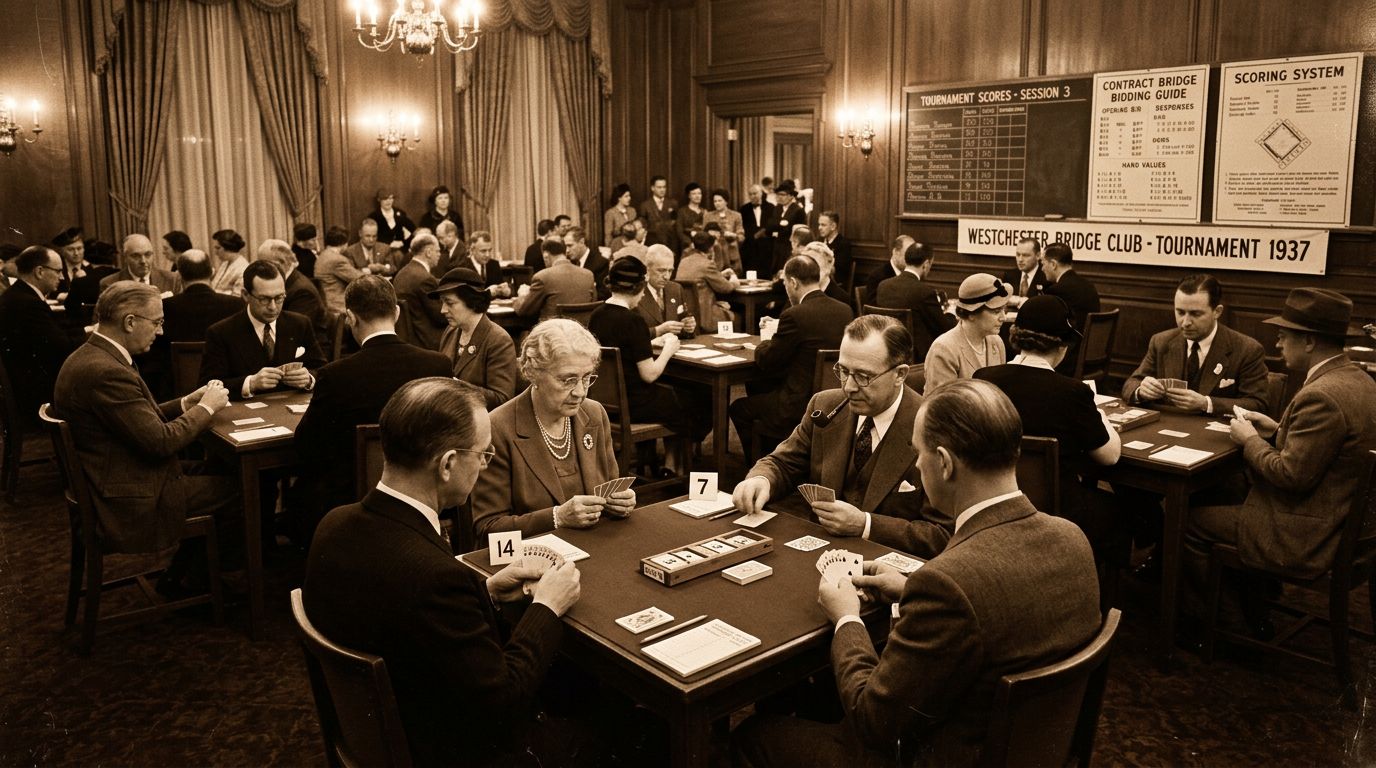
In 1937, a group of bridge leaders decided enough was enough. Representatives from the American Bridge League, the United States Bridge Association, and the American Whist League met to discuss unification. The negotiations were contentious, everyone wanted control, nobody wanted to compromise.
The breakthrough came from an unlikely source: the realization that fighting was costing everyone money and prestige. Regional tournaments were undercutting each other. Conflicting rules confused players. National championships lacked credibility because competing organizations claimed authority.
On May 29, 1937, the American Contract Bridge League was officially formed by merging the major competing organizations. The name was deliberate: “Contract Bridge” to distinguish from auction bridge, “American” to stake national authority, “League” to suggest cooperation rather than dictatorship.
The founding principles were straightforward:
- Unified rules for tournament play
- Standardized masterpoint system to track player achievement
- Regular national championships with legitimate authority
- Support for regional and local clubs
- Governance by elected representatives
Easy to state, hard to implement.
Early Years and Growing Pains (1937-1950s)
The ACBL’s first challenge was establishing legitimacy. Why should independent clubs join? What did the ACBL offer beyond bureaucracy and rules?
The answer was masterpoints. The ACBL created a unified system for awarding points based on tournament performance. Accumulate enough masterpoints, and you achieved ranks: Junior Master, Master, National Master, Life Master. The system was arbitrary, why these point thresholds? why these names?, but it worked because humans love achievement systems and recognized ranks.
By the late 1930s, clubs were joining because their players wanted masterpoints. Tournaments applied for ACBL sanctions because players attended sanctioned events. The system became self-reinforcing: join the ACBL to get access to the players who’d joined the ACBL to get access to tournaments that required ACBL membership.
World War II interrupted everything. Tournaments were suspended. Players joined the military. Bridge clubs closed as members deployed overseas. The ACBL survived by going dormant, maintaining minimal operations until peace returned.
The post-war boom changed everything. Returning veterans had learned bridge during deployment and wanted to keep playing. The game exploded across America, suburban clubs, college campuses, military bases. The ACBL went from struggling for legitimacy to struggling with overwhelming growth.
By 1950, the ACBL had tens of thousands of members. By 1960, over 100,000. The organization that had been formed to prevent chaos now faced the challenge of managing success.
The Masterpoint System: Genius or Madness?
The ACBL’s masterpoint system deserves its own section because it’s simultaneously the organization’s greatest achievement and most controversial feature.
The concept is simple: award points based on tournament performance. Win a club game, get fractional masterpoints. Win a regional championship, get significant points. Win a national championship, get gold points, red points, and platinum points with special significance.
Accumulate points to achieve ranks:
- 5 points: Junior Master
- 20 points: Club Master
- 50 points: Sectional Master
- 100 points: Regional Master
- 300 points: NABC Master
- 500 points: Life Master (the big one)
- And many more ranks beyond…
Why does this work? Because humans are psychologically wired to respond to achievement systems. Players chase masterpoints like video gamers chase achievements, even when the points themselves have no monetary value. A Life Master designation doesn’t pay the bills, but thousands of players have spent years pursuing it.
Critics argue the system has problems:
- Masterpoints can be accumulated through quantity (playing often) rather than quality (playing well)
- The thresholds are arbitrary and have been adjusted multiple times
- Inflation has devalued achievements, there are now over 12,000 Life Masters, compared to a handful in the 1950s
- Different types of points (black, silver, red, gold, platinum) create complexity that confuses new players
But the system survives because the alternatives are worse. Pure win-loss records don’t account for strength of field. Elo ratings work for individual games but struggle with team events and partnerships. The masterpoint system, for all its flaws, provides a framework that most players accept.
Governance and Politics (1950s-1990s)
The ACBL is governed by an elected Board of Directors, with representatives from 25 geographic districts across North America. This structure ensures regional representation but also ensures endless political maneuvering.
Districts compete for national championship hosting rights, which bring tourism dollars and prestige. Coastal districts sometimes clash with interior districts over scheduling. Regions with growing membership want more representation. Everyone has an agenda.
The Board of Governors (later renamed to Board of Directors) makes policy decisions about:
- Tournament scheduling and location
- Masterpoint formulas and requirements
- Ethical standards and disciplinary procedures
- Technology adoption and online play
- Dues structures and financial management
Getting 25 directors to agree on anything is challenging. Getting them to agree on controversial topics, like whether online bridge should award the same masterpoints as face-to-face play, is nearly impossible. Decisions often require years of debate, committee studies, and political compromise.
The ACBL’s staff, based in Memphis (later Horn Lake, Mississippi), handles day-to-day operations. They organize tournaments, maintain membership records, publish the monthly Bridge Bulletin magazine, and deal with the reality that 160,000+ members have 160,000+ opinions about how things should run.
National Championships (NABCs)
The ACBL’s flagship events are the three annual North American Bridge Championships: Spring, Summer, and Fall NABCs. Each NABC is a week-long festival featuring dozens of events:
Major championships:
- Vanderbilt Cup (Knockout Teams)
- Spingold Trophy (Knockout Teams)
- Reisinger Trophy (Board-a-Match Teams)
- Grand National Teams
- And many others
Side events:
- Pairs games
- Swiss teams
- Bracketed knockouts
- Charity events
- Junior and senior championships
A typical NABC attracts thousands of players competing across multiple hotel ballrooms and convention centers. The logistics are staggering, scheduling, directing, scoring, hospitality, and managing the inevitable disasters that come with running events for thousands of competitors.
NABCs also serve social functions. Players reunite with friends, partnerships form and dissolve, bridge politics happen over dinner and drinks. The tournaments are as much about community as competition.
Scandals and Controversies
The ACBL’s history includes its share of controversies:
Cheating scandals - The 2015 revelations about top American pairs using illegal signals devastated the ACBL. Players who’d won national championships, represented North America internationally, and served as bridge ambassadors were suspended. The ACBL’s response was criticized as both too harsh (by defenders) and too lenient (by critics).
Online bridge integration - When COVID-19 forced bridge online in 2020, the ACBL struggled to adapt. Online tournaments awarded masterpoints, but at what rate? Could online play substitute for face-to-face? How do you prevent cheating when players are alone at computers? The ACBL’s responses satisfied nobody completely.
Governance reform - Periodic calls to restructure the Board, reduce its size, or change election methods. The ACBL has made incremental reforms but resisted fundamental restructuring.
Financial management - Questions about how membership dues are spent, whether staff compensation is appropriate, and whether investments are prudent. The ACBL publishes financial statements, but transparency debates continue.
Inclusivity and culture - Efforts to make bridge more welcoming to women, younger players, and diverse communities. Progress has been real but slow.
Technology and Modernization (2000s-Present)
The ACBL entered the 21st century with technology from the previous one. Membership tracking was still partially paper-based. Tournament results were posted on physical bulletin boards. The Bridge Bulletin arrived by mail weeks after being written.
Modernization came in waves:
Online membership management - Members could finally update information, register for tournaments, and track masterpoints through a website
BBO integration - Partnership with Bridge Base Online brought ACBL events to the largest online bridge platform
Electronic scoring - Tablets and software replaced paper scorecards, speeding results and reducing errors
Live streaming - Major championships could be watched online with expert commentary
Mobile apps - Players could access their masterpoint records, find nearby games, and manage ACBL services from phones
Online tournaments - COVID-19 forced rapid expansion of online play, and the ACBL had to quickly scale up infrastructure
The modernization hasn’t been smooth. Technology investments are expensive, implementation has had glitches, and older members sometimes resist changes to familiar systems. But the alternative, remaining stuck in 1990s technology, would have been catastrophic.
The Bridge Bulletin
The ACBL’s monthly magazine deserves special mention. Published since 1938, the Bridge Bulletin reaches all members with content ranging from hand analysis to tournament reports to human interest stories about the bridge community.
For decades, the Bridge Bulletin was how most members stayed connected to bridge beyond their local clubs. It announced tournament schedules, reported championship results, and provided the teaching articles that helped players improve.
The magazine has evolved with technology, it’s now available digitally, but continues publishing in print because many members prefer physical copies. That dual format is expensive, but the Bridge Bulletin remains central to ACBL member experience.
Demographic Challenges
The ACBL faces a significant demographic challenge: the membership is aging. The average ACBL member is over 70. Bridge clubs that thrived in the 1970s and ’80s have closed as members aged out. Recruiting younger players has proven difficult.
The reasons are debated:
- Bridge requires time and commitment that busy younger people struggle to provide
- Other entertainment options (video games, streaming, social media) compete for attention
- The social environment of bridge clubs can feel unwelcoming to newcomers
- Bridge has an “old person’s game” reputation that discourages young people
The ACBL has tried various approaches:
- School bridge programs
- College scholarships
- Youth championships with subsidized entry
- Marketing campaigns targeting younger demographics
- Online bridge to meet people where they are
Results have been mixed. Youth bridge exists and produces excellent young players, but converting young players into lifelong ACBL members who attend tournaments remains challenging.
COVID-19 and Forced Adaptation (2020-2021)
The pandemic forced the ACBL to change decades of practice virtually overnight. Face-to-face tournaments were impossible. Clubs closed. The Spring 2020 NABC was canceled, the first time in decades.
The ACBL partnered with Bridge Base Online to offer sanctioned online games. Virtual clubs replaced physical clubs. Online regional tournaments offered masterpoints comparable to face-to-face events. The Summer 2020 NABC happened entirely online.
The transition was rocky. Online cheating concerns intensified, how do you prevent people from using computer assistance when they’re alone? Server issues caused disruptions. Older members struggled with technology. Directors had to learn new skills.
But bridge continued. Players who couldn’t have traveled to tournaments could compete from home. Clubs that had struggled with declining attendance found new members online. The barriers to entry dropped, no need to dress up, travel, or navigate unfamiliar convention centers.
As in-person bridge resumed in 2021-2022, the ACBL maintained online options. Hybrid tournaments offered both face-to-face and online participation. Virtual clubs coexisted with reopened physical clubs. The future appears to be mixed, some players returning to face-to-face, others staying online, many doing both.
The ACBL Today
The current ACBL represents over 160,000 members in the United States, Canada, Mexico, and Bermuda. It’s organized into 25 districts, each with elected representatives and local governance.
Services provided:
- Three annual NABCs
- Hundreds of regional and sectional tournaments
- Club sanction and support
- Masterpoint tracking and ranking
- Monthly Bridge Bulletin magazine
- Teacher accreditation programs
- Online tournament platform
- Ethical oversight and discipline
- International representation coordination
Financial structure:
- Membership dues ($50-60 annually for most members)
- Tournament fees and surcharges
- Partnerships and sponsorships
- Investment income from reserves
Challenges ahead:
- Demographic aging and membership recruitment
- Balancing online and face-to-face bridge
- Technology modernization
- Maintaining financial stability
- Adapting governance to changing needs
- Growing the game versus serving existing members
Legacy and Impact
The ACBL transformed American bridge from fractured regional competitions into an organized, structured activity with clear standards and recognized achievements. The masterpoint system, for all its quirks, provides motivation and structure. The NABCs create community and showcase excellence.
Is the ACBL perfect? Absolutely not. It’s bureaucratic, politically complex, slow to change, and often frustrating. But it provides infrastructure that makes North American bridge possible. Without the ACBL, there would be no unified tournament structure, no recognized achievement system, no community connecting 160,000+ players.
That’s the ACBL’s real achievement: creating and maintaining a bridge community across a continent, through technological disruption, demographic shifts, and global pandemics. The organization has survived for 85+ years because, despite all its flaws, it delivers enough value that players keep renewing their memberships and showing up to tournaments.
And as long as people shuffle cards and bid games, the ACBL will probably keep organizing them, arguing about how to do it better, and somehow making it work.
The American Contract Bridge League maintains headquarters in Horn Lake, Mississippi. Membership information, tournament schedules, and complete organizational details are available at acbl.org.