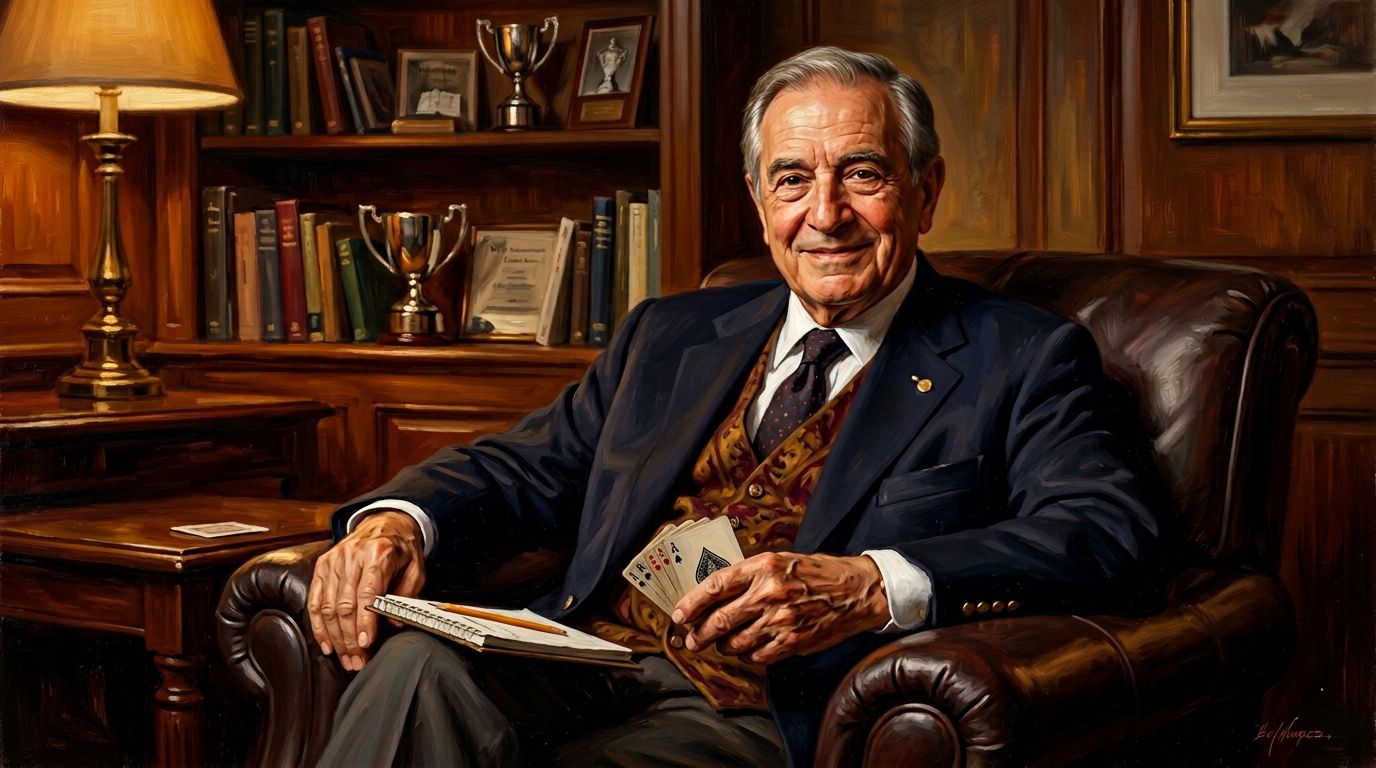
Benito Garozzo
SEO Title: Benito Garozzo - Blue Team Star, Inventor, Belladonna Partner | Bridge Encyclopedia
Meta Description: Benito Garozzo won 13 world titles with Italy’s Blue Team, partnered Giorgio Belladonna, and invented conventions still used today. Brilliant, theatrical, unforgettable.
Benito Garozzo played bridge like a man possessed. Theatrical gestures, intense focus, sudden bursts of brilliance. He won 13 world championships with Italy’s Blue Team. He partnered with Giorgio Belladonna in what many consider the greatest partnership in bridge history. He invented conventions and bidding treatments that players still use today. And if you watched him at the table, you’d think he was either crazy or genius. The answer was both.
The Salesman Who Sold Brilliance
Born in Naples in 1927, Garozzo came from trade, not aristocracy. He worked as a salesman, which shaped his personality. Outgoing, persuasive, dramatic. Those aren’t typical bridge player qualities, especially in 1950s Italy where the game was still associated with gentlemen’s clubs and quiet calculation.
When he started playing seriously in the Naples bridge scene, his style stood out immediately. Aggressive bidding, creative leads, defensive plays that seemed to come from nowhere. He won constantly at the club level. But club bridge and championship bridge are different games. Garozzo needed a partner who could match his creativity with technique and discipline.
He found that partner in Giorgio Belladonna. They joined forces in 1961 and proceeded to terrorize the bridge world for the next 15 years. Belladonna was the calm technician, Garozzo the inspired madman. The combination was devastating.
The Blue Team Years
The Italian Blue Team dominated international bridge from 1957 to 1975, winning 13 Bermuda Bowl titles. Garozzo joined the team in 1961 and became its public face. Where Belladonna was quiet and Forquet was intense but reserved, Garozzo was theatrical and quotable.
His bidding was complex and creative. The Blue Team systems (Roman Club, then Blue Team Club) were already sophisticated. Garozzo pushed them further, developing asking bids, control-showing sequences, and competitive methods that required complete partnership trust. With Belladonna, that trust existed. They could bid hands at the four-level on distributional values that would terrify normal partnerships.
The famous deals from the Blue Team era often featured Garozzo making inspired opening leads or defensive plays. He had a gift for reading declarer’s hand from the auction and playing partner for specific cards. Sometimes his reads looked psychic. They weren’t. They came from deep thought about bidding inference and card combinations.
But Garozzo also made errors that would cost lesser teams matches. An overly aggressive bid, a defensive play that didn’t work out, a lead that gave away the contract. The Blue Team could absorb these mistakes because the other three pairs were so strong. And when Garozzo’s brilliance clicked, he won boards that should have been impossible.
The Inventions
Garozzo wasn’t just a player. He was a theorist who developed bidding tools still used today. His most famous contribution is the super-accept after a Jacoby transfer. After 1NT - 2♦ (showing hearts), opener can jump to 3♥ with maximum values and strong heart support. This is now standard in many systems worldwide.
He also developed asking bids, advanced cuebidding structures, and competitive bidding methods used in Italian systems. The details are complex and require partnership study, but the concepts are elegant. Garozzo saw bidding as a language that could be refined to communicate precise information.
His theoretical work influenced modern bidding theory significantly. The idea that responder can force opener to describe their hand in detail through asking sequences comes from Garozzo’s work. So does the concept of control-showing bids that distinguish between first-round and second-round controls.
Not all his ideas survived. Some were too complex for general use, requiring more partnership discussion and memory than most players could manage. But the ones that did survive became part of standard expert practice. That’s a legacy beyond tournament wins.
The Belladonna Partnership
Garozzo and Belladonna were opposites in personality but perfectly matched at the table. Garozzo would make aggressive opening leads based on auction inference. Belladonna would follow up with perfect card reading and declarer technique. Or Garozzo would get them to a thin slam through creative bidding, and Belladonna would make it through precise play.
Their bidding partnership was famous for complex asking bid sequences. Garozzo would initiate with an asking bid, Belladonna would respond showing specific controls, and suddenly they’d be in 6♠ on 25 high-card points knowing they had all the necessary controls. Opponents watching the auction couldn’t follow it. That was partly the system’s complexity, partly deliberate obfuscation.
They fought occasionally. Garozzo was emotional, Belladonna was calm, and when Garozzo made an aggressive bid that didn’t work, tensions showed. But they stayed together because the results were undeniable. From 1961 to 1975, they won world championship after world championship. The partnership worked.
The Style
Watching Garozzo play was entertainment. He would lean forward intensely during critical moments. Wave his hands when explaining a play (usually in Italian, sometimes in broken English). Pull at his collar, adjust his cards, stare at the dummy. The theater was genuine, not an act. He felt the game deeply.
His defensive leads were often inspired. The queen from queen-jack-ten, setting up partner’s king for a later trick. The unexpected trump lead, cutting down a ruff. The fourth-best from a weak suit, establishing communication. These plays required reading the auction perfectly and trusting partner to have specific cards. When it worked, it looked brilliant. When it didn’t, it looked reckless.
As declarer, he was creative but sometimes loose. He’d try for overtricks when making the contract should be the priority. He’d take anti-percentage lines because he’d convinced himself the suit was breaking wrong. With Belladonna as partner providing solidity, Garozzo could afford some wildness. On other teams, his style might have been destructive.
The 1975 Scandal
The Blue Team era ended with cheating allegations at the 1975 Bermuda Bowl. Italian pairs were accused of illegal signaling. The specifics are still debated, but the accusations were serious enough that Italy withdrew from international competition.
Garozzo and Belladonna were not accused. Their partnership was clean. But the scandal tainted the entire Blue Team era. Players who had lost to Italy for years wondered if the dominance was legitimate. The question still surfaces in bridge historical discussions.
Garozzo’s response was characteristic: he defended the Blue Team’s record fiercely, pointed out that most accusations focused on other pairs, and continued playing. When Italy returned to international competition in the 1980s, he was still there, still winning, still playing with the same creative intensity.
The Later Years
After the Blue Team dissolved, Garozzo continued competing at the highest levels. He partnered with other Italian stars, played in American events, remained a force in European championships. His game adapted to new bidding methods, though he never abandoned the complex Italian style he’d helped develop.
He also became a teacher and author. His books on bidding and play were detailed, theoretical, and sometimes hard to follow. That was Garozzo’s style: if you wanted to learn from him, you had to work for it. No spoon-feeding. No simplification. Bridge was complex, and his teaching reflected that.
His partnership with Belladonna occasionally reunited for special events. The old magic was still there, though age had slowed both players. The bidding remained sophisticated, the partnership trust evident. They could still bid slams that confused opponents and make contracts that required perfect play.
The Personality
Garozzo was never boring. Emotional, dramatic, confident to the point of arrogance. He knew he was brilliant and didn’t hide it. This made him magnetic to some, insufferable to others. In the bridge world, you either loved Garozzo or found him too much.
His intensity at the table could intimidate opponents. The staring, the gestures, the visible concentration. Some players found it off-putting, maybe deliberately so. But Garozzo wasn’t playing psychology games. That was just how he processed the game: visibly, emotionally, intensely.
Away from the table, he could be charming and funny. The salesman’s personality came through. He told stories, explained hands with dramatic flair, and enjoyed the social aspects of bridge. But put cards in front of him and the intensity returned. Bridge was serious business.
Legacy
Garozzo’s legacy is dual: the wins and the inventions. Thirteen world championships put him in the conversation for greatest players ever. The bidding conventions he developed put him in the conversation for greatest theorists. Few players make both lists.
His partnership with Belladonna set a standard for what elite bridge partnerships should achieve. Technical excellence, creative bidding, defensive brilliance, championship performance under pressure. Modern partnerships study their methods and try to capture some of that magic.
The Blue Team’s dominance changed how countries approached international bridge. You couldn’t just assemble your best six players and hope for the best. You needed cohesive teams, developed systems, serious preparation. Garozzo was central to that approach. His theoretical work gave the team bidding tools, his playing skill made them work.
The Mad Genius
“Mad genius” is overused in sports, but Garozzo earned it. The creativity wasn’t random. It came from deep understanding of bidding inference, card combinations, and partnership coordination. But it looked mad because normal players don’t make those leaps.
His opening leads seemed psychic because he read auctions at a level most players don’t reach. His bidding seemed reckless because he trusted partnerships at a depth most players don’t achieve. His defensive plays seemed brilliant because he combined technique with table feel.
Take away the theater and you find real genius. Garozzo understood bridge at a level few players reach. He could see plays others missed, bid hands others couldn’t, defend positions others would butcher. The dramatic personality was just packaging. The substance was real.
Still Remembered
Garozzo passed away in 2024 at 96, still remembered as one of the Blue Team legends. His conventions are still played. His partnership with Belladonna is still studied. His world championship record still stands as one of the greatest in bridge history.
But more than the records, he’s remembered for how he played. With passion, creativity, and intensity that made bridge exciting to watch. In an era of increasingly mechanical bidding systems and solved defensive problems, Garozzo represented something different: bridge as art, not just science.
The salesman from Naples sold the world on Italian bridge dominance. Then he helped deliver it for 15 years. That’s not just a career. That’s a revolution with cards.