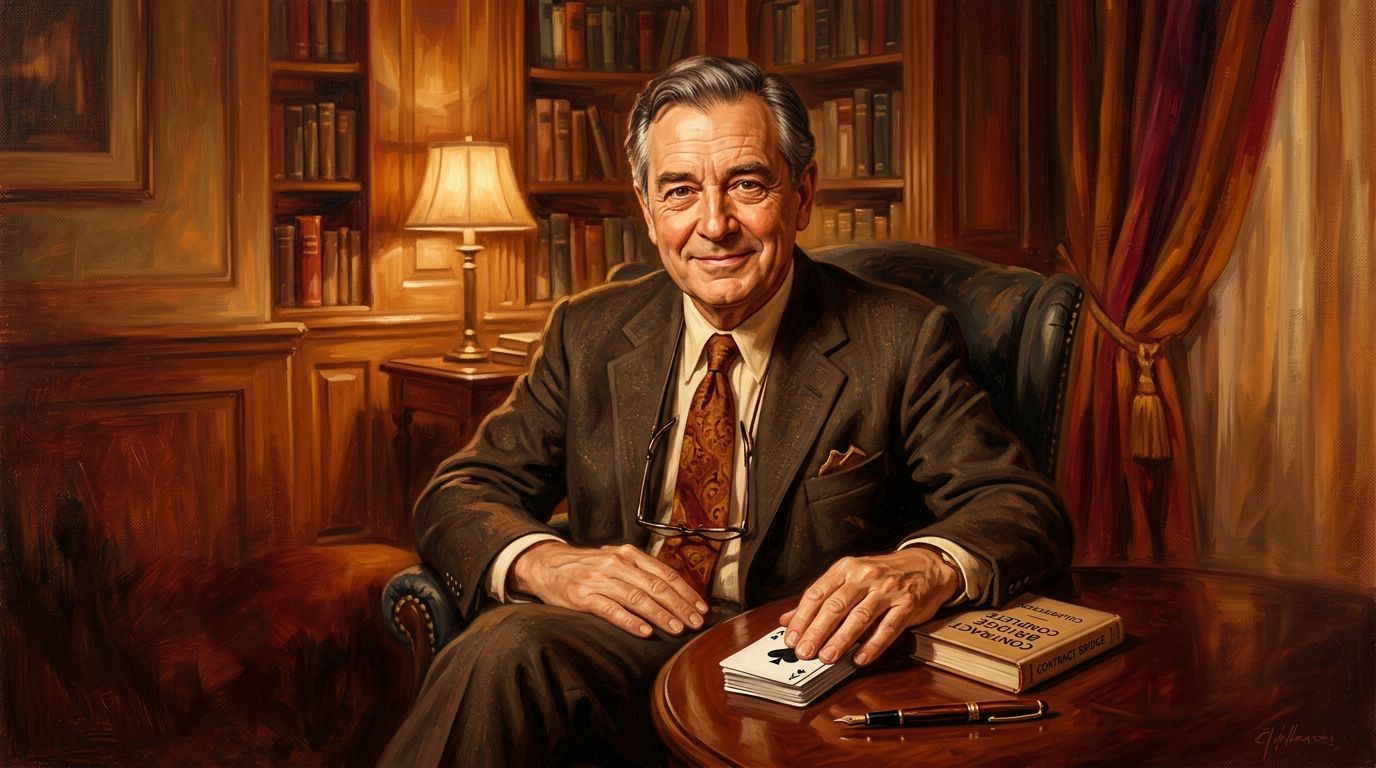
Ely Culbertson: Bridge's First Superstar
SEO Title: Ely Culbertson - Father of Contract Bridge and Marketing Genius | Bridge Encyclopedia
Meta Description: Ely Culbertson revolutionized contract bridge in the 1930s through brilliant marketing, the famous Culbertson-Lenz match, and bidding systems that shaped modern play.
If you play contract bridge today, you’re playing Ely Culbertson’s game. Not because he invented it (that was Harold Vanderbilt), but because he sold it to the world. Culbertson was part card player, part con artist, and all showman. He turned bridge from a parlor game into a national obsession, built a publishing empire, and did it with more flair than substance. But that’s what made him brilliant.
The Russian Prince Who Wasn’t
Born in Romania in 1891 to an American oil engineer and a Russian Cossack mother, Culbertson spun tales of noble lineage that were mostly fiction. He bounced around Europe, tried revolution in Mexico, and landed in New York broke. What he had was charm, languages, and nerve. What he found was Josephine Dillon, a sharp bridge teacher who became his wife and partner in both senses.
Together they spotted an opening. Contract bridge was new in 1926, and nobody owned it yet. Harold Vanderbilt had created the game, but he was old money and didn’t care about selling anything. The existing authorities taught auction bridge, not contract. Culbertson saw the vacuum and filled it.
Building the Empire
In 1929, Culbertson launched The Bridge World magazine. Not to teach bridge, not at first. To establish himself as the authority. He wrote with absolute confidence about bidding systems he was still inventing. He picked fights with other experts. He made pronouncements. And people started listening.
His system wasn’t revolutionary. Approach-forcing methods, honor tricks for hand evaluation, forcing bids to show strength. Other players used similar ideas. But Culbertson packaged it, named it, and marketed it relentlessly. He published books, ran bridge studios, licensed teachers. By 1931, when he wrote the Contract Bridge Blue Book, he had built a machine.
The Blue Book sold 100,000 copies in three months. Millions eventually. Not because it was the best bridge book, but because Culbertson convinced America it was the only bridge book. He had a gift for making complexity sound simple and simple ideas sound profound. “Four aces are worth two kings and a queen” sounds obvious until you realize most players in 1931 hadn’t thought about it systematically.
The Match That Changed Everything
Sidney Lenz was the established expert, author, gentleman player. In 1931, he challenged Culbertson to a match: 150 rubbers, highest stakes ever played for publicity alone. Culbertson accepted immediately. This was the fight he wanted.
The match ran December 1931 to January 1932 at the Chatham Hotel in New York. Radio coverage, newspaper reporters, gallery seating. Culbertson and Josephine against Lenz and three different partners (Lenz kept switching after losses). The bridge was often mediocre. Culbertson made errors. Josephine carried them through several sessions. But Ely understood what mattered: drama.
When Lenz made a questionable play, Culbertson pounced in the press. When Jo made a brilliant defensive play, Ely made sure every reporter got the details. When they were ahead, he gave interviews about his system’s superiority. When they were behind, he hinted at Lenz’s declining skills.
They won by 8,980 points over 150 rubbers. The victory was narrower than Culbertson claimed and wider than skill alone justified. Lenz’s partnerships had coordination issues. But none of that mattered. Culbertson won the publicity war absolutely. After the match, his system dominated American bridge for a decade.
The System and Its Limits
The Culbertson System worked for 1930s bridge. Forcing bids, asking bids, honor tricks counted in precise units. It gave structure to players who needed structure. But it was rigid. As players got better, they found the system’s limits.
The honor trick count was clumsy. Counting 1.5 honor tricks for AQ in a suit but only 1 for a King makes evaluation harder, not easier. The forcing pass and other conventional gadgets added complexity without proportional gain. By the late 1940s, Charles Goren’s point count system (4-3-2-1 for AKQJ) was obviously cleaner.
Culbertson fought the changes, but he had already moved on. World War II pulled him into politics. He wrote books about world federation and peace plans, none successful. Bridge was yesterday’s passion. He tried to return in the 1950s but couldn’t recapture the magic. Point count had won. Goren was “Mr. Bridge” now.
What He Got Right
Strip away the self-promotion and you find real contributions. Culbertson understood that bidding is a language. You need agreements, but you also need flexibility. His emphasis on partnership coordination shaped how serious players think. The idea of “system” itself, a coherent approach to bidding, comes largely from Culbertson’s work.
He also understood spectacle. The Lenz match proved bridge could be entertainment. The bridge broadcasts, exhibitions, and tournaments that followed all learned from Culbertson’s showmanship. He knew that growing the game meant making it exciting to watch, not just play.
And he could play. Not at the absolute top level, but well. His defensive card reading was sharp. He managed partnerships effectively, which is harder than it sounds when your partner is your wife and the stakes are your entire reputation.
The Dark Side
Culbertson was ruthless with rivals and casual with truth. He exaggerated his accomplishments, minimized others’ contributions, and burned through friendships. His marriage to Josephine collapsed badly. His later years were lonely, his peace crusades ignored, his bridge legacy overtaken by simpler systems.
But he changed the game. Before Culbertson, contract bridge was a new variant that might have faded. After Culbertson, it was America’s game. He built the infrastructure, published the teachers, created the market. Later experts stood on his shoulders even when they rejected his methods.
Related Articles
Legacy
When Culbertson died in 1955, point count had replaced honor tricks, Goren had replaced Culbertson as the public face of bridge, and the game had moved on. But everyone still played contract bridge, dealt with partnerships, thought about systems. That was Culbertson’s world.
He wasn’t the best player of his era. He wasn’t the best theorist. He was the best promoter, the best fighter, the best showman. He took a card game and built an empire. That empire crumbled, but the game survived. Sometimes the con man builds something real, even if he can’t admit how much was smoke and mirrors.
You can argue with the Culbertson System. You can’t argue with the fact that he made modern tournament bridge possible. Every time you sit down at a sectional, read a bidding article, or argue about system agreements, you’re in the world Ely Culbertson created.
The Russian prince who wasn’t royalty became bridge royalty anyway. That’s a better story than most of the ones he made up about himself.