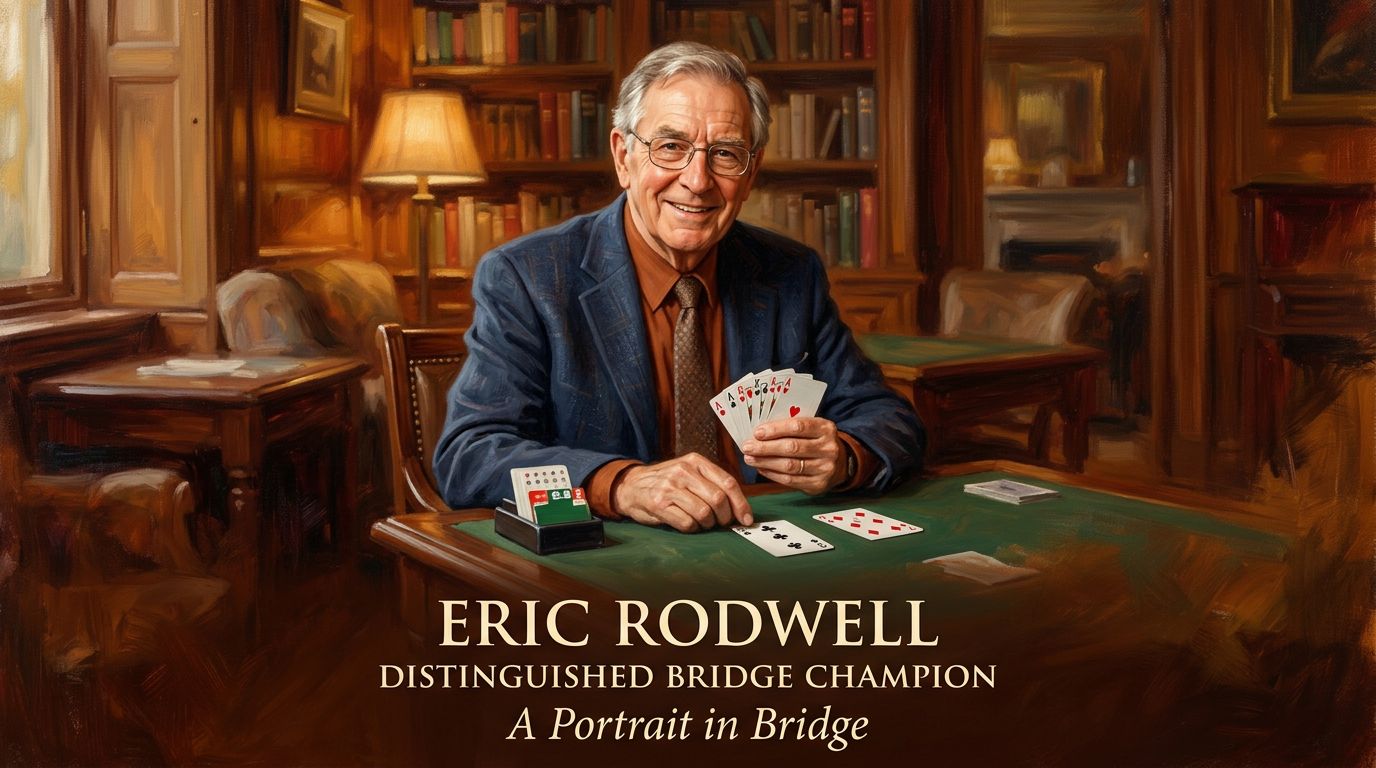
Eric Rodwell
SEO Title: Eric Rodwell - Bridge Theorist, World Champion, Meckstroth Partner | Bridge Encyclopedia
Meta Description: Eric Rodwell won 15+ world championships with Jeff Meckstroth, developed the Meckwell system, and revolutionized modern bidding theory. The mind behind the method.
Eric Rodwell is the architect. His partner Jeff Meckstroth gets the spotlight for brilliant plays and natural talent. But Rodwell is the one who built the system, developed the methods, analyzed the positions, and created the framework that makes Meckstroth’s brilliance possible. Together they’ve won more than 15 world championships and dominated American bridge for four decades. But strip away Rodwell’s theoretical work, and the partnership wouldn’t exist. He’s the mind behind the most successful American partnership in bridge history.
The Calculator
Rodwell was born in 1957 and grew up in California. He came to bridge as a teenager with a mathematical mind and obsessive attention to detail. Where other players learned bidding rules, Rodwell wanted to understand why those rules worked and whether better rules existed. Where others memorized defensive signals, Rodwell analyzed which signals conveyed maximum information with minimum ambiguity.
This analytical approach made him an excellent player quickly. By his late teens, he was competing in regional events and winning regularly. His bidding was precise, his defense was solid, his declarer play was technically correct. But he wasn’t satisfied with being good. He wanted to be perfect.
In 1977, at age 20, he met Jeff Meckstroth at a regional tournament in Ohio. Both were young, ambitious, and obsessed with bridge. They played a few sessions together and recognized something rare: compatible minds. Not identical minds - Meckstroth was intuitive where Rodwell was analytical - but compatible. They could finish each other’s bidding sequences and trust each other’s card play. The partnership formed that year has lasted 47 years.
Building Meckwell
The bidding system that became known as “Meckwell” didn’t spring fully formed. Rodwell built it piece by piece over decades. Start with a strong club structure (1♣ = 16+ points). Add relay sequences where one partner asks questions and the other describes their hand systematically. Incorporate asking bids for controls in slam auctions. Develop competitive bidding methods that show shape precisely.
Each piece required extensive development. Rodwell would propose a new method, they’d test it in practice, refine it through tournament experience, and either adopt or discard it. This iterative process happened constantly for 40+ years. Modern Meckwell is version 100.0 of a system that started at 1.0 in 1977.
What makes Meckwell effective isn’t complexity for its own sake. It’s information density. A sequence like 1♣ - 1♦; 1♥ - 1♠; 1NT - 2♣ conveys more precise information about shape and controls than natural bidding could communicate in twice as many bids. That precision allows them to bid slams with confidence or stop safely in games when slams are unlikely.
Rodwell’s role was primarily theoretical development. He analyzed which hand patterns occurred frequently enough to deserve special treatment. He calculated which relay structures maximized information transfer. He identified ambiguous sequences and resolved them through additional agreements. Meckstroth tested the methods at the table and provided feedback. Together they refined the system into a precision instrument.
The result is a bidding system so complex that few other partnerships can play it effectively. But in Meckstroth-Rodwell’s hands, it’s devastatingly efficient. They’ve used it to win 15 world championships and countless national events. The system works because they built it specifically for their partnership, not as a general tool for everyone.
The World Championships
Rodwell’s world championship record matches Meckstroth’s: 15+ titles across Bermuda Bowl, World Open Pairs, and World Team Olympiad events. His first world championship came in 1981 at age 24. His most recent came in the 2010s at age 60+. That’s nearly 40 years of world-class performance.
The world championship victories show consistency across eras and opponents. In 1981, they beat European teams playing standard methods. In the 2000s, they beat modern expert pairs playing sophisticated relay systems. In the 2010s, they beat younger players who grew up studying Meckwell methods. The partnership adapted and kept winning.
Rodwell’s contributions in these championships went beyond his personal performance. He prepared partnership agreements, analyzed opponents’ systems, and helped team strategy. His analytical mind identified patterns in opponents’ bidding and suggested exploitations. This behind-the-scenes work doesn’t show in individual statistics but contributes significantly to team success.
The famous deals from world championships often feature Meckwell bidding to unusual slams through relay sequences. Rodwell designed those sequences, tested them, refined them. When they worked in a world championship final to bid a making slam opponents missed, that’s Rodwell’s theoretical work producing practical results under pressure.
The Theorist
Beyond Meckwell, Rodwell contributed to bidding theory broadly. He wrote articles analyzing specific bidding problems, developed methods for competitive auctions, and influenced how expert players think about information exchange in bidding.
His approach to bidding theory is mathematical. Every bid should convey maximum information while maintaining system efficiency. Natural bids are useful when they describe relevant features (suit length, strength, shape). Artificial bids are useful when they ask questions or show controls. The optimal system balances natural and artificial methods to maximize information density.
This theoretical framework influenced modern expert bidding. The idea that bidding should be information-theoretically optimal (maximizing information transfer per bid) is now mainstream in expert circles. Rodwell didn’t invent this concept, but he systematized it and demonstrated its effectiveness through championship results.
He also contributed to defensive theory, though less visibly than bidding. His analysis of which signals convey maximum information in specific positions influenced partnership defensive methods. The general principle: every card you play should communicate something useful to partner while minimizing information leak to declarer. Obvious in theory, difficult in practice. Rodwell systematized it.
The Partnership Dynamic
The Meckstroth-Rodwell partnership works because they have complementary strengths. Rodwell develops methods and analyzes positions. Meckstroth executes at the table and provides intuitive feedback. Rodwell is the architect, Meckstroth is the contractor who makes the plans real.
This division isn’t absolute. Rodwell is an excellent player who executes brilliantly. Meckstroth contributes to theoretical development through practical insights. But the general pattern holds. Rodwell thinks deeply about bridge theory. Meckstroth plays at a level where theory becomes automatic.
Their partnership stability across 47 years is remarkable. Most partnerships dissolve after a few years due to personality conflicts, diverging methods, or simple boredom. Meckstroth-Rodwell kept finding new challenges, developing new methods, and maintaining the competitive fire. They still argue about hands, still disagree about specific treatments, still push each other to improve. That friction generates progress rather than conflict.
The partnership also shows unusual consistency. They rarely have disaster sessions where everything goes wrong. Their system is so well-developed, and their execution so reliable, that they play solid bridge even when not at their best. This baseline reliability combined with occasional brilliance is a powerful combination in team events.
The Professional
Like Meckstroth, Rodwell makes his living from bridge. Professional playing, teaching, coaching, and writing. This requires balancing championship play with commercial work. Rodwell manages it by maintaining clear boundaries. Championship events get full focus and preparation. Professional clients get professional service but simplified methods.
His teaching focuses on bidding theory and system development. Students who work with Rodwell aren’t learning Meckwell (too complex for most partnerships). They’re learning how to think about bidding systematically. How to identify partnership needs, develop methods to address them, test those methods, and refine them. That framework is more valuable than specific treatments.
He’s also coached teams preparing for major events. This coaching includes system development, opponent analysis, and tactical preparation. Rodwell’s analytical mind identifies patterns in opponents’ methods and suggests countermeasures. This preparation work doesn’t appear in masterpoint records but contributes significantly to team success.
The Writing
Rodwell co-authored several books with Meckstroth explaining their methods. These books are technical, dense, and require serious study. They’re not meant for casual players. They’re resources for expert partnerships who want to understand modern relay theory and potentially incorporate elements into their own systems.
The most influential book is probably “Meckwell Lite,” which presents simplified versions of their methods for partnerships who want relay structures without full complexity. Even “lite” versions require significant partnership discussion and practice, but they’re more accessible than full Meckwell. The book influenced multiple expert partnerships who adopted elements of their methods.
Rodwell’s writing style is clear and systematic. He explains the logic behind methods, not just the mechanical rules. This helps readers understand why a treatment works, which enables adaptation to their own partnerships. Recipes are useful, but understanding the underlying principles is more valuable.
He also wrote articles for bridge magazines analyzing specific theoretical problems. These articles reached a broader audience than his books and influenced expert thought on bidding theory. Even players who don’t play Meckwell absorbed ideas from Rodwell’s theoretical work.
The Longevity
Rodwell’s career spans five decades of world-class play. He was winning national championships in his 20s. He’s still winning them in his late 60s. That consistency requires continuous adaptation and maintenance of skills.
Bridge has changed dramatically during his career. Bidding systems are more sophisticated now (partly due to his influence). The field of expert players is deeper. Competition is fiercer. Rodwell adapted by continuously refining Meckwell, incorporating new ideas, and discarding outdated methods. The system he plays today differs significantly from the version he played in 1980s, though the core philosophy remains.
His mental sharpness has held up remarkably. Relay bidding requires remembering complex sequences under pressure. At age 67, his memory and processing speed remain strong enough to execute Meckwell at world championship level. That’s partly genetic luck, partly maintenance through continuous study and practice.
The Personality
Rodwell at the table is focused, calm, and analytical. He thinks through positions carefully, considers alternatives, and chooses the percentage play. This deliberate approach occasionally draws slow play complaints, but it’s essential to his game. He doesn’t rush decisions.
Away from the table, he’s friendly and accessible. He enjoys discussing bridge theory, explaining methods, and debating bidding problems. This openness helped spread Meckwell ideas through the expert community. Other theorists might guard their methods as proprietary secrets. Rodwell published them.
He’s also competitive without being confrontational. He wants to win, but he respects opponents and accepts losses professionally. This demeanor makes him well-regarded throughout the bridge world. Even players he’s beaten repeatedly in major events speak positively about him.
The Influence
Rodwell’s influence on modern bridge extends beyond his personal record. The Meckwell system demonstrated that relay methods could work at the highest level. This encouraged other partnerships to experiment with artificial structures and precision bidding. Modern expert bridge is more sophisticated partly because Rodwell showed what’s possible.
His theoretical work on information-optimal bidding influenced how experts think about system design. The questions he asked - Which hand patterns occur frequently? How can we exchange maximum information efficiently? What’s the optimal balance between natural and artificial methods? - are now standard in expert system development.
He also influenced partnership philosophy. The Meckstroth-Rodwell model of long-term partnership development through continuous refinement became something expert pairs aspired to achieve. Not just play together for a while, but build something systematic over decades. That’s Rodwell’s approach, and it changed partnership culture in expert bridge.
The Records
Rodwell’s tournament record mirrors Meckstroth’s: 15+ world championships, countless national titles, one of the highest masterpoint totals in ACBL history. These numbers tell part of the story. The other part is consistency across decades. He didn’t just have a great run and fade. He’s been winning constantly for 47 years.
His masterpoint total reflects sustained excellence across formats. Regional events, national championships, international competition. Team events, pair events, different forms of scoring. Rodwell wins consistently across all of them. That versatility shows depth of skill beyond specialized expertise.
The Architect’s Legacy
Eric Rodwell built something that will last beyond his playing career. The Meckwell system influenced modern bidding theory permanently. The partnership with Meckstroth set a standard for longevity and success that other partnerships measure themselves against. The theoretical work on information-optimal bidding changed how experts think about system design.
But maybe his most important contribution is showing that bridge rewards systematic thinking. Not just intuition or natural talent, though those help. Systematic analysis, careful development, rigorous testing, continuous refinement. That’s the Rodwell approach, and it produced 15 world championships and a revolution in bidding theory.
When you watch Meckstroth make a brilliant play, remember that Rodwell designed the bidding sequence that gave him the information needed to make that play. The magic at the table starts with architecture in the practice room. That’s what Eric Rodwell does. He builds frameworks for brilliance.
Still Building
At age 67, Rodwell is still playing world-class bridge and still refining Meckwell. New methods get proposed, tested, adopted or discarded. The system evolves continuously. His mind remains sharp, his passion for theoretical work unchanged, his partnership with Meckstroth as strong as ever.
The question isn’t when he’ll stop. He shows no signs of it. The question is how much further he can push bidding theory and how many more championships the partnership can win. Given their track record, betting against them is unwise. The architect is still building, and the structure keeps improving.
Fifteen world championships. Forty-seven year partnership. A bidding system that changed expert bridge. That’s not just a career. That’s a permanent contribution to the game. Eric Rodwell didn’t just play bridge at the highest level. He rebuilt how the highest level thinks about playing bridge.