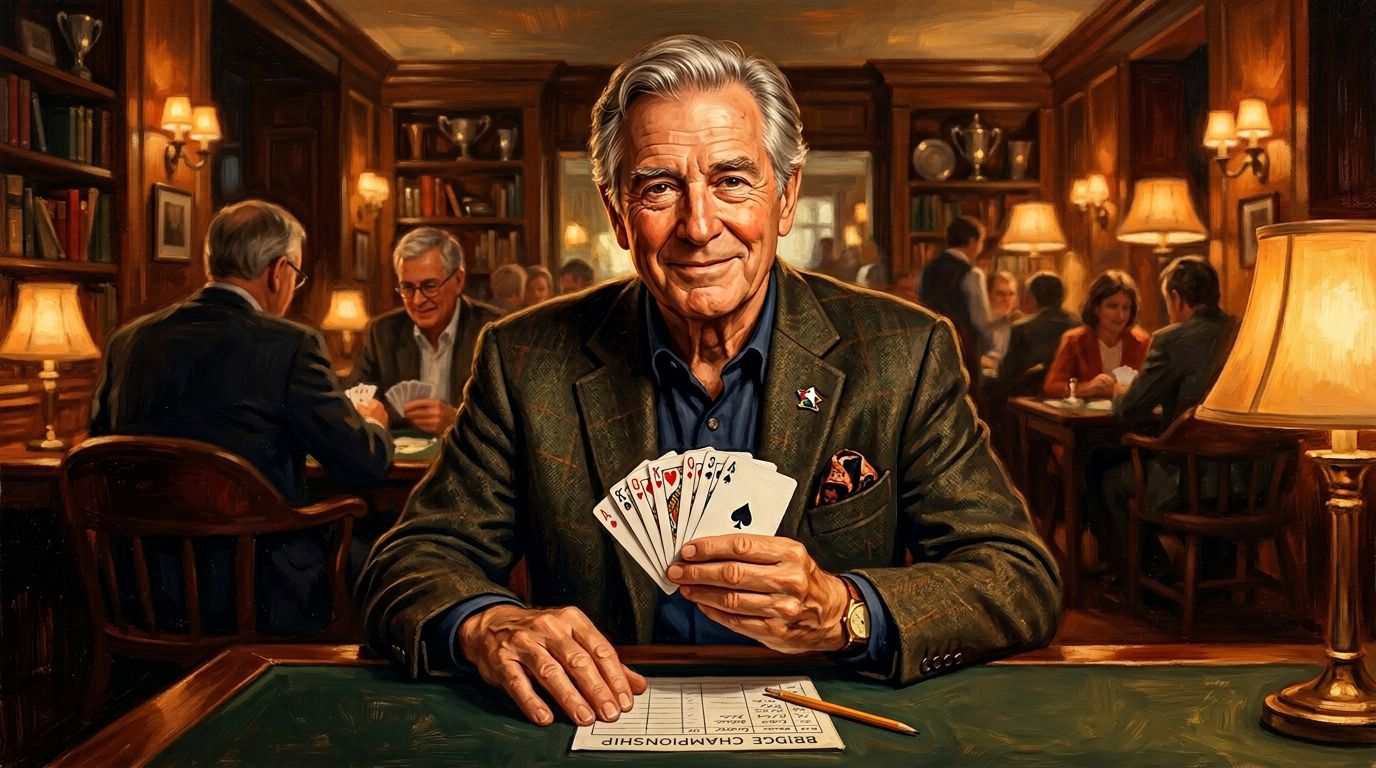
Giorgio Belladonna
SEO Title: Giorgio Belladonna - Italian Blue Team Legend, 16 World Titles | Bridge Encyclopedia
Meta Description: Giorgio Belladonna won 16 world championships with Italy’s Blue Team, partnering Garozzo in the greatest partnership in bridge history. Quiet genius, devastating card play.
Giorgio Belladonna won more world championships than any player in bridge history. Sixteen titles from 1957 to 1975, most of them with Italy’s legendary Blue Team. He partnered with Benito Garozzo for what many consider the greatest partnership ever. And if you weren’t watching closely, you might have missed how good he was. Belladonna didn’t have Garozzo’s charisma or Forquet’s intensity. He just played near-perfect bridge for two decades.
The Accountant Who Counted Cards
Born in 1920s Rome, Belladonna came to bridge through the Italian club scene in the post-war years. He worked as an accountant, which tells you something about his mind. Precise, methodical, comfortable with numbers and patterns. Those skills translated directly to card play.
When Carl’Alberto Perroux assembled the Blue Team in 1956, Belladonna was already one of Italy’s best players. But the team needed more than individual talent. They needed partnerships that could execute complex systems under pressure, players who could think several tricks ahead, defenders who could read cards from tiny clues. Belladonna could do all of that.
The Blue Team’s early years paired Belladonna with Walter Avarelli. They won world championships in 1957, 1958, 1959. Three straight titles with the Roman Club system, a complex bidding structure that required exceptional partnership coordination. Belladonna and Avarelli had it. But the partnership that would define Belladonna’s career started in 1961 when he paired with Benito Garozzo.
The Garozzo Partnership
Garozzo was flashy where Belladonna was quiet, theatrical where Belladonna was controlled. On paper, they shouldn’t have worked. In practice, they were devastating. Garozzo would make inspired leads and brilliant defensive plays. Belladonna would reconstruct entire hands from the auction and card play, then execute complex squeezes and endplays. They complemented each other perfectly.
Their bidding was precise. The Roman Club and later Blue Team Club systems they played were among the most sophisticated ever used in world championship competition. Strong club, canapé tendencies, asking bids, complex competitive sequences. Most partnerships would have collapsed under that much structure. Belladonna and Garozzo made it look effortless.
The famous deals from their partnership often featured Belladonna as declarer. Garozzo got them to the right contract, often through bidding sequences that confused opponents. Belladonna would then navigate layouts that looked impossible. His technique was classical: count the hand, place the cards, execute the line that worked. If there was a squeeze, he found it. If there was an endplay, he executed it.
The Blue Team Dominance
From 1957 to 1975, the Blue Team won 13 Bermuda Bowl titles and 3 World Team Olympiads. Belladonna played in virtually all of them. This wasn’t a hot streak or lucky run. It was systematic superiority across two decades.
The team had advantages beyond individual skill. Carl’Alberto Perroux’s financial backing meant players could focus on bridge. Their training was professional. Their systems were carefully developed and refined. But systems don’t make plays. Players do. And Belladonna made plays consistently that other world-class players missed.
His defensive card reading was probably his greatest strength. Given the auction and the first few tricks, he could reconstruct declarer’s hand with scary accuracy. Watch the old records of Blue Team matches, and you’ll see Belladonna finding killing defensive plays that seem to come from nowhere. They came from counting, inference, and concentration.
The 1975 Scandal and After
The Blue Team era ended badly. The 1975 Bermuda Bowl in Bermuda saw cheating allegations against other Italian pairs. The specifics are still debated, but the accusations were serious enough that the Italian Bridge Federation withdrew from international competition for several years.
Belladonna and Garozzo were never directly accused. Their records were clean, their partnership above suspicion. But the scandal tainted the entire era. Players who had lost to Italy for years wondered if other pairs had also cheated. The Blue Team’s dominance became suspect, at least in some quarters.
Belladonna’s response was characteristic: he kept playing. When Italy returned to international competition in the 1980s, he was still there, still winning. His game barely declined. He partnered successfully with younger players, adapted to new systems, continued competing at the highest level into his 60s.
In 1987, at age 67, he played in another Bermuda Bowl. His team didn’t win, but Belladonna’s play was still sharp. That’s a 30-year span of world-class performance, which is absurd in any sport. Bridge rewards experience and judgment, but it also demands concentration and mental stamina. Belladonna had all of it.
The Playing Style
Belladonna at the table was calm, focused, and methodical. He didn’t rush. He thought through positions carefully, considered alternatives, chose the line with the best chance. That sounds obvious, but under championship pressure, many players short-circuit the process. They go with instinct or habit. Belladonna kept thinking.
His declarer play was technically perfect. He could execute double squeezes, strip squeezes, any endplay position you could construct. But technique wasn’t what separated him. Lots of experts know the plays. Belladonna recognized when to use them. He would bid a hand, get the opening lead, and know within a few tricks whether he needed to strip the hand, cash winners and hope, or finesse twice.
His partnership with Garozzo worked partly because Belladonna was willing to let Garozzo be the public face. Garozzo gave interviews, explained their system, wrote books. Belladonna played cards. When journalists asked him about a deal, his answers were short and precise. “I counted the hand. The squeeze was marked.” That was the explanation. If you didn’t understand, you probably weren’t going to.
The Numbers
Sixteen world championship titles. That record still stands and likely won’t be broken. Modern bridge has more competition, more countries fielding strong teams, shorter spans of dominance. The Blue Team’s two-decade run was a specific moment in bridge history when one team achieved systematic superiority.
But the raw number doesn’t capture Belladonna’s consistency. He wasn’t just on winning teams. He was one of the reasons they won. Check the critical matches, the close victories, the deals where Italy pulled ahead. Belladonna is there, making the play that gained the IMPs.
His teammates from the Blue Team era - Garozzo, Forquet, Avarelli - all acknowledged Belladonna as the partnership’s rock. Garozzo might make the spectacular play, but Belladonna made the correct play every time. Consistency beats brilliance over a long match.
Legacy
When Belladonna died in 1995, he left a record that defines championship bridge. Not flashy, not self-promoting, just devastatingly effective. He played the Blue Team systems perfectly, but he could have played any system perfectly. The system was just the tool. The skill was in reading the cards and making the right decision.
Modern players study Belladonna’s declarer play the way chess players study Fischer’s endgames. The technique is instructive, but more important is the approach: figure out what the hand requires, then execute it. Don’t get fancy. Don’t try to be clever. Find the right line and take it.
His partnership with Garozzo set a standard that has never been matched. Sixty years later, when experts discuss the greatest partnerships in bridge history, Belladonna-Garozzo is the first name mentioned. Not because they were perfect (they weren’t), but because they combined technical excellence with championship performance over an unmatched span.
The Quiet Champion
There’s a type of greatness that doesn’t announce itself. It doesn’t need highlight reels or dramatic moments. It shows up, does the work, and accumulates results. Belladonna was that type. He didn’t need to tell you he was the best defensive player in the world. He just defended perfectly and let the results speak.
In an era of colorful personalities and big egos, Belladonna was the accountant who counted to thirteen and made every squeeze work. That’s not a story that makes headlines. But it won sixteen world championships.
The next time someone tells you bridge is about flair and instinct and reading opponents’ souls, remember Giorgio Belladonna. He beat the world for twenty years with concentration, technique, and perfect execution. Sometimes quiet genius is the loudest statement you can make.