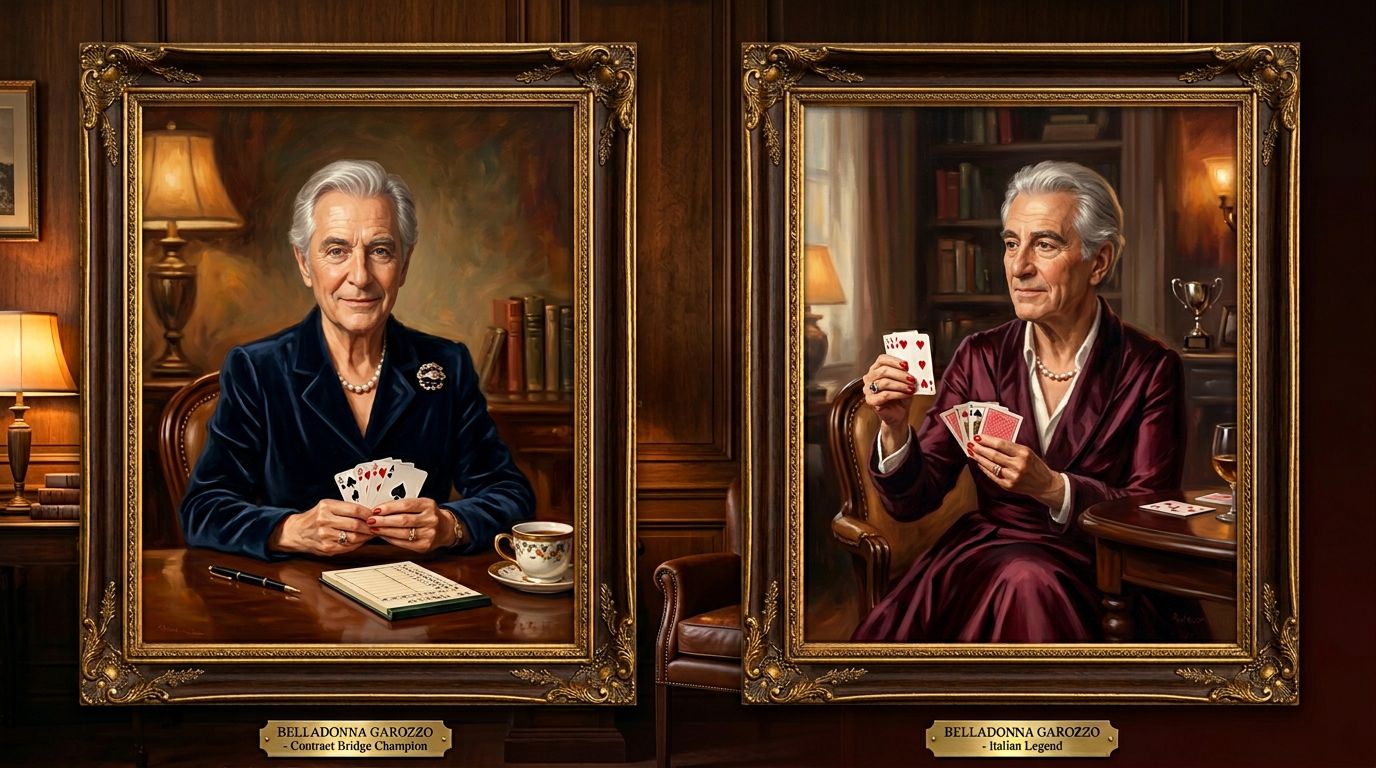
Belladonna Garozzo
SEO Title: Belladonna-Garozzo - Italy’s Blue Team Legends, Bridge’s Greatest Partnership
Meta Description: Giorgio Belladonna and Benito Garozzo formed the heart of Italy’s legendary Blue Team. 16 Bermuda Bowls together, revolutionary bidding systems, and a partnership that defined bridge excellence.
Keywords: Giorgio Belladonna, Benito Garozzo, Blue Team, Italian bridge, Bermuda Bowl champions, Roman Club system, bridge partnerships, world bridge champions
When you talk about the greatest partnership in bridge history, all arguments lead back to Giorgio Belladonna and Benito Garozzo. They won 16 Bermuda Bowls together. They were the heart of Italy’s Blue Team that dominated world bridge for two decades. They revolutionized bidding theory with the Roman Club system. And they played with a coordination that seemed almost supernatural.
This wasn’t just a successful partnership. This was bridge played at a level that made opponents feel like they were competing in a different game. The Blue Team era from 1957-1975 was Italian dominance, and Belladonna-Garozzo were its beating heart.
The Blue Team Era
In the late 1950s, Italian bridge organized differently than American bridge. The Blue Team was assembled and sponsored by wealthy patrons who wanted to win the Bermuda Bowl. They brought together Italy’s best players, gave them time to practice, and created a professional team before professional bridge existed elsewhere.
Belladonna joined the Blue Team in 1957. Garozzo joined in 1961. When they partnered together, something clicked. Their partnership coordination was immediate and natural. Within a year, they were the Blue Team’s anchor pair.
From 1961 to 1975, the Blue Team won 13 consecutive Bermuda Bowls. Belladonna-Garozzo played together for most of those championships. That’s not just success. That’s dynasty-level dominance that bridge has never seen again and probably never will.
The Roman Club
Belladonna and Garozzo didn’t just play better. They thought about bridge differently. They developed the Roman Club system, which revolutionized how world-class players thought about bidding structure.
Roman Club used a 1♣ opening to show either a balanced hand or a strong hand. The 1♦ opening was artificial and forcing, showing four-card majors. This let them define hand types very precisely early in the auction, creating bidding sequences that reached optimal contracts that standard systems couldn’t find.
The system required enormous partnership trust. Miss a response to the 1♦ inquiry and the whole auction falls apart. Forget a structure and you’re in the wrong contract. But Belladonna and Garozzo never seemed to miss. Their partnership memory and coordination were perfect.
Critics called it overengineered. Too complicated, too fragile, too dependent on perfect execution. Those critics weren’t wrong about the demands. But they were wrong about the conclusion. When executed properly by a pair with perfect coordination, Roman Club was devastatingly effective.
Their system innovation influenced how modern expert bridge thinks about bidding. Relay structures, artificial bids that show hand patterns, precise definition early in the auction - these are now standard in top-level bridge. In the 1960s, they were revolutionary. Belladonna-Garozzo proved they worked.
Playing Style
At the table, they were poetry. Belladonna’s card play was legendary - he could see through cards, find impossible squeezes, and execute plays that looked like magic but were actually perfect card reading. Garozzo’s defense was technically flawless, and his competitive bidding judgment was phenomenal.
Together, they had an almost telepathic coordination. Watch old records of their defensive play. One would make an unusual discard, and the other would immediately know what it meant. They’d defend hands with a card sequence that looked random but systematically destroyed declarer’s communications. That’s partnership understanding at a level most players never approach.
Their declarer play was equally coordinated. When Belladonna or Garozzo was declaring, partner’s signals gave them maximum information with minimum risk. They could execute complex plays requiring perfect reading of partner’s hand because their signaling methods were so refined.
The style wasn’t flashy or aggressive. It was precise, controlled, and relentless. They didn’t need spectacular coups to win. They just ground down opponents through technically superior play on board after board until the match was decided.
The Championships
Sixteen Bermuda Bowls together. Let that sink in. The premier world championship in bridge, won 16 times by the same partnership. No other partnership has come close to that total.
The 1965 Bermuda Bowl in Buenos Aires was typical of their dominance. They faced a strong American team in the final. Belladonna-Garozzo played nearly error-free bridge throughout the match, bidding difficult slams, defending precisely, and grinding out small advantages on partscore hands. Italy won comfortably.
In 1973, they faced another strong American challenge. By then, they’d been playing together for 12 years. Their partnership was so refined that opponents rarely got a good result against them. In the close boards, Belladonna-Garozzo found the winning lines that other pairs missed.
The consistency across championships was remarkable. Not just winning but dominating. Matches where Italy won by substantial margins because Belladonna-Garozzo were extracting every available matchpoint from their cards.
Partnership Dynamics
Unlike some famous partnerships marked by arguments and friction, Belladonna and Garozzo had genuine friendship and mutual respect. They enjoyed playing together, trusted each other completely, and built a partnership that lasted decades.
Belladonna was older and more established when they partnered. Garozzo was younger but equally talented. This could have created ego conflicts. Instead, they found balance. Belladonna’s experience complemented Garozzo’s fresh thinking. Garozzo’s precision complemented Belladonna’s creativity.
They practiced together extensively. Not just playing hands but analyzing auctions, discussing system refinements, and working through defensive positions. This dedication to continuous improvement kept them ahead of opponents even as other teams studied their methods and adapted.
The mutual respect was visible. When Belladonna made a brilliant play, Garozzo acknowledged it. When Garozzo found the killing defense, Belladonna appreciated it. This positive reinforcement strengthened the partnership rather than creating competition for who was the better player.
What Made Them Different
Other world-class pairs might match them in bidding precision or declarer play or defensive technique. No one matched them in all three simultaneously. Belladonna-Garozzo had no weaknesses.
Their bidding got them to optimal contracts. Their declarer play extracted every available trick. Their defense never gave anything away. And their partnership coordination meant they supported each other perfectly throughout the hand.
This completeness is what made them nearly unbeatable. Opponents couldn’t exploit weaknesses because there weren’t any. Try to pressure them with aggressive bidding, and they defended accurately. Play conservative bridge against them, and they found the small edges that added up to big wins.
The End of the Blue Team
The Blue Team’s dominance ended in 1975 when they finally lost a world championship final. By then, Belladonna was 52 and Garozzo was 45. They’d been playing together for 14 years and won 13 Bermuda Bowls.
After 1975, the Blue Team era ended. Italian bridge continued but never regained the systematic dominance of those years. Belladonna and Garozzo continued playing but less frequently together. The partnership that defined an era wound down.
What’s remarkable is how long it lasted. Fourteen years of nearly unbeaten play at the world championship level. Other great partnerships lasted that long, but none stayed unbeaten for so much of it. The Blue Team’s run from 1961-1975 may be the greatest sustained excellence in bridge history.
Famous Hands
In a 1967 Bermuda Bowl match, they bid a grand slam in notrump that required a specific finesse to work. Other pairs stopped in six. Belladonna took the finesse - made seven. That board swung the match. Their bidding precision let them make the aggressive call that other pairs couldn’t justify.
Against America in a 1969 match, Garozzo defended a spade contract by finding a specific discard sequence that forced declarer into an impossible position. It required visualizing declarer’s hand from the auction, reading Belladonna’s defensive signals, and executing a perfect discard sequence. Down one in a contract that looked cold. That’s Belladonna-Garozzo defense.
In the 1973 finals, Belladonna declared a difficult 3NT contract that required reading the position perfectly to avoid the defense setting up their suit. He executed a complex strip-and-endplay that looked simple but required perfect timing. Made three with overtrick. Just another day at the office.
System Legacy
The Roman Club system they developed influenced how modern bridge thinks about bidding structure. The idea that you can use artificial bids to define hand types precisely, then use that information to reach optimal contracts, is now standard in expert bridge.
Their canape style (sometimes bidding a shorter suit before a longer one to show specific patterns) influenced European bidding development. While American bridge stayed more natural, European expert pairs adopted many Roman Club concepts.
Modern relay systems owe a debt to Roman Club. The precision they achieved through artificial structures proved that complex systems work if partnership execution is good enough. That encouraged future generations to develop even more sophisticated relay structures.
What They Represent
Belladonna-Garozzo represent bridge at its highest level. Technical perfection, partnership coordination that seems telepathic but is actually just years of practice, and sustained excellence over more than a decade.
They proved that innovative bidding systems can provide real edges if executed flawlessly. They showed what’s possible when two world-class players commit to building perfect partnership coordination. They set a standard for excellence that bridge still measures itself against.
The Impossible Standard
Sixteen Bermuda Bowls together. Thirteen consecutive from 1961-1975. Partnership coordination so perfect that opponents felt overmatched before the match started. Bidding innovation that changed how expert bridge thinks about system design.
That’s not a resume. That’s Mount Rushmore territory.
Modern partnerships look impressive winning two or three world championships together. Belladonna-Garozzo won sixteen. The scale is different. They played in an era when the Blue Team was so dominant that other teams were competing for second place.
Some argue that competition was weaker then, that modern bridge is more sophisticated. Maybe. But Belladonna-Garozzo beat the best players their era offered, year after year, with a consistency no modern partnership has approached. That has to count for something.
The Final Assessment
Was Belladonna-Garozzo the greatest partnership in bridge history? The trophy count says yes. Sixteen Bermuda Bowls together is a record that will probably never be matched. The Blue Team era dominance was complete.
But greatness isn’t just about trophies. It’s about influence, innovation, and how you changed the game. Belladonna-Garozzo revolutionized bidding theory, raised the standard for partnership coordination, and showed what’s possible when two world-class players build perfect understanding over years of practice.
They weren’t just a successful partnership. They were bridge excellence embodied. When they sat down at the table, opponents knew they were facing the best partnership in the world. That knowledge was backed by results spanning nearly two decades.
The Blue Team era ended. The Bermuda Bowl victories stopped. But the standard Belladonna-Garozzo set didn’t fade. Modern partnerships still chase it. Sixteen world championships together, thirteen consecutive, technical perfection, and partnership coordination that looked like magic.
That’s not just a great partnership. That’s the partnership all others get measured against. Two Italian players who played bridge better together than anyone before or since. The heart of the Blue Team, and the gold standard for what partnership bridge can be when done perfectly.