Bridge Scoring: Duplicate vs Rubber - Complete Guide
Scoring in bridge isn’t just bookkeeping. It’s the engine that drives every decision you make at the table. The same hand that’s an easy pass in rubber bridge becomes a mandatory bid in matchpoints. Understanding why changes everything.
Why Scoring Systems Matter
Bridge has two main scoring systems, and they create completely different games.
Duplicate bridge puts you in competition with everyone else who played the same cards. Your goal isn’t to win money or rubbers - it’s to beat other pairs who held your exact hands. This creates wild swings in strategy. A 50-point difference matters enormously because that’s how matchpoints are won.
Rubber bridge is a long-form game where you’re trying to win two games before your opponents do. The scoring is cumulative, and big swings (like slams and doubled contracts) matter way more than squeezing out an extra 10 points.
Play enough bridge and you’ll see the same auction go completely differently based on scoring. That aggressive 3NT bid? Makes perfect sense at matchpoints. Terrible idea at IMPs.
The Foundation: Trick Points
Before we get into bonuses and penalties, here’s how tricks themselves score. These numbers are the same across all forms of bridge:
Minor suits (♣ and ♦): 20 points per trick over six
Major suits (♥ and ♠): 30 points per trick over six
Notrump: 40 points for the first trick over six, then 30 for each additional trick
So if you bid 3NT and make it exactly, you score:
- First trick (the 7th): 40 points
- Second trick (the 8th): 30 points
- Third trick (the 9th): 30 points
- Total: 100 points
If you bid 4♥ and make it:
- 30 + 30 + 30 + 30 = 120 points
Notice anything? Game contracts (which require 100+ points in trick value) are easier to reach in majors and notrump than minors. You need 5♣ or 5♦ (11 tricks) but only 3NT, 4♥, or 4♠ (9-10 tricks). This is why bridge players are obsessed with finding major suit fits.
Game and Slam Bonuses
Here’s where scoring really shapes the game. Making a game contract (100+ trick points) earns you a bonus on top of the trick points:
Game bonus (not vulnerable): 300 points
Game bonus (vulnerable): 500 points
So that 3NT contract making exactly? You don’t just get 100 points. You get 100 (tricks) + 300 or 500 (game bonus) = 400 or 600 total.
A partial (under 100 trick points) only gets 50 points added in duplicate, or different scoring in rubber bridge (we’ll get to that).
Slams have bigger bonuses:
Small slam (12 tricks), not vulnerable: 500 bonus
Small slam (12 tricks), vulnerable: 750 bonus
Grand slam (13 tricks), not vulnerable: 1,000 bonus
Grand slam (13 tricks), vulnerable: 1,500 bonus
These bonuses stack with the game bonus. So 6NT making vulnerable scores:
- 40 + 30 + 30 + 30 + 30 + 30 = 190 (trick points)
- 500 (game bonus)
- 750 (small slam bonus)
- Total: 1,440 points
That’s huge. And it’s why you’ll sometimes see pairs bidding slams on what look like risky holdings - the upside is enormous.
Duplicate Scoring: Matchpoints
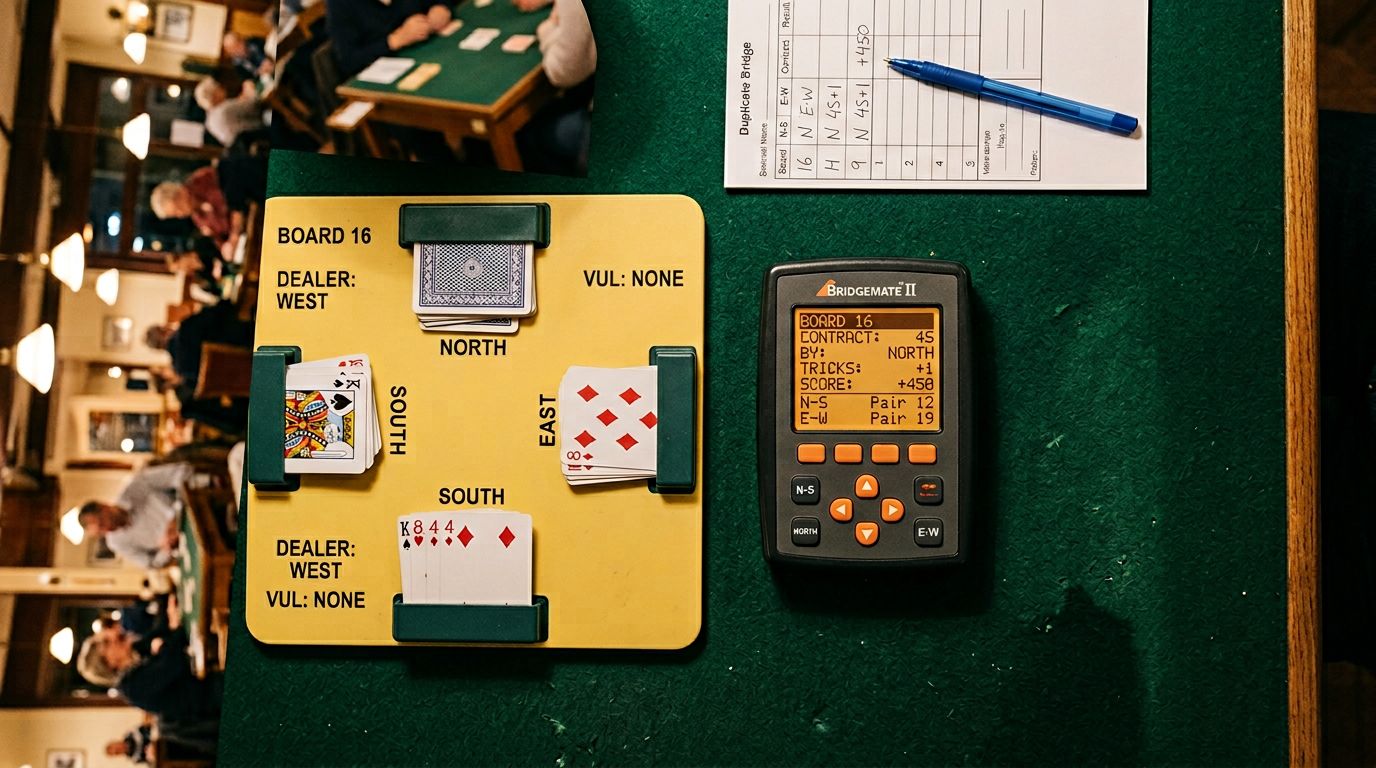
Matchpoints is the most common form of duplicate bridge at clubs. The concept is simple: you get one point for each pair you beat, half a point for each pair you tie.
If 12 pairs play the same hand, there are 11 possible matchpoints (you can beat 0 to 11 other pairs). Getting 7 or more is good. Getting 9+ is excellent.
This creates some strange incentives.
Small edges matter. Making 3NT with an overtrick (430 points) instead of making it exactly (400 points) can be the difference between a top and a middle board. That’s why you’ll see duplicate players taking weird risks for overtricks that would be insane in rubber bridge.
Going down when everyone else is down costs nothing. If the whole field is in 4♠ going down one, you don’t want to be the pair who chickened out and played 3♠ making four. You’d get a zero for being “right.”
Being in the right contract matters more than making overtricks. 140 points (2♠ + 2) loses badly to 170 points (3♠ + 1) or 420 points (4♠ making). But the jump from 420 to 450 (+1 overtrick) is less significant. Get to game. That’s priority one.
Going plus is beautiful. If you’re in 3NT down one (-50) and everyone else is down two or three, you get a bad board. But if half the field bid the shaky game and half stopped in 2NT, you want to be in the game. Because +400 crushes the pairs at +120.
Duplicate Scoring: IMPs (International Match Points)
IMPs are used in team games and online competitions. Instead of comparing to everyone’s score, you compare to your teammates (or opponents in a Swiss or knockout).
Point differences convert to IMPs on a sliding scale:
| Point Difference | IMPs |
|---|---|
| 0-10 | 0 |
| 20-40 | 1 |
| 50-80 | 2 |
| 90-120 | 3 |
| 130-160 | 4 |
| 170-210 | 5 |
| 220-260 | 6 |
| 270-310 | 7 |
| 320-360 | 8 |
| 370-420 | 9 |
| 430-490 | 10 |
| 500-590 | 11 |
| 600-740 | 12 |
| 750-890 | 13 |
| 900-1090 | 14 |
| 1100-1290 | 15 |
| 1300-1490 | 16 |
| 1500+ | 17+ |
The key insight: the scale compresses differences. Making an overtrick (30 points) is worth 1 IMP. Making a game when they don’t (300+ points) is worth maybe 7-10 IMPs. But the difference between making game and going down in game might only be 10-11 IMPs.
This makes IMPs more conservative than matchpoints but more aggressive than rubber bridge.
Overtricks matter less. That extra 30 points? Just 1 IMP. Not worth risking your contract.
Games and slams matter more. The jump from a partial to a game is worth real IMPs. Same with slams.
Big swings are capped. You can’t get destroyed on one board the way you can in rubber bridge. Down 1100? That’s painful (about 15 IMPs) but not game-ending.
Rubber Bridge Scoring
Rubber bridge is old-school bridge - the way the game was played for decades before duplicate became popular. You’re playing for a rubber (winning two games), and scoring is cumulative.
Vulnerability is dynamic. You’re not vulnerable until you win a game. After that, you’re vulnerable and your opponents aren’t - until they win a game too.
The rubber bonus is big. Win two games before your opponents win any: 700 bonus points. Win two games while they win one: 500 bonus.
Partials carry forward. If you bid 2♥ making three, that’s 90 points toward your game. Next hand, 1NT making three (90 more) gives you a game. These “part-score” points accumulate.
Honors score. Hold all four aces in notrump or all five top trump honors (A-K-Q-J-10) in a suit contract? That’s 150 points. Four of the five top honors? 100 points. This is pure luck, but it adds up.
Doubles matter enormously. The penalty structure makes doubled contracts a huge risk. Down one vulnerable doubled is -200. Down three vulnerable doubled is -800. These swings can decide a rubber.
Because rubbers can last an hour and big scores accumulate, rubber bridge is more conservative. You don’t stretch for thin games when being set costs you 100 points and gives opponents momentum toward their game.
Penalties and Undertricks
When you go down, the penalty depends on whether you’re doubled and whether you’re vulnerable.
Undoubled penalties (per trick):
- Not vulnerable: 50 per trick
- Vulnerable: 100 per trick
So down two in 4♠ not vulnerable is -100. Vulnerable it’s -200.
Doubled penalties get harsh fast:
| Down | Not Vul | Vulnerable |
|---|---|---|
| 1 | 100 | 200 |
| 2 | 300 | 500 |
| 3 | 500 | 800 |
| 4 | 800 | 1100 |
| 5 | 1100 | 1400 |
Notice the progression gets worse. Down one doubled is bad but survivable. Down three doubled vulnerable is catastrophic (-800).
Making doubled contracts: You get double the trick points plus 50 for the insult. So 3NT doubled making is 100 (tricks) × 2 + 50 = 250, plus the game bonus. With overtricks, each one is worth 100 (not vulnerable) or 200 (vulnerable).
This is why you rarely see doubled contracts at the table unless someone screwed up the auction.
How Scoring Affects Bidding Decisions
Let’s say you hold a balanced 26 HCP between you and partner. You can make 3NT about 60% of the time.
At matchpoints: Bid 3NT every time. If it makes, you score 400-600 and beat everyone in partials. If it fails, you’re down 50 - but half the field is probably down too.
At IMPs: Bid 3NT. The 300-500 bonus for game is worth risking a down one (-50 to -100) with 60% odds.
At rubber bridge: Maybe bid it, maybe don’t. If you’re already vulnerable and opponents have a game, the risk of -100 (or worse, doubled -200) isn’t offset by the game bonus as cleanly. Table texture matters - are you ahead or behind?
Or consider a 50% small slam:
At matchpoints: Often wrong. If you’re the only pair who bids it, you either get a top (making) or a bottom (down). The field in game is getting 420-680, and you’re gambling to beat them by 500 points or lose to them by 500 points. You need to be confident others will bid it too.
At IMPs: Bid it if you’re a favorite. A 50% slam wins you about 11 IMPs when it makes, costs you about 11 when it fails. With 50%+ odds, the math works.
At rubber bridge: Think hard. That slam bonus is beautiful, but the swing if you go down is painful. Position in the rubber matters. Behind? Gamble. Ahead? Lock in the game.
Quick Reference: Common Scores
Here’s what you’ll see constantly at the table:
Game contracts making exactly:
| Contract | Not Vul | Vulnerable |
|---|---|---|
| 3NT | 400 | 600 |
| 4♥ / 4♠ | 420 | 620 |
| 5♣ / 5♦ | 400 | 600 |
Common partials making exactly:
| Contract | Not Vul | Vulnerable |
|---|---|---|
| 1NT | 90 | 90 |
| 2NT | 120 | 120 |
| 2♥ / 2♠ | 110 | 110 |
| 3♣ / 3♦ | 110 | 110 |
Small slams making exactly:
| Contract | Not Vul | Vulnerable |
|---|---|---|
| 6NT | 990 | 1440 |
| 6♥ / 6♠ | 980 | 1430 |
| 6♣ / 6♦ | 920 | 1370 |
Overtricks in game contracts:
- Major suit: +30 per trick
- Minor suit: +20 per trick
- Notrump: +30 per trick (after the first)
The Bottom Line
Scoring isn’t background noise. It’s the game.
At matchpoints, fight for every trick and bid aggressive games. Small edges compound. Going plus in a normal contract is fine, but you want to be in the same contract as everyone else or better.
At IMPs, bid sound games and slams, protect your contract, don’t gamble for overtricks. Big numbers matter, but the scale compresses disasters.
At rubber bridge, play position and momentum. The cumulative nature of scoring means you can afford to be patient when ahead and need to gamble when behind.
Learn the numbers, internalize the incentives, and you’ll start making bids that look weird to beginners but make perfect sense to anyone who understands what they’re really playing for.