Bridge Play Terms Glossary
Winning the auction is just the beginning. Making your contract requires technique, and technique requires vocabulary. This glossary covers every declarer play term you’ll encounter.
From basic plays to advanced techniques, here’s your reference guide to the language of card play.
A
Avoidance Play: Playing the hand to keep a dangerous opponent (the one with length or entries) off lead. You want the safe hand leading, not the one who can hurt you.
Available Trick: A trick you can cash immediately without losing the lead. Count these before you play.
Assumption: Playing as if cards lie a certain way because that’s your only chance to make the contract. “I had to assume trumps were 3-2.”
B
Bath Coup: Holding AJx over opponent’s KQx and ducking when king or queen is led. You score two tricks. Named after the city in England where it was allegedly first played.
Block: When high cards in the short hand prevent you from running a suit. The suit is blocked.
Break: How a suit divides between opponents. “Spades broke 3-2” means spades split favorably.
Broken Suit: A suit that’s not solid. You can’t run it without losing tricks.
C
Cash: To play a card that will definitely win the trick. Usually an ace or established winner.
Chinese Finesse: Leading a high honor through an opponent, hoping they have a higher honor and misdefend. Not a real finesse, more a swindle. “I Chinese finessed the queen and they covered.”
Communication: The ability to move between hands. Entries. You need communication to execute most plays.
Combination: A specific card holding between your hand and dummy. Knowing the right way to play combinations is essential. See Card Combinations.
Coup: A specialized technique. See Bath Coup, Crocodile Coup, Grand Coup, etc.
Cover: Playing a higher card on opponent’s honor. “Cover an honor with an honor” is the general rule, but not always right.
Crocodile Coup: When you “swallow” your own high card by ruffing it to avoid a guess or establish lower cards. Advanced technique.
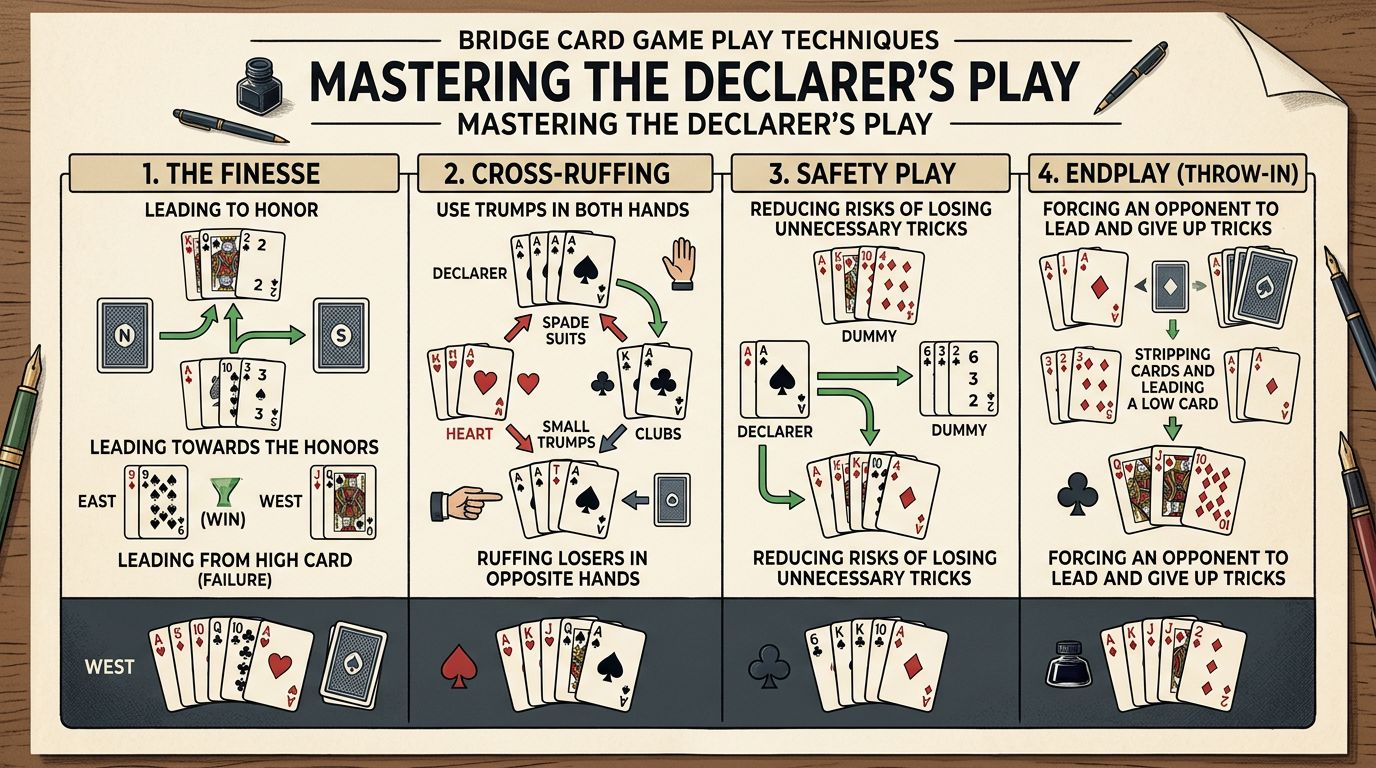
Crossruff: Playing the hand by ruffing in both hands alternately without drawing trumps. Usually scores extra tricks but requires careful planning.
Cut: What happens when a defender ruffs your winner. “They cut my ace.”
D
Danger Hand: The opponent you don’t want on lead. Usually because they can lead through your holding or cash winners.
Decoy: A card played to tempt opponents into a mistake. The play equivalent of a false card by defenders.
Deep Finesse: A finesse for a lower honor (finessing the 9 or 10). Requires specific holdings.
Developing: Establishing tricks in a suit by knocking out opponents’ high cards. “I developed the diamonds.”
Discovery Play: A play designed to find out about the hidden hands. You’re gathering information before committing to a line.
Discard: Throwing away a card from a suit when you can’t follow suit and aren’t ruffing. Sometimes called “pitching” or “sloughing.”
Double Dummy: Perfect play by all four hands with all cards visible. Computer analysis. In real play, you don’t see the defenders’ cards.
Double Finesse: Taking two finesses in the same suit, usually for queen and jack. Example: leading toward AK10x hoping both queen and jack are onside.
Double Squeeze: A squeeze that operates against both opponents. Very advanced.
Doubleton: A holding of exactly two cards in a suit. Often relevant for ruffs or unblocking.
Draw Trumps: Playing the trump suit to remove opponents’ trumps. Usually (but not always) the first thing you do. See Trump Management.
Drop: When an opponent’s high card falls because they have no choice. “The queen dropped under my ace.”
Duck: Deliberately not winning a trick you could win. Used for various strategic reasons - preserving entries, rectifying the count, etc. See Holdup Play.
Dummy: The partner of declarer. Also the cards laid down by dummy after the opening lead. Dummy has no say in play.
Dummy Reversal: A technique where you ruff losers in the long trump hand and draw trumps with dummy’s trumps. Scores an extra trick.
E
Echo: Playing high-low in a suit to show an even number of cards. Defensive technique but declarer should recognize it.
Eliminate: Stripping a suit from both your hand and dummy to prepare an endplay. “I eliminated diamonds before throwing them in.”
Elimination Play: Removing opponents’ safe exit cards before throwing them in. See strip and endplay.
Endplay: A technique where you force an opponent to lead to their disadvantage - either into a tenace or giving a ruff-sluff. See Endplays and Throw-Ins.
Entry: A card that lets you reach a particular hand. Entries are gold - waste them and you’re sunk.
Establish: Making lower cards into winners by forcing out opponents’ higher cards. “I established the 13th club.”
Exit: Getting out of the lead, usually throwing an opponent in. “I had no safe exit.”
F
False Card: A card played to deceive opponents. Mostly a defensive technique but declarer can false-card too.
Finesse: Leading toward a tenace, hoping a missing honor is positioned favorably. The quintessential declarer technique. Can’t win at bridge without finesses.
Finessing Position: When the opponent with the missing honor sits before your tenace. “The king was in finessing position.”
Forcing Defense: When defenders make you ruff, shortening your trumps. You need to recognize this and counter it.
Frozen Suit: A suit no one can afford to lead without giving up a trick. Common in endplays and squeezes.
G
Grand Coup: Shortening your trumps by ruffing winners to execute a trump coup. Elegant when you pull it off.
Guess: Sometimes you just have to pick. Drop or finesse, which opponent has the queen. This is bridge.
H
High-Low: Playing a higher card then a lower card in the same suit. Usually a signal by defenders, but declarer can do it too when unblocking.
Holdup: Refusing to win a trick (usually with an ace) until a later round, trying to exhaust one opponent of the suit. Classic notrump technique. See Holdup Play.
Honor: A, K, Q, J, or 10. The cards that matter in suit combinations.
Hook: Another word for finesse. “I hooked the queen.”
I
Inferential Count: Figuring out how suits split based on bidding and early play. “From the auction, I placed them with 4 spades.”
Intermediate Cards: The 10, 9, 8. Not high honors but often crucial for establishing tricks.
Intra-Finesse: Finessing against a specific card in the middle of a suit. Advanced technique.
J
Jettison: Deliberately discarding a high card (usually to unblock or create an entry). “I jettisoned the king to reach dummy.”
L
Lay Down: Play a hand with no chance of failing. “It was a lay down for 6NT.”
Lead: The first card played to a trick. Opening lead = first card of the hand. Leading toward an honor is usually better than leading the honor itself.
Length: Having more cards in a suit than opponents. Length creates tricks.
Line: Your plan for making the contract. “The winning line was to finesse twice in hearts.”
Loser: A card that will (probably) lose a trick. Count your losers when planning the play. See Planning the Play.
Loser-on-Loser: Discarding a loser from one hand while losing a trick in another suit. Used to preserve trump control or create endplay positions.
M
Marked Card: A card whose location is known from the bidding or play. “The ♠Q was marked after the auction.”
Menace: A threat card in a squeeze. The card that will become a winner if opponent discards from that suit.
Merrimac Coup: Sacrificing a high card to destroy an entry in a specific hand. Mostly a defensive play.
Morton’s Fork: An endplay where opponent must either give you a trick directly or lead into a tenace. Named after a tax collector who argued people could afford taxes whether they lived lavishly or frugally.
O
Odds: The mathematical probability of a certain lie of cards. Even odds = 50%. 3-2 breaks are 68% likely, 4-1 is 28%, etc.
Offside: When a missing key card is badly placed for you. “The king was offside, finesse lost.”
Onside: When a missing key card is favorably placed for you. “The king was onside, finesse worked.”
Opening Lead: The very first card played in the hand, by the player to declarer’s left. The most important single card in the hand.
Overruff: Trumping higher than an opponent who already ruffed. You ruff with the 8, they overruff with the jack.
Overtake: Playing a higher card from the long hand to win a trick in the short hand. Usually to preserve entries.
Overtrick: A trick above what you contracted for. Scores extra points but making your contract comes first.
P
Partial Elimination: Stripping some suits (but not all) before an endplay. Sometimes you can’t eliminate everything.
Percentage Play: The line with the best mathematical odds. Doesn’t always work, but it’s your best shot.
Pitch: Discarding a card. “I pitched a diamond.”
Plan: What you figure out before playing from dummy at trick one. See Planning the Play.
Positional: A holding that only works if a specific opponent has a key card. AQx is positional - you need the king behind the queen.
Preservation: Keeping a specific card or entry for later. Preserving communication is often critical.
Promote: Making lower honors into winners by forcing out higher honors. Defenders promote tricks by forcing you to use up your honors.
Pseudo-Squeeze: A position that looks like a squeeze but isn’t. Opponent feels squeezed but actually has a safe discard.
Q
Quick Tricks: Tricks you can cash immediately (aces and kings). Different from total trick-taking potential.
R
Rectify the Count: Losing tricks deliberately to get down to the right number of cards remaining for a squeeze. Essential squeeze technique.
Repeated Finesse: Taking the same finesse more than once. Example: leading toward KJ10 twice.
Restricted Choice: A principle that when an opponent plays a specific honor, they’re more likely to have been forced to play it (didn’t have a choice). Helps with two-way finesses.
Reversal: See Dummy Reversal.
Ruff: Playing a trump on a trick in a different suit. You’re void in the suit led so you trump it.
Ruff and Discard (also Ruff-Sluff): When opponent leads a suit both declarer and dummy are void in, you ruff in one hand and discard a loser from the other. Usually bad for defense, good for declarer.
Ruff Out: Establish a long suit by ruffing out opponents’ cards in that suit. “I ruffed out the spades.”
Ruffing Finesse: Leading a high card from dummy when you’re void in hand, intending to ruff if covered or discard if it holds. Works when the key card is onside.
Rule of 11: On opening leads, subtract the card led from 11. The answer tells you how many higher cards are in the other three hands. Works for 4th-highest leads.
Run: To cash all your winners in a suit. “I ran the clubs.”
S
Safety Play: A technique that gives up the maximum number of tricks in a suit to ensure a certain number. You sacrifice a possible overtrick to guarantee your contract.
Set Up: See Establish.
Short Suit: A suit where you have few cards (doubleton or shorter). Relevant for ruffs and distributions.
Simple Squeeze: A squeeze against one opponent. The basic form.
Singleton: Holding exactly one card in a suit. Often signals ruffing potential.
Sloughing: Discarding. Same as pitching.
Solid Suit: A suit with no losers. You can run it. AKQJx is solid.
Split: How a suit divides between opponents. See Break.
Spot Card: Any non-honor card (9 or lower). The “small” cards.
Squeeze: A technique where opponents are forced to discard from a critical suit, establishing your lower cards. Advanced but powerful. Many types exist.
Stepping Stone: Using one opponent as an entry to reach another opponent for an endplay. Advanced.
Stopper: A holding that will prevent opponents from running a suit. Axx, Kx, QJx all stop a suit at least once in notrump.
Strip: Removing all cards in certain suits from both hands to prepare an endplay. See Eliminate.
Strip and Endplay: The full technique - remove safe exit suits, then throw an opponent in. See Endplays and Throw-Ins.
Suit Establishment: The process of making low cards in a long suit into winners. Core notrump technique.
T
Tenace: A holding like AQ or KJ - two honors with a gap. The classic finessing position.
Throw-In: Deliberately giving an opponent the lead (usually in an endplay). See Endplays and Throw-Ins.
Top: A card that will definitely win. “I had three tops.”
Transportation: See Entry and Communication. Getting between hands.
Trump: The suit named in the contract. Also, to ruff. “Trump” is both noun and verb.
Trump Control: Having enough trumps to prevent opponents from running their suit. You need to keep at least one trump usually.
Trump Coup: A technique where you shorten your trumps to the same length as an opponent’s, then lead through them at the end. Wins an “impossible” trump trick.
Trump Echo: Playing high-low in trumps by defenders to show three trumps. Declarer should watch for this.
Trump Management: The strategy of how you handle the trump suit - when to draw them, when to delay. See Trump Management.
Trump Promotion: When defenders force you to ruff high or overruff, creating a trump trick for them. Common defensive technique.
Two-Way Finesse: When you can finesse either opponent for a missing honor (usually the queen with AKJ10). You need to decide which opponent is more likely to hold it.
U
Unblock: Deliberately playing high cards early to avoid blocking the suit later. If you have Kx opposite AQJxx, you must drop the king early or the suit blocks.
Underlead: Leading a low card from an honor holding. Underleading aces is usually wrong but sometimes necessary.
Undertrick: A trick short of your contract. Each undertrick costs penalty points.
Upper: Leading the higher of touching honors. “He led upper from KQ.”
V
Vienna Coup: Cashing a winner to “unblock” opponent’s stopper, setting up a squeeze. Advanced technique named after Austrian experts.
Void: Having zero cards in a suit. Valuable for ruffing.
W
Winner: A card that will take a trick. Also called a “trick.”
Working Card: An honor that’s well-placed with respect to your other honors and will help produce tricks. KQx are working cards. Qx opposite xxx is not working (it’s “wasted”).
Quick Reference Links
- Planning the Play
- Trump Management
- Card Combinations
- Holdup Play
- Endplays and Throw-Ins
- Squeeze Technique
- Deceptive Play
Looking for bidding or defense terms? Check out: