Bridge Slang and Jargon: The Colorful Language of Bridge
Bridge players have their own colorful vocabulary. This is the fun glossary - the slang, jargon, and expressions you’ll hear at the table.
Some of these are old-fashioned, some are modern, but they’re all part of bridge culture. Learn them and you’ll sound like you’ve been playing for years.
A
Aces Loaded: When all the aces are in one hand or one partnership. Usually means someone’s getting slaughtered. “Aces loaded, we’re going down.”
Advance Save (also Advance Sacrifice): Bidding to sacrifice before opponents even get to their game. Preemptive. Risky but sometimes brilliant.
Air: Nothing. No values. “I had air - 2 points.”
Anchor: The player on a team who consistently performs well. The reliable one. “Sarah’s our anchor, she never has a bad game.”
B
Baby: A small card, usually 2-5. “Lead a baby spade.”
Balanced Hand: Not just the technical definition (no singletons/voids) - players often say “balanced garbage” to describe flat hands with scattered points but no good features.
Beans: Points. “How many beans did you have for that 2NT?”
Beer Card: The seven of diamonds (♦7). In some bridge clubs, if you play it and it wins the last trick, you get a free beer. Ask before you order. Also called the “rag.”
Bidding Box: The physical box containing cards for your bids. “Check the bidding box” = look at what was actually bid, not what you remember.
Biff: To trump. British slang. “I biffed their ace.”
Big Casino: The 10 of diamonds (♦10). From the card game Casino. Not common in bridge but you’ll hear it occasionally.
Blind Lead: Leading without useful information. “It was a blind lead, I had no clue.”
Blow: Ruffing. “I blew their king.”
Board: The duplicate board containing the cards. Also used for “hand.” “That was a wild board.”
Bog: A terrible result. British term. “We got an absolute bog.”
Book: Six tricks for declarer. Called “book” because you need these plus your bid level. Bidding 3NT means you need book (6) plus 3 = 9 tricks.
Both Red or Both White: Both sides vulnerable (red) or both non-vulnerable (white). “It’s both red, be careful.”
Broke: Having no cards left in a suit. “I’m broke in spades.”
Buck: Passing a decision to partner. “I’m bucking this to you.”
Bust: A terrible hand. 0-4 points typically. “Total bust, sorry.”
C
Caddy: The duplicate board. British term.
Cards: The general quality of your hand beyond point count. “I have the cards” = my hand is working well despite point count.
Chinese Finesse: Leading a high honor hoping the opponent covers (or doesn’t cover) incorrectly. Not a real finesse, more a bluff. Sometimes considered mildly offensive term, though widely used.
Coffin: Four honors in one hand (AKQJ or similar in partner’s suit). Called coffin because they’re “buried” (all in one hand where they do less good than spread between partners). “I had a coffin in clubs.”
Cold: A contract that can’t fail. “It’s cold for 6NT.”
Collection: A bad hand with scattered honors that don’t work together. “I had a collection - three queens.”
Cooking: When a double becomes very profitable. “We cooked them for 800.”
Count: Either signaling how many cards you have, or knowing how the hand is distributed. “I lost count” = I don’t know who has what.
Cow: COW = “Contract Or Worse.” When you bid a contract and get doubled, and your partner pulls to something that’s even worse. “Don’t be a cow!”
Crunchola: Getting squeezed badly. Made-up word. “I was in crunchola, had to throw a winner.”
Cut: To ruff. “I cut their ace.”
D
Dead: Certain. “That finesse is dead” = won’t work. Or “He’s dead in the water” = can’t make the contract.
Dog: A terrible hand or contract. “This 3NT is a dog.”
Dogged: Messy, difficult. “That was a dogged hand.”
Doubleton: Two cards in a suit. Standard term but sounds like slang to beginners. “Doubleton queen - great.”
Dummy: Partner of declarer. Lays down cards and watches. Also can mean a hand with no entries: “Dummy is dead.”
E
Eight-Ever, Nine-Never: A guideline for playing AQxx opposite xxxx. With 8 combined, finesse. With 9 combined, play for the drop. Often wrong but useful memory aid.
Exit: Throwing someone in. “I need an exit card.”
F
Falsecard (verb): To deliberately mislead. “I falsecarded the jack.”
Fillets: High cards that aren’t quite honors. Nines and tens. Good fillets = useful intermediates.
Flat: A balanced hand (4-3-3-3 or 4-4-3-2). “I was flat.”
Flannery: A specific convention, but players use it jokingly for any awkward hand. “This is a Flannery hand” = I have no good bid.
Frozen: Can’t lead a suit without giving up a trick. The suit is frozen.
G
Galloping Gerties: Queens. Particularly worthless queens. From racehorse slang. “I had three galloping gerties, no help.”
Garbage: Terrible cards. “I opened with garbage on a good day.”
Garbage Stayman: Using Stayman with a weak hand just to escape 1NT. Controversial. Risky. Sometimes brilliant when it works.
Go Fetch or Go For: To double opponents, expecting a big penalty. “I’m going for them.”
Good: An established card or suit. “My diamonds are good” = they’re winners.
Goulash: A form of redeal in rubber bridge with weird dealing (stacked suits). Creates wild hands. Not used in duplicate.
Grosvenor Gambit: Making an insane play that works only if your opponent is brilliantly analyzing the hand and outthinks themselves. Named after a fictional player. “I pulled a Grosvenor.”
Guess: What you do when skill runs out. “Pure guess.”
H
Hand Hog: A player who always wants to declare. Grabs the contract even when partner should play it.
Help: Useful cards in a suit. “I have help in diamonds” = honors or shortness.
Hit: Making a good guess or finding the right card. “I hit the queen.”
Hitting the Deck: When a key card appears. “The spade king hit the deck.”
Hold Up: Refusing to take a trick (usually your ace). Standard technique but sounds like slang.
Honor: AKQJ10. But “honors” can also mean the worthless bonus in rubber bridge. “We had honors” = AKQJ in trumps.
Hook: Finesse. “Hook the queen.”
Hot: A hand with great honor concentration or trick-taking power. “My hand got hot after that auction.”
I
In the Slot: When a missing key card is perfectly placed (usually behind a finesse). “King was in the slot.”
Ink: To write down a good score. British term. “We inked that one.”
Iron Duke: The Ace of trumps. Old-fashioned British term.
J
Jacks: Lowest of the honors. “Jacks and worse” = bad hand.
Jettison: Deliberately throw away a high card. Standard term that sounds like slang.
Junk: Worthless cards. Small spot cards.
K
Kibitzer: Someone watching the game. From Yiddish. Some kibitzers know the game better than the players. Don’t talk during the hand if you’re kibitzing.
Kill: To destroy an entry or a suit. “That killed the dummy.”
Kitchen Sink: Everything. “I threw the kitchen sink at them” = bid everything I had.
Knocked Out: When your key card is forced out. “They knocked out my ace.”
L
Lay Down: A contract that can’t fail. “Cold” or “ice cold” mean the same thing. “It’s a lay down.”
Lay Down Your Hand: What dummy does after opening lead. Archaic phrasing - we say “put down dummy” now.
Lead Through Strength, Up to Weakness: Old defensive maxim. Still good advice.
Length: Long suits. “I had length in clubs.”
Lift: A good break or favorable lie. “We got a lift when spades broke 3-3.”
Light: Fewer points than typical. “I opened light.”
Little Casino: The 2 of spades (♠2). Like big casino, from the card game.
Live: Cards that can still win tricks. “My queens are live.”
Loaded: Full of high cards or controls in one suit. Or “aces loaded” = all aces in one hand/partnership.
Long: Having more cards in a suit than opponents. “I was long in hearts.”
Louie: A loser. “That’s a louie.”
Luck: What your opponents have when they make contracts. You never have luck, you played well.
M
Make: To fulfill your contract. “Did you make?”
Marked: When a card’s location is certain from the bidding or play. “The king was marked.”
Master: An established winner (card that will win a trick). “I had two master spades.”
Masterless: A suit with no more winners. “Spades are masterless now.”
Meat: Easy pickings. A juicy penalty. “That’s meat.”
Moose: A big penalty. “We scored a moose - 800.”
Moysian Fit: A 4-3 trump fit (only 7 cards). Named after Alphonse Moyse Jr. Usually avoided, sometimes playable. “We played in a Moysian.”
Mush: Bad cards. British term.
N
Naked: An honor without protection. “Naked king.”
Nail: To catch someone. “We nailed them.”
Nine of Trumps: Sometimes called “curse of Scotland.” Supposedly because it resembled the Duke of Cumberland’s coat of arms. Obscure.
No-Play: A contract with no chance. “It’s a no-play.”
Nothing: Zero useful cards. “I have nothing in spades.”
Nullo: A theoretical contract to take zero tricks. Not actually played in bridge but mentioned in some variations.
O
Off: Down. “We went off one” = down one.
Off Two Aces: Missing two aces. Often said ruefully when you bid slam missing them.
Onside: When a missing card is favorably placed. “King was onside.”
Overboard: Bidding too high. “We went overboard.”
Overbrick: Making way more than you bid. “Made 12 tricks in partscore, serious overbricks.”
P
Paint: Face cards (honors). “I have no paint.”
Pass Out: When three consecutive passes end the auction. “It passed out in 2♠.”
Penalty: Either the scoring penalty for going down, or penalty double. Context.
Phantom: A phantom sacrifice is bidding to save when opponents can’t actually make their contract. Embarrassing. “Phantom save, they were going down.”
Piano: A hand with all the keys (high cards). British slang. “I had the piano.”
Pitch: Discard. “Pitch a diamond.”
Pop: To take a trick with a high card. “Pop the ace.”
Protected: An honor with guards. Kxx is protected, Kx is barely protected, K alone is naked.
Psych (or Psychic Bid): A deliberate gross misrepresentation. Rare, must be disclosed. Debatable ethics.
Puke: A terrible hand. Very informal. “I opened, partner had puke.”
Pull: Either pulling partner’s penalty double back to a suit (rescue), or pulling trumps (drawing them). Context matters.
Punt: To make a wild guess or bid. “I punted 6NT.”
Pure: A clear-cut decision or position. “Pure finesse.”
Q
Quack: A queen or jack. Sometimes both together. “I had quacks in every suit - four queens.”
Quick: Immediate winners (aces and kings). “How many quick tricks?”
R
Rag: A small, worthless card. 2, 3, 4, 5.
Raggedy: A suit full of small cards. “Raggedy spades.”
Raise: Supporting partner’s suit. Standard term.
Rectify: Fixing the count for a squeeze. Advanced technique.
Red: Vulnerable. “We’re red.”
Rhythm: The flow and tempo at the table. Breaking rhythm can give information (unethically).
Rip: To double aggressively. British term. “I ripped them.”
Robbed: When a finesse loses or a key card is offside. “I got robbed, king was offside.”
Rock Crusher: An enormous hand. 25+ points. “I had a rock crusher.”
Rule of 2 and 3: Preempt to the level equal to your tricks + 2 non-vulnerable or + 3 vulnerable. Guideline, not law.
Running: Cashing winners consecutively. “I’m running clubs.”
S
Safe: A lead or play that doesn’t give anything away. “Safe exit.”
Sandbagging: Deliberately underbidding to trap opponents or conceal strength. Debatable ethics.
Set: To defeat a contract. “We set them two.”
Shape: Distribution. “Great shape - 6-5.”
Shedding: Discarding. British term.
Shooting: Trying for tops (matchpoints) with aggressive bids or unusual lines. “We’re shooting.”
Short: Few cards in a suit. “Short in spades.”
Shut Out: When preempts prevent opponents from bidding normally. “The preempt shut them out.”
Signoff: A bid that says “this is the contract, pass.” Standard term.
Singleton: One card in a suit. Standard term but sounds exotic.
Slam: 6-level (small slam) or 7-level (grand slam). Standard term.
Slaughter: A huge penalty or disaster. “We slaughtered them.”
Smash: To ruff high. British.
Smother: A smother play is when you force an opponent’s honor to fall under their partner’s higher honor. Advanced technique.
Solid: A suit with no losers. “Solid spades.”
Splat: Going down badly. “We went splat in 3NT.”
Spot: A non-honor card.
Spot Cards: The small cards, 2-9.
Squeeze: Forcing opponent to discard a critical card. Standard technique with slang-like name.
Stab: A speculative bid or lead. “I stabbed 3NT.”
Stay: To pass partner’s invitation. “I stayed in 3NT.”
Stepping Stone: Using one opponent to reach the other. Advanced.
Stiff: Singleton. “Stiff king” = singleton king. Very common slang. “I had a stiff ace, couldn’t use it.”
Sting: A penalty. British. “We got stung for 500.”
Stopper: A holding that stops opponents’ suit. Standard term.
Stripped: When you’ve eliminated a suit from both hands. “I stripped diamonds.”
Stuff: Either your cards (“nice stuff, partner”) or discarding. Context.
System: Your bidding agreements. Could be Standard American, 2/1, Precision, etc.
T
Table Feel: Intuition about what’s happening based on tempo, body language (legal), and atmosphere. “I had a table feel they were saving.”
Take: Winning a trick. “Take it with the ace.”
Take the Field: Bidding to beat the room (matchpoints). “We’re taking the field with 6NT.”
Tap: Forcing declarer to ruff, shortening their trumps. “We tapped them.”
Telephone Number: A huge penalty. 800, 1100, etc. Looks like a phone number on the score sheet. “We scored a telephone number.”
Tempo: The pace of play. Also means a timing advantage. “I need tempo to establish diamonds.”
Thick: Well-filled with intermediates. “Thick suit - AKJ1098.”
Thin: Not enough values. “That 3NT was thin.”
Thread: Leading or playing carefully through a dangerous position. “Thread the queen through.”
Tight: Not enough room, or barely enough values. “Tight auction” or “Tight 6NT.”
Top: Maximum matchpoints. “We got a top.”
Tops: High cards. “I had all the tops.”
Tramp: Trump. British slang, uncommon in US.
Trap: Setting up a penalty by passing with a strong hand. “I trapped them.”
Trash: Worthless cards.
Trick: Four cards, one from each player. Standard term.
Tripleton: Three cards. “Tripleton queen.”
Trump: The suit named in the contract. Standard term that beginners think is slang.
Tub: British slang for a bad result. “We got a tub.”
Two-Way: A finesse you can take either direction. “Two-way finesse for the queen.”
U
Unblock: Playing high cards early. Standard term.
Uppercut: A defensive play where you ruff high to force declarer to overruff with a high trump, promoting partner’s holding. Beautiful when it works.
V
Void: Zero cards in a suit. Standard term but exotic-sounding.
W
Wasted: Values in a suit where they don’t help. “Kx opposite void is wasted.”
White: Non-vulnerable.
Whitefish: A hand with no honors or shape. Totally worthless. Rare term.
Wood: Face cards, paint. British. “I had the wood in spades.”
Wriggle: Escape sequences after opponents double your conventional bid. “We wriggled out.”
Wrong-Siding: When the weaker hand declares, exposing the stronger hand to opening lead. Often bad. “We wrong-sided it.”
X-Y-Z
X: Double. “They X’d us.”
XX: Redouble.
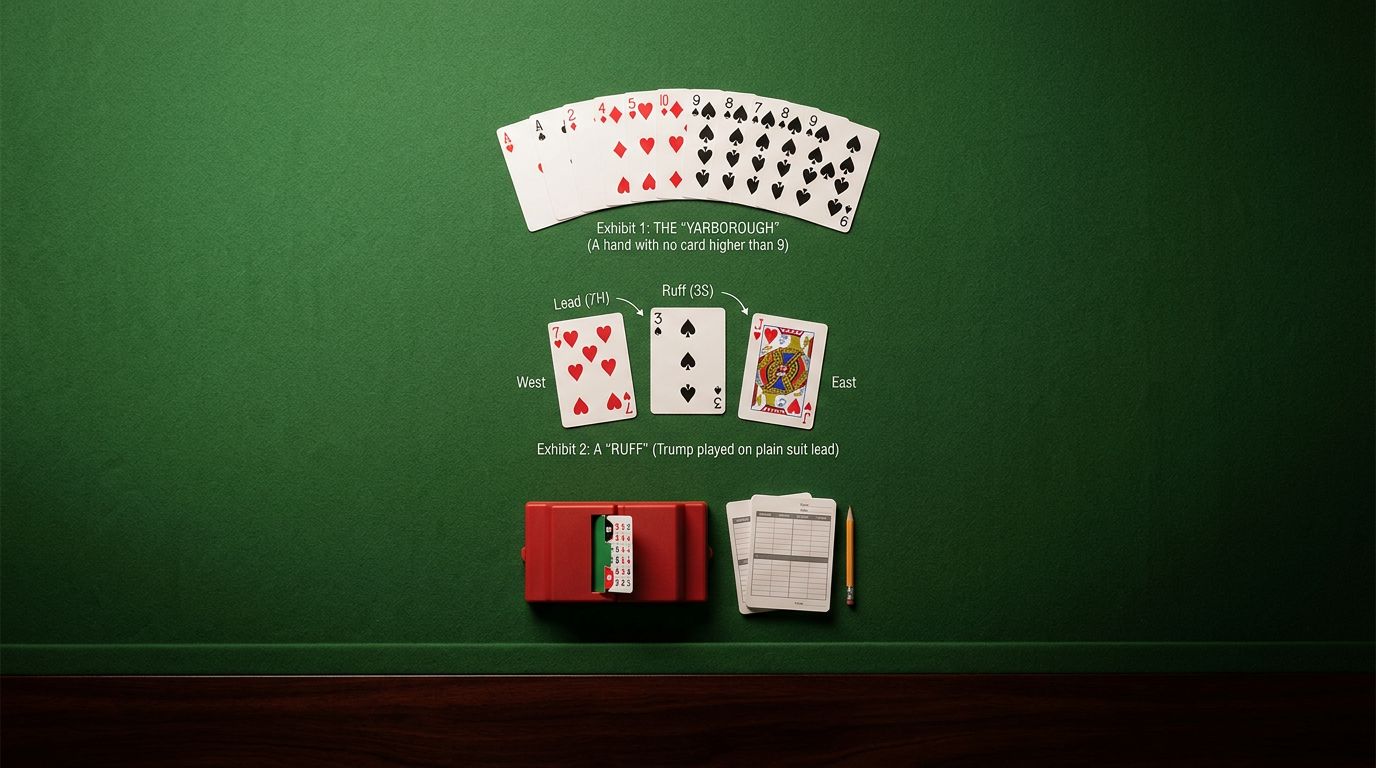
Yarborough: A hand with no card higher than 9. Named after the Earl of Yarborough, who supposedly offered 1000-to-1 against it (the actual odds are about 1827-to-1). Essentially worthless. The most famous piece of bridge slang. “Total yarborough.”
Zero: The worst matchpoint result. A bottom. “We got a zero.”
Zonked: Squeezed, or badly beaten. “I was zonked on that hand.”
Regional Variations
British Terms:
- Biff, smash (to ruff)
- Pips (spot cards)
- Mush (bad cards)
- Bog, tub (bad result)
- Ink (good result)
- Treble (redouble)
American Terms:
- Stiff (singleton - universal now but originally American)
- Moose (big penalty)
- Telephone number (huge penalty)
- Zonked (squeezed)
Australian Terms:
- Similar to British, plus local variations. “Bonzer” = good.
Table Culture Notes
What You Can Say: Anything about your own cards AFTER the hand is over. Compliment partner (genuinely). Acknowledge a good defense or play by opponents.
What Not To Say:
- During the hand: Nothing about what you should have bid, what you hold, what you’re hoping for.
- After the hand: “You should have…” (unless partner asks). No blame, no criticism.
- Ever: Personal insults, questioning integrity, slow-rolling gloating.
Humor: Bridge players love wordplay and self-deprecating humor. “I had a hand like a foot” (flat and ugly). “That was anti-percentage” (worst possible guess). Use it to defuse tension, not create it.
Quick Reference Links
Need serious terminology?
Remember: Bridge slang is colorful and fun, but don’t let it confuse you. The underlying concepts are serious. Learn the real terms first, then enjoy the slang.