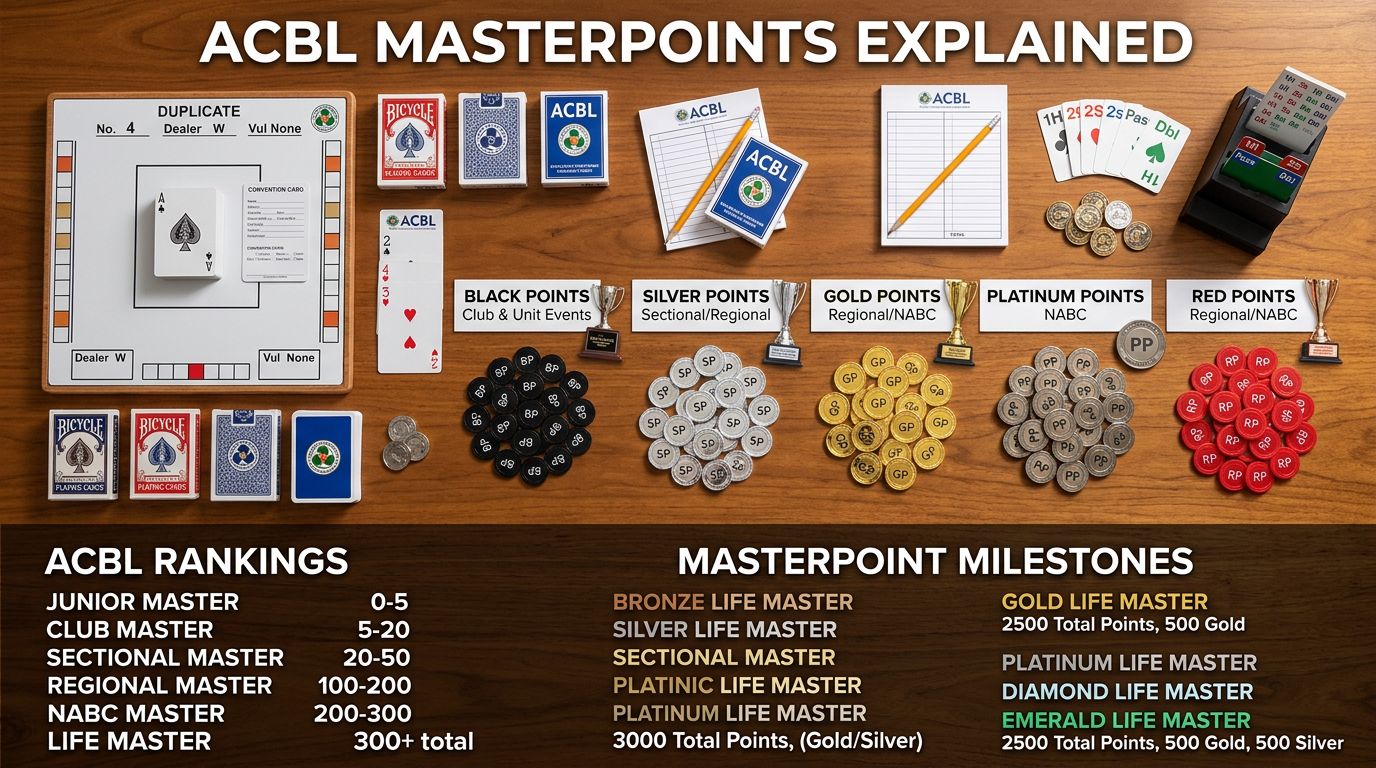
ACBL Masterpoints Explained
Masterpoints are bridge’s currency of achievement. They measure tournament success, track your progress, and unlock ranking titles that follow you for life. If you play ACBL bridge, you’ll hear people talk about their points constantly. “How many points do you have?” is a standard introduction at tournaments.
Understanding the masterpoint system helps you set goals, choose which events to play, and figure out what all those colored points actually mean.
What Are Masterpoints?
Masterpoints are awards you earn for placing well in ACBL-sanctioned bridge events. Win a club game, you get points. Place in a regional tournament, you get more points. Final table at a national championship, you get a lot of points.
The ACBL tracks your masterpoints forever. They accumulate across your entire bridge career. Someone who’s been playing for 40 years might have 5,000 points. A new player might have 2.
Points serve two purposes: measuring achievement and unlocking rankings. Your total masterpoints show roughly how much tournament bridge you’ve played and won. Your ranking title (Life Master, Silver Life Master, etc.) shows you’ve met specific milestones.
The Five Colors of Masterpoints
Here’s where it gets interesting. Not all masterpoints are equal. They come in five colors, and the color indicates what level of event you earned them at.
Black Points
Black points are the most common. You earn them at club games. Every Tuesday night duplicate at your local bridge club awards black points to winners.
The club masterpoint game (usually the biggest weekly game) awards the most. A typical structure might give 0.70 points to first place in a 10-table game, scaling down to 0.10 for fifth. Smaller club games award fewer points.
Black points are easy to accumulate if you play regularly. A decent player at a weekly club game will rack up dozens of black points per year. Some players have thousands.
But here’s the thing: black points alone won’t advance you to the higher ranks. To become Life Master, you need pigmented points (explained below). You can’t grind your way to Life Master just by dominating your Tuesday game.
Silver Points
Silver points come from sectional tournaments. These are ACBL tournaments that draw players from a local area, usually running 3-4 days with multiple events.
Sectionals are bigger than club games but smaller than regionals. They might attract 100-300 players across various events. The competition is tougher than club games because you’re facing players from multiple clubs.
Silver points are more valuable than black points for advancing through rankings. They prove you can win outside your comfort zone.
A typical sectional event might award 1-3 silver points for winning, depending on the number of tables. Smaller events award less. You’ll also earn some black points in most sectional events, even when you win.
Gold Points
Gold points come from regional tournaments. These are major events that draw hundreds or thousands of players from across multiple states or provinces.
Regionals run for a week or more and offer dozens of different events. Morning pairs, afternoon Swiss teams, evening knockouts, stratified games, single-session events, two-session championships, the schedule is packed.
Gold points are significantly more valuable than silver or black. They’re required for Life Master and higher ranks. Winning a regional event feels like a real accomplishment because you beat a large field of serious players.
Awards vary widely by event size. A small regional side game might award 2-3 gold points for winning. A championship event at a major regional could award 20+ gold points to the winners.
Most regional events also award some silver and black points along with the gold. The exact mix depends on the event and how many tables played.
Platinum Points
Platinum points come from North American Bridge Championships (NABCs). These are the three biggest ACBL tournaments each year: Spring, Summer, and Fall NABCs.
NABCs draw thousands of players from across North America and around the world. They run for 10 days and offer every possible event format. The competition is fierce.
Platinum points are rare and prestigious. They’re required for the highest Life Master ranks (Bronze, Silver, Gold Life Master). Even making the cutoff for masterpoints in a major NABC event is an achievement.
Championship events at NABCs award huge amounts of platinum points. Win the Blue Ribbon Pairs or the Reisinger, you’re looking at 50-100+ platinum points. Most NABC events also award some gold, silver, and black points in the mix.
Red Points
Red points are the rarest. They come from specific NABC championship events only. The Vanderbilt, Spingold, Blue Ribbon Pairs, Grand National Teams finals, and a handful of other top events award red points.
Red points don’t serve any specific ranking purpose that platinum doesn’t. But they’re a badge of honor. Having red points means you’ve placed in one of bridge’s most prestigious events.
Most players never earn a single red point. To win red points, you need to be really good and probably really serious about bridge.
Pigmented vs. Non-Pigmented Points
This is crucial vocabulary for understanding requirements.
Non-pigmented points are black points. The common ones you earn at club games.
Pigmented points are everything else: silver, gold, platinum, and red. They’re “pigmented” because they have color (well, so does black, but work with me here).
When the ACBL says you need “25 gold points or better” for Life Master, they mean gold, platinum, or red. Colors higher in the hierarchy count.
When they say “50 pigmented points,” they mean any combination of silver, gold, platinum, or red. Black points don’t count.
This distinction matters because you can’t achieve advanced ranks with only club game success. You need to venture out to bigger tournaments.
How Points Are Awarded
The formula for masterpoint awards gets complicated, but the basics are simple: bigger event, better finish, more points.
Table count matters. A 15-table game awards more points than a 5-table game. This prevents point inflation from tiny events.
Your finish determines your award. First place gets the most. Second gets less. Points usually go down to around 40-50% of the field in larger events.
Stratification affects awards. Many events are stratified by masterpoint holdings. You might be in Flight A (unlimited), Flight B (0-2500 points), or Flight C (0-750 points). You can win your flight without winning overall, and you’ll get masterpoints for your flight finish.
The exact formulas involve multipliers, minimum awards, and ACBL regulations that change periodically. Directors handle the calculations. You just need to know: win more, get more points.
The Ranking System
Masterpoints unlock ranking titles. These titles stick with you forever and appear on convention cards, in tournament results, and wherever your name shows up in ACBL records.
Here’s the progression:
Rookie: 0-5 points. Everyone starts here.
Junior Master: 5+ points. Play a few club games, you’ll get here.
Club Master: 20+ points. Regular club players reach this in a year or two.
Sectional Master: 50+ points. You’ve branched out beyond club games.
Regional Master: 100+ points, including 5+ silver points. Now you’re winning at sectionals.
NABC Master: 200+ points, including 5+ silver, 5+ gold, and 5+ platinum/red. You’ve played in NABCs and earned points there.
Life Master: 500+ points, including 50+ pigmented points and 25+ gold/platinum/red points. This is the big one.
Bronze Life Master: 1,000+ points, including 200+ pigmented, 100+ gold/platinum/red, and 25+ platinum/red.
Silver Life Master: 2,500+ points, including 500+ pigmented, 250+ gold/platinum/red, and 100+ platinum/red.
Gold Life Master: 5,000+ points, including 1,000+ pigmented, 500+ gold/platinum/red, and 200+ platinum/red.
Sapphire Life Master: 7,500+ points (requirements similar to Gold but higher thresholds).
Diamond Life Master: 10,000+ points. Also called Grand Life Master.
Emerald Grand Life Master: 15,000+ points.
Platinum Grand Life Master: 25,000+ points. There are maybe 50 people in the world at this level.
Most players never make Life Master. It’s a genuine accomplishment that takes years of tournament play and consistent success. The average club player might take 10-20 years to accumulate 500 points with the required pigmented mix.
The ranks beyond Life Master are mostly about volume. If you play enough tournaments and win your share, you’ll eventually rack up thousands of points. Bronze and Silver Life Master are achievable for dedicated players. Gold Life Master and beyond require serious commitment.
How Fast Can You Earn Points?
It depends entirely on how much you play and how well you do.
A club player who plays once a week and finishes in the top 30% might earn 10-20 black points per year. At that rate, reaching 500 total points takes decades, and you still need pigmented points.
Someone who plays sectionals monthly and regionals quarterly might earn 50-100 points per year, including good amounts of silver and gold. That’s a faster track to Life Master.
Serious players who attend multiple NABCs per year, play most regional events, and consistently finish well can earn 200-300+ points annually. These players can make Life Master in 3-5 years.
The best players in the world accumulate thousands of points. They play professionally, attend every major tournament, and win constantly. Bob Hamman has something like 60,000+ masterpoints. That’s insane.
Do Masterpoints Measure Skill?
Sort of.
Masterpoints correlate with skill because better players win more and accumulate points faster. Someone with 5,000 points is almost certainly a stronger player than someone with 50 points.
But they also measure volume. Someone who plays 100 tournaments per year will accumulate more points than someone who plays 10, even if they’re the same skill level.
They also reflect era. Points were harder to earn 30 years ago. The ACBL has added more events and opportunities, making accumulation faster now.
And they reflect luck over short timeframes. Sometimes weak players get hot and win. Sometimes strong players go cold.
Within rough bands, masterpoints are meaningful. A Life Master probably plays better than a Regional Master. A Gold Life Master probably plays better than a Bronze Life Master. But a player with 800 points isn’t necessarily better than a player with 700.
People obsess over points anyway. It’s human nature. The numbers give concrete goals and visible progress in a game where improvement is hard to measure.
Strategic Point Accumulation
If you’re chasing Life Master or higher ranks, strategy matters.
Play bigger events when possible. A regional event awards more pigmented points per session than a club game. Time at the table is your limiting resource.
Focus on events you’re good at. If you’re a strong pairs player but weak at Swiss teams, play more pairs events. You’ll win more and earn points faster.
Enter stratified events where you can win your flight. Winning Flight B in a regional event awards good gold points. Finishing middle of the pack in Flight A awards less.
NABCs offer the best point potential but the toughest competition. Pick your battles. Maybe skip the open Vanderbilt and play the side game instead.
Partnerships matter. A strong regular partnership will win more than pickup partnerships. Invest in building reliable partnerships.
Don’t play just for points. It’s a trap. Play to get better, enjoy the game, and win because you’re playing well. The points will come.
The Mini-McKenney and Ace of Clubs
The ACBL runs year-long races for most masterpoints earned. The Mini-McKenney ranks players by total points earned during the year. The Ace of Clubs ranks club game performance specifically.
These races reset annually and have stratifications by existing masterpoint holdings. Winning your category is prestigious and comes with recognition.
Most players ignore these races. But if you play a lot, checking where you rank can be fun. Top finishers in each category get awards at NABCs.
Are Masterpoints Worth Chasing?
Depends what you want from bridge.
If you enjoy tournament competition and want concrete goals, masterpoints provide structure. The Life Master chase gives you something to work toward.
If you play bridge for fun with friends, masterpoints don’t matter. Plenty of strong players never pursue rankings.
If you’re competitive by nature, masterpoints scratch that itch. Watching your total climb and reaching new ranks feels good.
Just don’t let points replace actually enjoying bridge. The game is supposed to be fun. If grinding for points makes it feel like work, you’re doing it wrong.
Masterpoints are ultimately just numbers in the ACBL database. They don’t make you a better person or player. But they’re a useful measuring stick for tournament success, and for many players, they add motivation and structure to competitive bridge.
Chase them if you want. Ignore them if you prefer. Either way, the cards still play the same.