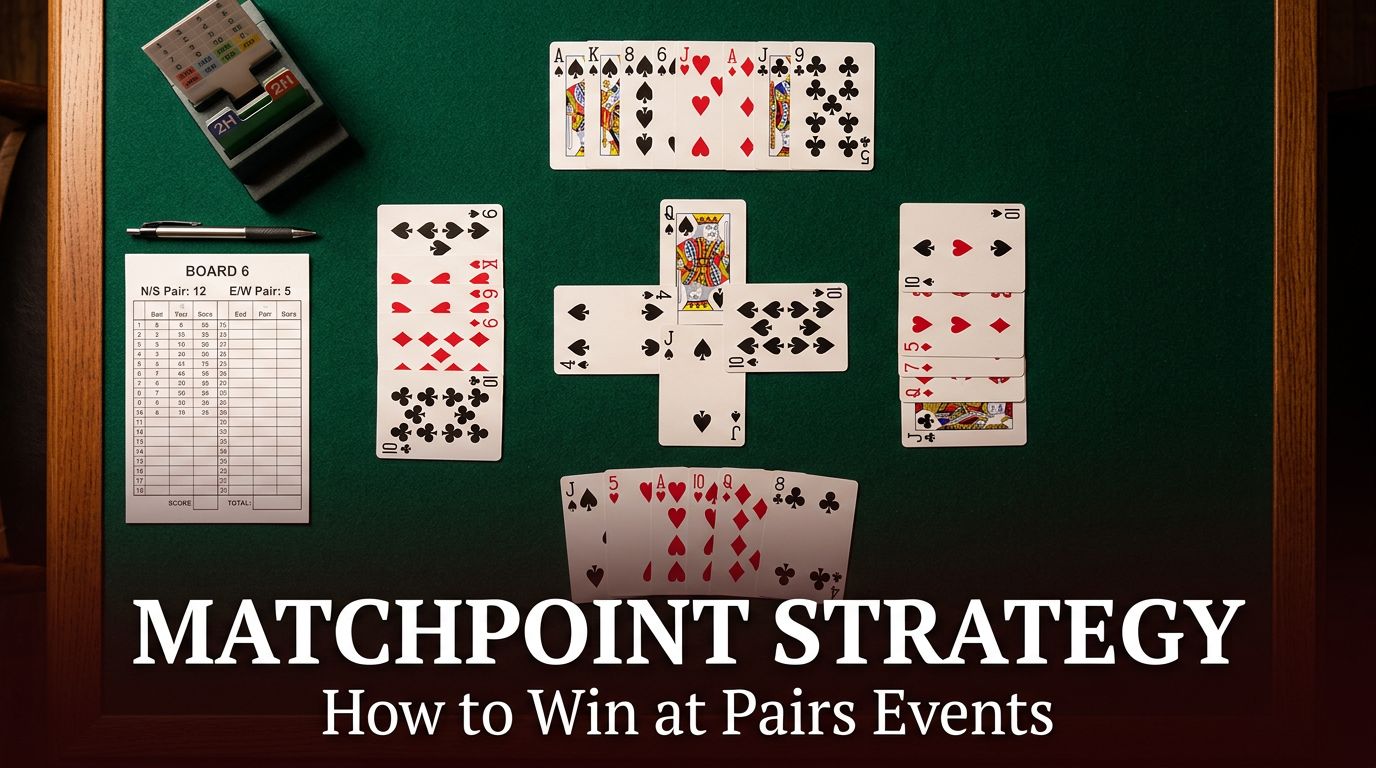
Matchpoint Strategy: When Overtricks Matter More Than Safety
Matchpoint bridge is a different game. You can make your contract all day and still score poorly. You can go down in a contract that shouldn’t be bid and get a good result. The question isn’t “did I make this?” It’s “did I do better than everyone else?”
This changes how you bid, how you play, and how you think about risk.
The Overtrick Problem
You’re declaring 4♠ and you’ve got 10 tricks in the bag. You can see a possible 11th trick if you take a club finesse, but if the finesse loses, you might go down. What do you do?
In rubber bridge or IMPs, you take your 10 tricks and run. Making 4♠ with an overtrick scores you 30 extra points, which is nice but not worth risking your contract. Going down costs 420 points.
In matchpoints, you take the finesse.
Here’s why. Most pairs will be in 4♠. If you make 10 tricks and they make 11, they score +450 and you score +420. They beat you. If you make 11 tricks and they make 10, you beat them. That 30-point difference is the difference between a top and an average board.
But what about the risk? If the finesse loses and you go down, you get -50 while everyone else gets +420. That’s a bottom.
The key is this: in matchpoints, you’re not playing one board. You’re playing 20 or 24 or 26 boards. One bottom won’t kill you. What kills you is getting average on every board. You need some tops to win.
Taking calculated risks for overtricks is how you get tops.
Playing With the Field
The most important concept in matchpoint strategy is “playing with the field.” This means making the same decisions everyone else makes, then trying to execute slightly better.
If everyone is going to be in 4♠, you should be in 4♠. Your job is then to make 4♠ with more overtricks than they do, or to make it when they go down.
If you’re in 3NT while everyone else is in 5♣, you’re now playing a different contract. If both contracts make the same number of tricks, you’ll probably lose (game in a major or notrump scores better than game in a minor). You need something unusual to happen.
This doesn’t mean always do what everyone else does. Sometimes you have a good reason to deviate. But you need to understand that deviating creates variance. You’re now playing for a top or a bottom instead of competing in the normal range.
When to Play Safe
Yes, you should take risks for overtricks in matchpoints. But not on every board.
The time to play safe is when you’re in a contract that not everyone will reach. You’re in 3NT and you’re pretty sure most pairs are stopping in 2NT or 3♣. Your 3NT is probably making, and if it makes you’ll beat most of the field just by being in game.
Now you don’t take the finesse for the overtrick. You take your 9 tricks. Making 3NT for +400 beats everyone who stopped in partscore (they’re scoring 90 or 110 or 130). If you risk the contract for a 10th trick and go down, you turn your top into a bottom.
Another time to play safe is when the field might be going down. If the contract is thin and you suspect half the field won’t make it, you play to make. Let them crash and burn while you post +420.
Declarer Play Examples
Let’s walk through specific situations.
Example 1: The Overtrick Finesse
You’re in 4♥ on this layout:
Dummy: ♠A53 ♥K842 ♦AJ4 ♣765
You:   ♠K42 ♥AQ1095 ♦K5 ♣AQ2
You get a spade lead. You have 10 tricks: 2 spades, 5 hearts, 2 diamonds, 1 club. You can try the club finesse for an 11th trick, but if it loses they might cash a club and a diamond for down one.
In matchpoints, you take the club finesse. The field is in 4♥, and whoever makes 11 tricks beats everyone who makes 10. Yes, you might go down. But the upside (beating most of the field) is worth the downside (one bad board).
Example 2: The Safety Play
You’re in 6♠ on this layout:
Dummy: ♠K843 ♥A54 ♦AQ3 ♣AJ4
You:   ♠AQ1092 ♠K3 ♦K52 ♣K62
You need 12 tricks. You have 11 top tricks and need to pick up the spades. If spades are 2-2, you’re fine. If they’re 3-1 with the jack offside, you need to finesse.
The safety play in spades is to cash the ace first, then lead toward the king. If someone shows out on the first round, you can finesse on the second round. This picks up any 3-1 break but loses if someone has all four spades.
Do you take the safety play?
Yes. The field probably isn’t in 6♠. Most pairs are in 4♠ making 12 tricks. If you make your slam, you beat them. If you go down, you lose to them. The whole match is making this slam. You’re not looking for overtricks. You’re protecting your contract.
Example 3: The Guess
You’re in 3NT and you have to guess which opponent has the ♠Q for your 9th trick. No clues from the bidding or play. Pure guess.
In IMPs, you’d think about the percentage play based on restricted choice or vacant spaces. In matchpoints, you think about the field.
If everyone is in 3NT and everyone has the same guess, it doesn’t matter what you do. Half will guess right, half will guess wrong. You’ll get an average board.
But if you think some pairs might be in a different contract, or might have gotten a different lead that gives them the information, then you’re trying to beat them. Make your best guess and move on.
The point is this: when everyone has the same guess, the result is random luck. Don’t overthink it.
Bidding Strategy
In matchpoints, you stretch to bid games and you avoid slams unless they’re cold.
Thin Games
If a game is 40% to make, you bid it in matchpoints. Why? Because if you’re in partscore and the field is in game:
- When game makes (40% of the time), you get a bad score
- When game fails (60% of the time), you get a good score
So you’ll beat 60% of the field. Sounds good, right?
But the pairs who bid game also beat you 40% of the time, and they beat you by more. The pairs who made the game get a top, you get a bottom. The pairs who failed in game get an average, you get a top.
The math works out that bidding thin games wins in matchpoints. When they make, you look brilliant. When they fail, you lose but so does everyone else who bid game.
Slams
Slams are different. If you bid a slam that makes, you get a top. If you bid a slam that fails, you get a bottom. But if you don’t bid the slam and it makes, you still get an OK result (you made your game while others went down in slam).
This means you should only bid slams that are close to cold. If a slam is 55% to make, that’s not enough. Half the field will bid it and make, getting a top. Half will bid it and fail, getting a bottom. You’ll get slightly above average by staying out (you make game while the failed slams go down).
You need the slam to be about 70% or better before it’s worth bidding in matchpoints. The risk-reward is asymmetric. The gain from making a slam (beating pairs in game) is similar to the loss from failing in a slam (losing to pairs in game). But you don’t know if the field will bid it.
Competitive Bidding
In matchpoints, you compete aggressively. Sometimes this means bidding one more time when you probably shouldn’t.
The opponents have bid to 3♥. You think you can make 3♠, but you’re not sure. Do you bid it?
Yes. Here’s why. If 3♠ makes and you pass, they make 3♥ and you get -140. Bottom board. If you bid 3♠ and make it, you get +140. Top board.
If 3♠ goes down one, you get -50. But if 3♥ also makes, the pairs who defended 3♥ get -140. You lose to them, but you beat the pairs who also bid 3♠ and went down.
The calculus is complicated, but the principle is simple: in matchpoints, taking your chances in your contract is often better than defending their contract. Even if you’re not sure you can make it.
Defensive Strategy
On defense, you’re trying to beat the contract. But you’re also thinking about overtricks.
If the opponents are in 3NT and you’re on lead, you might try a risky lead that could beat the contract if it works, or give away the contract if it doesn’t. In IMPs, you’d make the safe lead. In matchpoints, the risky lead is often right.
Why? Because if 3NT is making at most tables, your goal is to beat it. If your safe lead lets them make 3NT and everyone else does too, you get average. If your risky lead beats 3NT when their safe leads don’t, you get a top.
The other defensive consideration is overtricks. If you’re beating 3NT by 2 tricks and you can try for a 3rd undertrick, do you?
Usually no. Beating it by 2 instead of 1 might matter if some pairs let it make. But if everyone is beating it, the difference between -100 and -150 is only 1 matchpoint per pair you beat. Not worth risking the contract making if your desperate defense gives declarer a chance.
The Matchpoint Mindset
The key to matchpoints is accepting that you’ll have bad boards. You’ll take a finesse, it will lose, you’ll go down, bottom board. That’s part of the game. What you can’t do is play scared and take average after average.
Think of it this way: if you get 50% on every board, you’ll score 50% overall. That’s a losing game. You need boards where you score 80%, 90%, 100%. To get those, you need to take risks. Some will work, some won’t. But the ones that work will carry you.
The best matchpoint players have a simple philosophy: make the normal bid, then try to outplay the field in the execution. They don’t look for weird contracts or unusual strategies. They compete in the same auctions as everyone else, they reach the same contracts, and then they make one more trick in the play because they took a finesse that others didn’t take, or they defended more accurately, or they found a lead that gave them an extra undertrick.
That’s the game. Not being different, but being slightly better at the same things everyone else is doing.