Rubber Bridge Scoring
Before duplicate bridge, before matchpoints and IMPs, there was rubber bridge. This is the game people played (and still play) at home. You sit down with three friends, shuffle the cards, and play until someone wins. The scoring is cumulative, vulners change based on who’s winning, and the goal is to win two games before your opponents do.
It’s a completely different feel from duplicate bridge. Instead of comparing your result to a field, you’re racing your opponents to win games and rubbers.
The Basic Structure
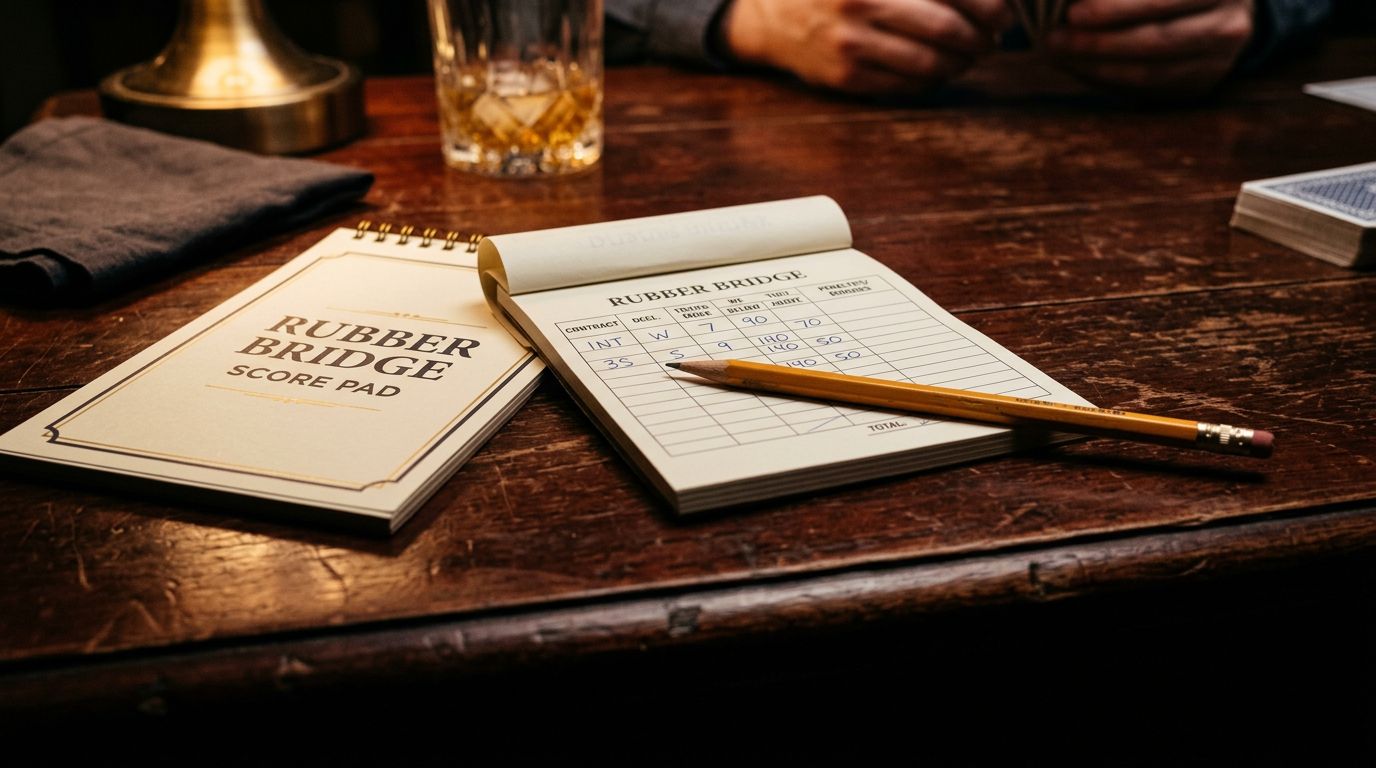
Rubber bridge is scored in two columns: “We” and “They.” You and your partner are We, your opponents are They. Every hand, you write the result in one column or the other.
The scorepad has a horizontal line across the middle. Scores go either below the line or above the line.
Below the line: Points for bidding and making contracts. This is how you win games.
Above the line: Bonuses and penalties. Overtricks, undertricks, honors, slam bonuses. These don’t count toward game, but they do count toward who wins money at the end.
Scoring Below the Line
When you bid a contract and make it, you score below the line based on what you bid and made:
- Clubs or Diamonds: 20 points per trick bid and made
- Hearts or Spades: 30 points per trick bid and made
- Notrump: 40 points for the first trick, 30 for each additional trick
You only get credit for what you bid. If you bid 2♥ and make 4, you only score 60 points below the line (2 × 30). The two overtricks go above the line.
To win a game, you need 100 points below the line. You can get there in one hand by bidding game (3NT, 4♥, 4♠, 5♣, 5♦), or you can accumulate it over several hands with partscores.
Games and Rubbers
When you score 100 points below the line, you win a game. The scorekeeper draws a line across both columns, and a new game starts. The scores below the line reset to zero. Everything above the line stays.
If you win a second game before your opponents win their first, you win the rubber. If each side wins one game, the rubber continues until someone wins the second game.
Winning the rubber gets you a big bonus:
- Win 2 games to 0: +700 points (above the line)
- Win 2 games to 1: +500 points (above the line)
At the end of the rubber, you add up everything: all the below-the-line scores, all the above-the-line bonuses, overtricks, penalties, everything. Whoever has more points wins. Usually you’re playing for money, so you settle up based on the difference.
Vulnerability
After you win your first game, you become vulnerable. This means:
- Penalties for going down are higher
- Bonuses for making slams are higher
- Game and partscore bonuses are higher
At the start of a rubber, nobody is vulnerable. After one side wins a game, they’re vulnerable and the other side isn’t. If it goes to a third game (one game each), both sides are vulnerable.
Vulnerability changes your bidding strategy. When you’re vulnerable and they’re not, going down is expensive. When they’re vulnerable and you’re not, doubling them can be lucrative.
Overtricks
When you make more tricks than you bid, the overtricks score above the line:
- Not vulnerable: Same value as the contract (20 for minors, 30 for majors, 30 for NT)
- Vulnerable: Same value as the contract
- Doubled: Different calculation (see below)
For example, you bid 3♥ and make 5. You score 90 points below the line (3 × 30) for the contract you bid. You also score 60 points above the line (2 × 30) for the two overtricks.
Overtricks don’t help you win the game (they don’t go below the line), but they increase how much you win when you win the rubber.
Undertricks (Going Down)
When you don’t make your contract, you don’t score anything. Your opponents score above the line based on how many tricks you were short:
Not vulnerable:
- Down 1: 50
- Down 2: 100
- Down 3: 150
- And so on, 50 per trick
Vulnerable:
- Down 1: 100
- Down 2: 200
- Down 3: 300
- And so on, 100 per trick
These go above the line in your opponents’ column. They don’t help them win games, but they do increase their total score.
Doubles and Redoubles
If your opponents bid 2♠ and you think they’re going down, you can double. If you’re right and they go down, the penalties are bigger. If you’re wrong and they make it, they score more points.
Making doubled contracts:
If they make a doubled contract, they get double the normal below-the-line score, plus a 50-point bonus above the line. Overtricks also score more:
- Not vulnerable: 100 per overtrick
- Vulnerable: 200 per overtrick
Going down doubled:
The penalties are much steeper:
Not vulnerable:
- Down 1: 100
- Down 2: 300
- Down 3: 500
- Each additional: +200
Vulnerable:
- Down 1: 200
- Down 2: 500
- Down 3: 800
- Each additional: +300
Redoubles:
If they double you and you think you’ll still make it, you can redouble. This doubles all the scores again. Redoubles are rare because the stakes get huge.
Slam Bonuses
When you bid and make a slam, you get a bonus above the line:
Small slam (12 tricks):
- Not vulnerable: 500
- Vulnerable: 750
Grand slam (13 tricks):
- Not vulnerable: 1000
- Vulnerable: 1500
These are in addition to the points you score for the contract itself. Bid 6♠ vulnerable, make it, you get 180 below the line (6 × 30) plus 750 above the line for the slam bonus.
If you bid a slam and fail, you don’t get the bonus. You also go down and your opponents score the undertrick penalties. This is why slam bidding needs to be accurate.
Honors
Honors are a quirky part of rubber bridge that doesn’t exist in duplicate. If you’re dealt certain high cards in the trump suit (or in notrump), you get a bonus above the line:
In a suit contract:
- 4 honors (A, K, Q, J of trumps) in one hand: 100
- 5 honors in one hand: 150
In notrump:
- 4 aces in one hand: 150
You get these points just for being dealt the cards. It doesn’t matter if you bid or made the contract. If your opponents bid 4♠ and you hold ♠AKQJ, you still get 100 points for honors even though they won the contract.
Honors add a luck element to rubber bridge. You can lose a hand but still get 100 points for honors. It’s frustrating when it happens against you and satisfying when it happens for you.
Partscore Strategy
One unique aspect of rubber bridge is the partscore carryover. If you bid and make 2♥, you score 60 points below the line. You’re 40 points away from game. On the next hand, if you bid and make 1NT, you score 40 more points below the line, reach 100, and win the game.
This creates interesting strategic decisions. When your opponents have a partscore, you might compete more aggressively to prevent them from completing their game. When you have a partscore, you’re more eager to bid because you’re close to game already.
In duplicate bridge, every hand is independent. In rubber bridge, the state of the score matters. A partscore sitting on the board changes the whole dynamic.
Sample Rubber
Let’s walk through a simple rubber to see how it all works.
Hand 1: You bid 4♠ and make exactly. You score 120 below the line (4 × 30). You win the first game. A line is drawn, and you’re now vulnerable.
Hand 2: They bid 3NT and make with an overtrick. They score 100 below the line (40 + 30 + 30) and 30 above the line for the overtrick. They win the second game and become vulnerable. We’re tied 1-1 in games, both vulnerable.
Hand 3: You bid 2♥ and go down one. They score 100 above the line (vulnerable penalty). The score is tied below the line at 0-0 for the new game, but they’re ahead overall because of the penalty.
Hand 4: They bid 1NT and make exactly. They score 40 below the line.
Hand 5: You bid 3♣ and make 5. You score 60 below the line and 40 above the line for the two overtricks.
Hand 6: They bid 2♠, you double, they make exactly. They score 60 × 2 = 120 below the line, plus 50 for the doubled bonus. They reach 100 + 120 = 220 below the line (more than 100), so they win the third game and the rubber.
Final score:
- We: 120 + 60 = 180 below, 40 above = 220 total
- They: 100 + 40 + 120 = 260 below, 30 + 100 + 50 + 500 (rubber bonus) = 680 above = 940 total
They win by 720 points. If you’re playing for a penny a point, you owe them $7.20.
Chicago Scoring
A variant of rubber bridge is Chicago (also called Four-Deal Bridge). You play exactly four hands. Vulnerability rotates: nobody vulnerable on deal 1, dealer’s side vulnerable on deals 2 and 3, both vulnerable on deal 4.
After four deals, you add up the scores. There’s no rubber, so you get a smaller bonus for making a game:
- Not vulnerable game: 300
- Vulnerable game: 500
- Partscore: 50
Chicago is popular because it has a defined endpoint. You can play a Chicago wheel in 20-30 minutes, whereas a rubber can go on for an hour if games keep alternating.
Why Rubber Bridge Matters
Most serious players today focus on duplicate bridge. But rubber bridge is still the form of the game most people play at home. It’s social, it’s easy to understand, and you don’t need a director or a movement or scoring software.
The scoring system rewards consistent bidding and cardplay over the course of multiple hands. You can’t win a rubber on one lucky deal (though honors help). You need to win two games, which usually means playing well over 10-15 hands.
Rubber bridge also teaches you to think about the score. When you’re vulnerable and they’re not, you need to be more conservative. When they have a partscore, you need to think about competing. These considerations don’t exist in duplicate, where every hand is scored independently.
If you learned bridge playing rubber at home, understanding the scoring helps you appreciate where the game came from. And if you’ve only played duplicate, try a rubber sometime. It’s a different rhythm, a different strategy, and a reminder that bridge is fundamentally a partnership game played over time.