Dummy Play: Planning and Executing from Declarer's Perspe...
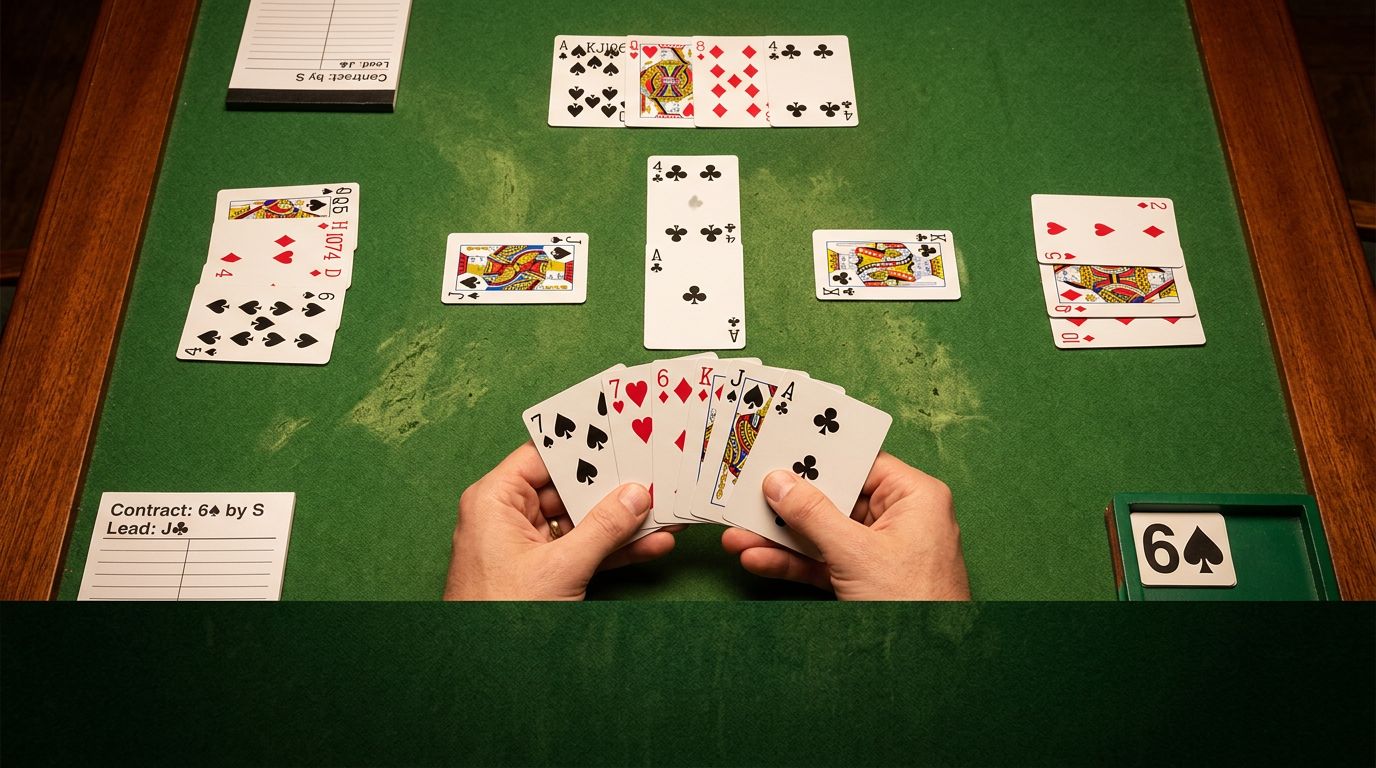
The opening lead hits the table. Your partner spreads their cards face-up, becoming the dummy. Now you’re on your own.
For the next few minutes, you control 26 cards across two hands. The defenders get to see 13 of them (dummy) and can deduce plenty about the other 13 (yours) from the bidding and play. You get to see all 26 and plan accordingly.
That’s your edge. Use it.
What Is the Dummy?
After the auction ends, the player to declarer’s left makes the opening lead. As soon as that card hits the table, declarer’s partner spreads their hand face-up on the table and becomes the “dummy.”
The name isn’t an insult (mostly). It comes from the French word “mort,” meaning dead. The dummy hand is dead, it doesn’t make decisions. Declarer plays from both hands, calling for cards from dummy when it’s dummy’s turn.
From this point forward, it’s declarer vs. the defenders. Dummy just sits there, occasionally commenting on your line of play. (Good dummies don’t actually comment. They wait until the hand is over.)
The First Look: Taking Stock
When dummy comes down, new declarers immediately start playing. Good declarers pause.
Here’s what to do before you play a single card to trick one:
1. Count Your Winners (Notrump)
If you’re in 3NT, count your sure tricks. Not your hopeful tricks. Your sure tricks.
Dummy:
♠ AK3
♥ 654
♦ KQ1098
♣ 32
Your hand:
♠ 654
♥ AK2
♦ A32
♣ AQ54
Count: 2 spades, 2 hearts, 3 diamonds (ace-king-queen), 1 club. That’s 8 tricks. You need 9 for 3NT. Where’s the 9th coming from? Maybe a long diamond if they split 3-2 (68% chance), maybe a club finesse (50% chance).
Plan before you play. If you need the diamonds to split, you’ll need to preserve entries to dummy. If you’re taking the club finesse, you need to plan when to take it.
2. Count Your Losers (Suit Contracts)
If you’re in 4♠, count your losers. You can afford 3 in a game contract (13 total tricks minus 10 you need to make). More than 3, and you’re in trouble unless you can get rid of some.
Dummy:
♠ K432
♥ 2
♦ AKQ4
♣ 8654
Your hand:
♠ AQJ109
♥ A43
♦ 32
♣ AK3
Count losers: 0 in spades (you have 10 between the hands), 2 in hearts, 0 in diamonds, 1 in clubs. That’s 3 losers. Perfect. But if spades don’t break and someone has 4 trumps, you might lose a trump trick too. Better plan for how to avoid that.
3. Look at the Opening Lead
The lead tells a story. A ♥K shows KQJ or KQ10. A low ♠3 suggests length. The opening lead is the only card the defense chooses freely. Use that information.
4. Identify Dummy’s Assets
What does dummy bring to the party?
- Long suit? ♦KQ1098 might produce 3-4 tricks if you can establish it.
- Ruffs? If dummy has 2 hearts and you have 5, you might ruff hearts in dummy.
- High cards in your weak suits? Dummy’s ♠K might cover your ♠xxx.
- Entries? How many times can you get to dummy? Count aces, kings, and ruffing opportunities.
Your plan depends on what dummy offers. If dummy is balanced with scattered honors, you’re grinding for tricks. If dummy has a long suit and shortness, you’re setting up ruffs and long cards.
Planning the Play
After you’ve taken stock, make a plan. Not a vague “I’ll try this and see what happens” plan. A real plan.
Notrump: Establish Your Long Suit
In notrump, you usually win by establishing a long suit. Find your best suit (often dummy’s), knock out the defender’s stoppers, then cash the established winners.
Example:
Dummy:
♠ 432
♥ 65
♦ AKQJ10
♣ 432
You:
♠ AK5
♥ A32
♦ 432
♣ AK65
You have 9 top tricks: 2 spades, 1 heart, 5 diamonds, 2 clubs. Just cash them and go home. But wait, you need to get to dummy to cash those diamonds. If you cash your outside winners first, you might have no way to reach dummy.
Plan: Win the opening lead in hand, cross to dummy with a diamond, cash the remaining diamonds, then cash your outside winners. Simple, but only if you plan it before trick one.
Suit Contracts: Eliminate Losers
In a suit contract, your plan is usually “how do I get rid of losers?”
The main ways:
- Ruff them in dummy (or less commonly, in hand)
- Discard them on dummy’s winners
- Finesse to avoid them
- Force the opponents to lead the suit
Example:
Contract: 4♠
Dummy:
♠ K32
♥ 32
♦ AKQ54
♣ 654
You:
♠ AQJ109
♥ A54
♦ 32
♣ AK2
Count losers: 0 spades, 2 hearts, 0 diamonds, 1 club. You can afford 3 losers for game, so you’re safe. But you can do better.
Plan: Draw trumps, then cash dummy’s diamonds. If they split 3-2, you’ll have 2 long diamonds in dummy. Discard your 2 heart losers on them. Now you lose only 1 club, making an overtrick.
That’s the difference between declarers who make their contracts and declarers who make with overtricks. Planning.
Entries to Dummy: Managing Communication
You can see dummy’s tricks. But can you reach them?
Entries are the roads between your hand and dummy. Without them, dummy’s winners are stranded.
Preserving Entries
Dummy:
♦ KQ1098
♣ 32
You:
♦ A32
♣ AK4
You have 3 diamond tricks and 2 club tricks. Easy, right? But if you cash the ♦A first, you’re in your hand. Now you have to use a club to get to dummy to cash the ♦KQ. Then you’re stuck in dummy with the ♦109 and no way back.
Better plan: Cash a club to get to dummy, run the ♦KQ109, come back with the other club, cash the ♦A. Now you’ve used your entries efficiently.
Principle: Use entries to reach established winners, not to establish them.
Creating Entries: The Duck
With ♠87654 in dummy (no outside entries) and ♠AK2 in hand, duck a spade early. Now after you cash the ace and king, your remaining small spades are entries to dummy’s established winners.
Principle: Duck to create entries in long suits.
Entry Timing
Use entries in the right order: establish the suit first, then use your entry to cash the winners. Don’t burn your last entry while the suit is still being established.
Using Dummy’s Assets
Dummy usually brings something useful. Your job is to figure out what and exploit it.
Long Suits
Dummy’s long suit is often your best source of tricks.
Dummy:
♥ KQ1098
♣ A (entry)
You:
♥ 32
If hearts split 3-2 (68% of the time), you have 3 heart tricks after the ace is knocked out. Even if they’re 4-1, you might still get 2 tricks.
Plan: Lose a heart early (establish the suit), then use the ♣A to get to dummy and cash the hearts.
Ruffs in Dummy
If dummy has shortness in a suit and enough trumps, you can ruff your losers there.
Contract: 4♥
Dummy:
♥ 432
♠ 2
♦ AK543
♣ 6543
You:
♥ AKQ109
♠ AK543
♦ 2
♣ AK
You have 2 spade losers. But dummy is short in spades. After you lose 1 spade, you can ruff your remaining spade losers in dummy with dummy’s small trumps.
Plan: Win the opening lead, cash 1 top spade (in case someone has a singleton and can ruff), lose a spade, ruff your remaining spades in dummy. Now draw trumps and claim.
Honor Combinations
Dummy’s honors combine with yours to create tricks. With ♠KJ3 in dummy and ♠Q42 in hand, lead toward dummy twice. If LHO has the ace, you get 2 tricks. If RHO has it, you get 0. Use dummy’s honors to create chances.
When to Draw Trumps vs. Delay
New players are taught: draw trumps immediately. But that’s not always right.
Draw Trumps When:
- You have enough tricks without ruffs
- You can’t risk someone ruffing your winners
- Dummy’s high trumps are your only entries
Delay Drawing Trumps When:
- You need to ruff losers in dummy first
- You must establish a side suit and need the tempo
- You’re setting up an advanced play (squeeze, endplay)
Example: Delay Trumps
Contract: 4♥
Dummy:
♥ 432
♠ 32
♦ AK32
♣ 7654
You:
♥ AKQ109
♠ AK54
♦ 54
♣ AK
You have 2 spade losers. If you draw trumps immediately, those spade losers are still there. Instead, cash the ♠AK, lose a spade, ruff your last spade in dummy, then draw trumps. Now you’ve eliminated the losers before drawing trumps.
Example Hands with Dummy Play Decisions
Example 1: The Hold-Up Play
Contract: 3NT
Opening lead: ♠5
Dummy:
♠ K3
♥ 654
♦ KQ1098
♣ 432
You:
♠ A42
♥ AK2
♦ A32
♣ AQ65
RHO plays the ♠Q. Do you win the ace?
Decision: Hold up. You have the ♠K in dummy as a second stopper. If you win the ace immediately and later lose the lead to LHO, they’ll run spades.
Instead, duck. Win the second spade (or even the third). Now if you lose the lead, RHO might not have spades left to return to partner. You’ve broken communication between the defenders.
This is the hold-up play: delaying winning a trick to disrupt the defense’s communication.
Example 2: Safety Play in Trumps
Contract: 4♠
Dummy:
♠ KJ32
♥ A32
♦ KQ4
♣ 654
You:
♠ AQ1098
♥ K5
♦ A32
♣ AK2
You have 10 spades. Missing 3 to the 765. Do you finesse the queen?
Decision: Cash the ace first. If someone shows out (has 0 spades), you’ve saved yourself. Now you can finesse through the remaining trumps.
If both follow to the ace, cash the king. If both follow again, the last trump falls and you don’t need to finesse.
This is a safety play: giving up the chance at an overtrick to guarantee the contract. You’re in game. Take your 10 tricks and move on.
Example 3: Using Dummy’s Entries
Contract: 6NT with 6 diamonds in dummy, no outside entries.
Decision: Don’t cash all your winners first. Use a diamond to get to dummy, cash the diamonds, then come back to cash your remaining winners. If you cash everything in hand first, dummy’s diamonds are stranded.
Common Dummy Play Mistakes
Mistake 1: Playing Too Fast
Dummy comes down, you see a line of play, you start executing it immediately. Then halfway through, you realize there’s a better line. Too late.
Take your time at trick one. In tournaments, you’re entitled to think. Use it.
Mistake 2: Not Counting
Count every time. Winners in notrump, losers in suits. “Enough” tricks often means one short.
Mistake 3: Drawing Trumps Automatically
Ask yourself: “Do I need dummy’s trumps for ruffs?” If yes, use them first. If no, draw trumps immediately.
Mistake 4: Ignoring the Opening Lead
The opening lead and bidding tell you where high cards are. LHO opened? They likely have the missing king. RHO passed? They probably don’t. Use the clues.
Mistake 5: Running Out of Entries
Count entries before you start. “I need 2 entries. I have 2. Good.” If you’re short, create them by ducking or preserving high cards.
Mistake 6: Taking Unnecessary Risks
Don’t finesse for overtricks when you’re already making. A failed finesse for an 11th trick that lets the defense cash 5 winners is terrible bridge.
Mistake 7: Blocking Suits
With ♦KQ109 in dummy and ♦AJ8 in hand, unblock the ace first, then the jack. Don’t block the suit by carelessly cashing high cards.
Mistake 8: Forgetting About the Defense
Your elegant line works perfectly, unless the defense leads trumps and removes dummy’s ruffs. Always ask: “What can they do to hurt me?” Take your ruffs early if needed.
Sharpen Your Strategy with Brian
Want to put these strategic concepts into practice? Brian analyzes your bridge hands and explains the optimal line of play. Try Brian free →
The Mental Checklist
Before trick one:
- Count winners (notrump) or losers (suits)
- Identify dummy’s assets (long suit, ruffs, entries, honors)
- Count entries to dummy
- Make a plan
- Consider what can go wrong
- Execute
The best declarers adjust as new information arrives, but they always start with a plan. That’s the difference between hoping to make and expecting to make.
Use dummy well.