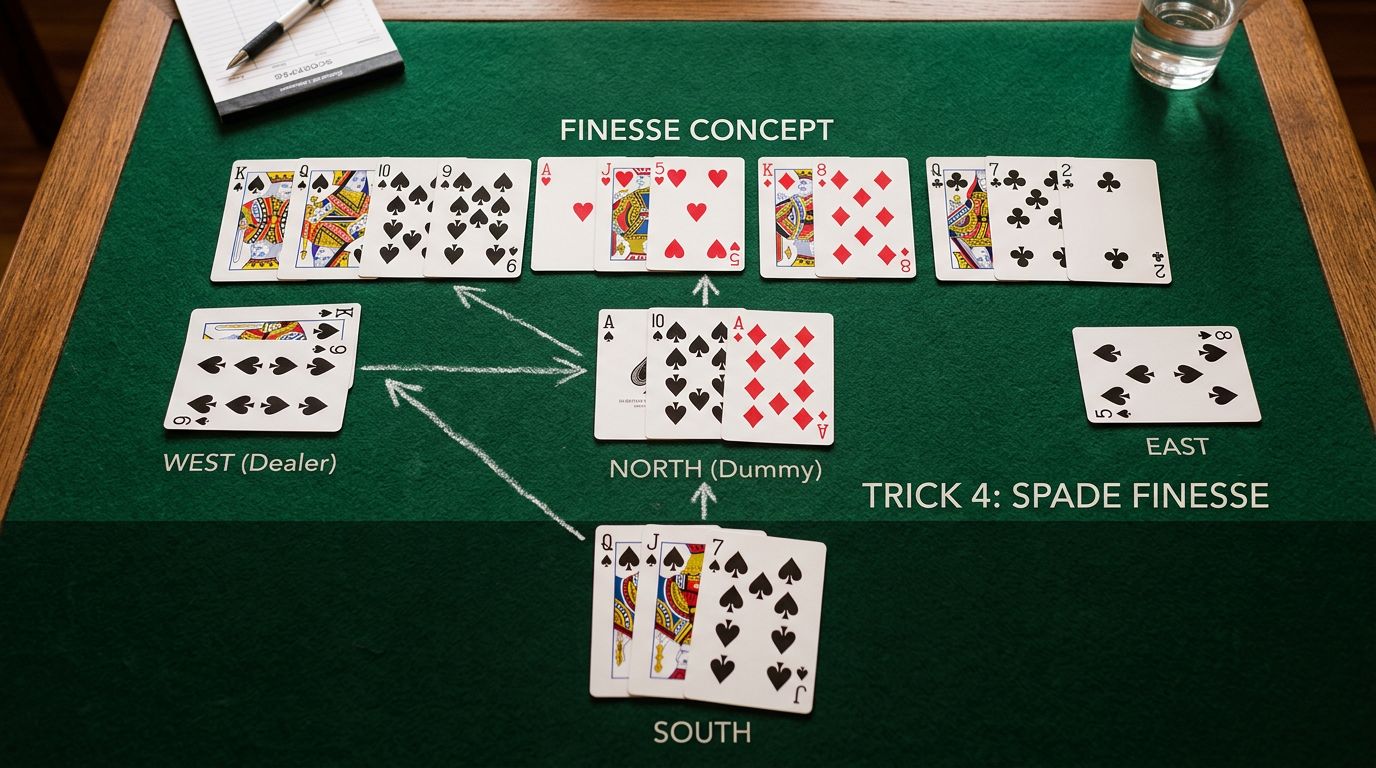
Entries and Communication
You’re declarer in 3NT. Dummy has 5 running diamonds, but only one outside entry. You take the opening lead in hand, cash the entry to dummy, and run the diamonds. Contract made.
Simple, right?
Now change one thing: the opening lead knocked out dummy’s only entry before you could use it. Now those 5 running diamonds are worthless. You go down with 9 tricks sitting in dummy.
Welcome to the world of entries and communication. It’s not sexy, it’s not flashy, but it’s the difference between making contracts and watching them collapse.
What Are Entries?
An entry is a high card that lets you get from one hand to the other. The ♠A is an entry to the hand that holds it. So is the ♠K if the opponents have already played the ace.
The problem: you have 26 cards split across two hands. To use all your tricks, you need to be able to move back and forth. Run out of entries, and tricks get stranded.
The Basic Problem
Dummy: ♦ AKQJ10
You: ♦ 32
You have 5 diamond tricks. But you need to get to dummy to cash them. If dummy has no outside entry (no ace or king in another suit), those diamonds are useless unless you’re already in dummy when you start running them.
This is the nightmare scenario for declarers: tricks you can see but can’t reach.
Preserving Entries
The first rule of entry management: don’t waste them.
Example 1: The Holdup Play
You’re in 3NT. LHO leads the ♠5. Dummy has ♠K3, you have ♠A2.
New players win the ace immediately. But wait. That king in dummy might be your only entry. If you win the ace, you’ve wasted two entries (ace and king) on one trick.
Instead, hold up. Play low from dummy, win the ace. Now dummy’s king is still there as an entry.
Or reverse it: win the king from dummy, save your ace for later as an entry to hand.
Principle: Don’t use two entries when one will do.
Example 2: Overtaking
Dummy: ♥ KQ43
You: ♥ AJ2
You need to get to dummy. You lead the jack, planning to overtake with the king. But wait, now you’ve used 2 honors (jack and king) to get to dummy once.
Better: lead the 2 toward dummy. Win the king or queen. Now the ace is in your hand, and dummy still has one high heart left. You’ve preserved an entry.
Principle: Lead toward honors rather than overtaking when possible.
Example 3: Unblocking
Dummy: ♣ KQ1098
You: ♣ AJ
You lead the ace. Dummy plays the 8. Now you lead the jack. Dummy plays the 9. You’ve just blocked the suit. The KQ10 are stranded because you can’t get to them.
Instead, unblock. Lead the ace, play the king from dummy. Then lead the jack, overtake with the queen. Now the 10 is good, and you’ve run 5 tricks.
Principle: Unblock high cards to avoid stranding honors.
This feels weird (wasting the king when the ace wins the trick), but it’s correct. You’re trading one trick now to ensure you get all 5 tricks.
Creating Entries
Sometimes you need to manufacture entries out of thin air.
Example 1: Ducking
Dummy: ♦ 87654
You: ♦ AK2
You have 2 entries (ace and king). But you’d like 3 so you can ruff something in dummy later. How?
Duck a diamond early. Give the opponents a trick. Now when you win the ace and king, the opponents are out of diamonds, and your little diamonds are entries to dummy. You’ve turned worthless spot cards into transportation.
Principle: Duck to create entries in long suits.
Example 2: Overtaking to Create Entries
Dummy: ♠ QJ109
You: ♠ AK2
You need 3 entries to dummy. You have 2 (the ace and king). But if you cash the ace and then lead the king, overtaking with the queen, you’ve created a third entry. The jack and 10 are now equals, and you can lead to either.
Yes, you’re “wasting” the king, but you’re gaining an extra trip to dummy. Sometimes that’s worth it.
Principle: Overtake to create additional entries when necessary.
Example 3: Finessing for Entries
Dummy: ♥ Q3
You: ♥ A42
You need to get to dummy. You could lead the ace and another, hoping to land in dummy. Or you could lead the 2 toward the queen, finessing LHO for the king.
If the finesse works, the queen is an entry. If it doesn’t, you’ve lost the king anyway. This is a rare case where you finesse not to win a trick, but to create an entry.
Principle: Finesse to create entries, not just to win tricks.
Timing: When to Use Entries
Having entries isn’t enough. You need to use them in the right order.
Example: Setting Up a Long Suit
Dummy: ♦ 87654
You: ♦ AK2
Outside entry in dummy: ♠A
You want to set up dummy’s diamonds. Here’s the wrong way:
- Lead a diamond to the ace.
- Lead a diamond to the king.
- Lead the ♠A to get to dummy.
- Oops. Diamonds don’t split 3-3. You can’t cash them.
Here’s the right way:
- Lead a diamond to the ace.
- Lead a diamond to the king.
- Lead a diamond, giving up a trick.
- Win whatever the opponents return.
- Lead to the ♠A.
- Cash the 2 long diamonds.
The difference? You used your side entry (the ♠A) after you established the suit, not before. Now it’s worth something.
Principle: Use entries to established suits, not developing suits.
Example: The Entry Squeeze
You’re in 3NT. You have 6 tricks. Dummy has a long suit that will produce 3 more tricks if you can get to it twice.
You have 2 entries to dummy, but you need to:
- Knock out a stopper
- Get back to cash the long suit
You can’t do both with 2 entries. Unless…
You knock out the stopper while you still have an entry in another suit. Opponents win and return their suit. You win, use entry #1 to get to dummy, cash one long trick, use entry #2 to get back and cash the rest.
Principle: Plan your entries before you start. Count how many you need, how many you have, and use them in order.
Entries in Suit Contracts
In suit contracts, entries work differently because you can ruff.
Using Ruffs as Entries
Dummy: ♥ 2 (and you have 3 small trumps)
You: ♥ — (void)
Dummy’s small heart is an entry if you can ruff it. Lead a heart from hand, ruff in dummy, and you’re in dummy. The “entry” is the ruff.
This comes up constantly in suit contracts. You use shortness in hand and length in dummy (or vice versa) to move back and forth.
Preserving Trump Entries
Dummy: ♠ AK3 (trumps)
You: ♠ QJ1098 (trumps)
You need to ruff something in dummy. You also need to draw trumps. The problem: if you draw all the trumps, you can’t ruff in dummy. If you ruff in dummy first, you might lose control.
Solution: use dummy’s high trumps as entries while they’re still trumps. Lead to the ace, ruff something, lead to the king, ruff something else. Now draw the remaining trumps from your hand.
Principle: Use high trumps as entries before drawing trumps.
Communication for Defenders
Defenders have the same problem: two hands, and you need to move the lead back and forth.
Example: Returning Partner’s Suit
Partner leads the ♠K (top of a sequence). You have ♠A32. Dummy has ♠QJ10.
You take your ace. Now you want to return spades so partner can run the suit. But how do you get back to partner?
If you return the 3, partner might think you started with A32 and declarer has 4 spades. If you return the 2 (lowest), partner knows you have 3 left and can count the hand.
Better yet, if you have an outside entry (say the ♥A), you might wait. Let declarer do something, then when you win the ♥A, return your last spade. Now partner knows you kept communication.
Principle: Preserve entries to partner’s long suit.
Example: Ducking to Keep Communication
Partner leads the ♦3 (fourth-best). Dummy plays low. You have ♦AJ5. Declarer plays the king.
Should you take the ace? If you do, you’ve broken communication. Partner led from Q10xx, and now the Q10 are stranded.
Instead, duck. Let declarer win the king. Now when partner gets in, they can lead diamonds through declarer’s remaining honor, and your ace-jack are sitting over it. You’ll take 4 diamond tricks instead of 1.
Principle: Duck to maintain communication with partner.
Common Mistakes
Mistake 1: Cashing Winners Without a Plan
You’re in 3NT. Dummy has ♦AKQ. You cash all three. Now you’re stuck in dummy with no way back to hand. Those 6 tricks in your hand are stranded.
Don’t cash winners just because they’re there. Cash them when you need them and when you can afford to land in that hand.
Mistake 2: Using the Last Entry to Get to a Non-Established Suit
You have 1 entry to dummy. Dummy has ♥87654. You use the entry, cash 1 heart, and hope the suit splits 3-3. It doesn’t. Now you’re out of entries and the hearts are worthless.
Use entries to cash tricks, not to develop them. Develop first, then use the entry.
Mistake 3: Blocking the Suit
Dummy: ♣ KQ109
You: ♣ AJ8
You lead the ace, then the jack. Now the KQ10 are blocked behind the jack. You can’t run the suit.
Unblock. Lead the jack first, overtake with the king. Then lead the 9, overtaking with the queen (if necessary). Plan your spot cards.
Mistake 4: Not Counting Entries
You need to get to dummy 3 times. You have 2 entries. You use one, use the second, and then realize you needed a third. Too late.
Count before you start. “I need 3 entries. I have 2. Can I create a third by ducking a round or by finessing?” Answer the question before you play to trick one.
The Advanced Play: The Entry-Shifting Squeeze
This is expert-level, but it’s beautiful.
You need 1 more trick. Dummy has ♦Qx and ♣Qx. You have the ♦Ax and ♣Ax. RHO has the ♦K and ♣K.
You run your trumps. On the last trump, dummy has ♦Qx and ♣Qx. RHO has to keep the ♦K and ♣K. But they can’t keep both. If they pitch a diamond, you cash the ♦A and ♦Q. If they pitch a club, you cash the ♣A and ♣Q.
The key: you need entries to dummy in both suits to execute the squeeze. Without entries, RHO just pitches whatever suit you can’t reach. With entries, RHO is squeezed.
Entries don’t just let you cash tricks. They let you execute advanced plays.
Sharpen Your Strategy with Brian
Want to put these strategic concepts into practice? Brian analyzes your bridge hands and explains the optimal line of play. Try Brian free →
The Bottom Line
Entries are the roads between your two hands. Without them, you’re stuck. Tricks sit in one hand while you’re in the other, unable to cash them.
Good declarers think about entries before trick one. They count: “I need 3 entries to dummy. I have 2. Can I create a third? Or can I make do with 2?”
They preserve entries by ducking, unblocking, and leading toward honors. They don’t waste aces and kings on the same trick. They don’t block suits by cashing high cards carelessly.
And they plan the order: set up the suit first, then use the entry to cash it.
Do this, and you’ll stop going down in cold contracts. Do this, and you’ll start making contracts that look impossible.
Entries aren’t flashy. But they’re the difference between an average declarer and a good one.