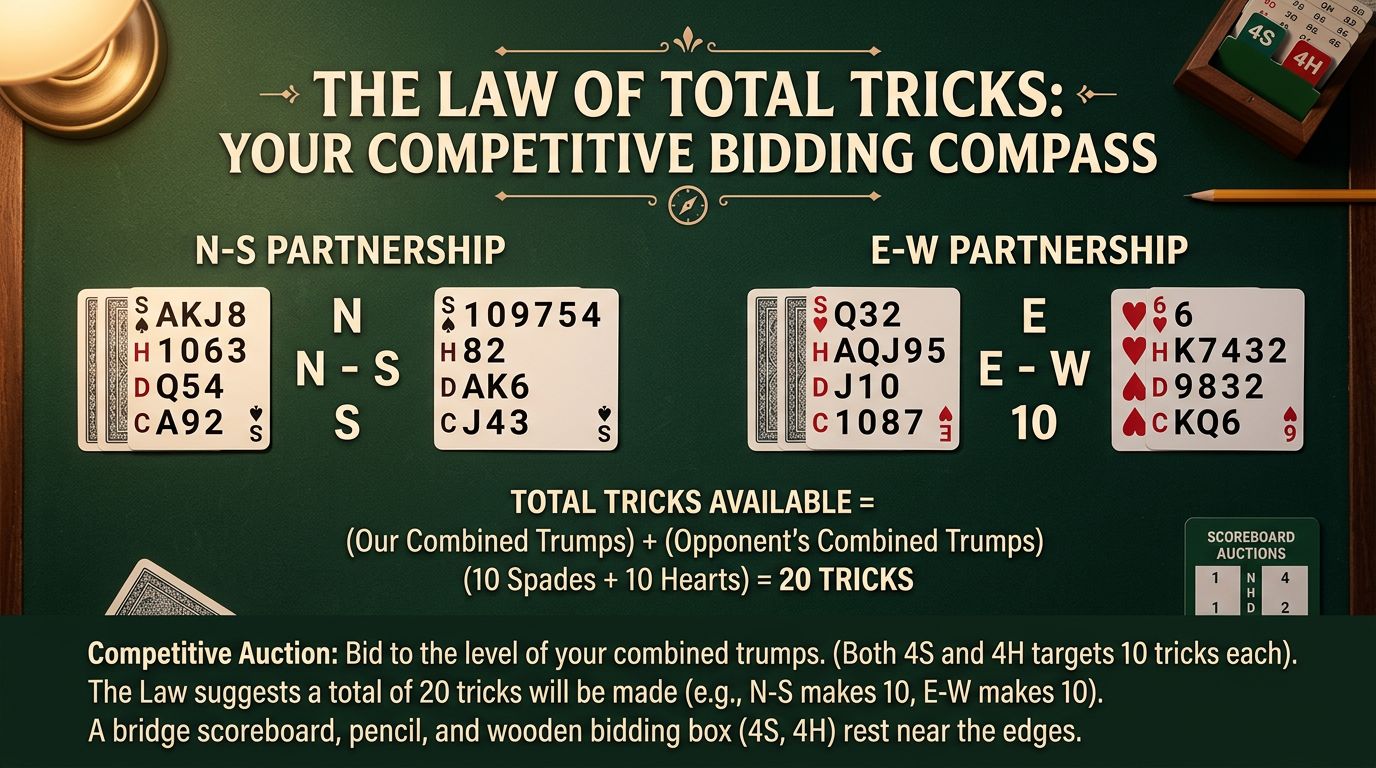
The Law of Total Tricks
You’re in a competitive auction. Both sides have a fit. The bidding is at the three-level, and you need to decide: bid one more or let them play it? Double or pass? Compete to 4♥ or defend 3♠?
The Law of Total Tricks gives you the answer. It’s not magic, it’s not perfect, but it’s the single most powerful tool for competitive bidding decisions.
The law of total tricks states that the total number of tricks available on a deal (their tricks in their best trump fit plus your tricks in your best trump fit) equals the total number of trumps (their trumps plus your trumps). If you have an eight-card heart fit and they have a nine-card spade fit, there are about 17 total tricks available. You might make nine tricks in hearts while they make eight in spades. Or you make eight and they make nine. But the total is around 17.
Larry Cohen popularized this principle in his book “To Bid or Not to Bid,” and it revolutionized competitive bidding. Before the Law, players guessed. After the Law, players counted trumps and made informed decisions.
Here’s how it works and how to use it at the table.
The Basic Principle: Total Tricks = Total Trumps
In competitive auctions where both sides have a trump fit, the total number of tricks available approximately equals the total number of trumps.
The Formula:
- Your trumps + their trumps = total tricks available
Example: You have 8 hearts, they have 9 spades. Total: 17 trumps = approximately 17 tricks.
If you can make 8 tricks in hearts (down one in 3♥), they can make 9 tricks in spades (making 3♠). Or you make 9 in hearts while they make only 8 in spades. Either way, the total is around 17 tricks.
Why This Matters
If there are 17 total tricks at the three-level (9 tricks needed), someone’s making their contract. You should compete.
If there are only 16 total tricks, both contracts fail. Now you decide: compete and go down, or defend and collect their penalty?
The Law gives you the framework for these decisions.
Counting Trumps in Competitive Auctions
Your side: Easy, infer from the bidding.
- 1♥ - 2♥ → 8 trumps
- 1♥ - 3♥ → 9 trumps
- Partner opens, you have 4-card support → 9 trumps
Their side: Listen to the auction.
- 1♠ - 2♠ → 8 trumps
- 1♠ - 3♠ → 9 trumps
- 1♠ - 4♠ → 10 trumps
- They compete to 3-level → probably 9 trumps (not doing it with 8)
Every bid tells you about trump length. Listen.
Using the Law for Bidding Decisions
The classic situation: you have a fit, they have a fit, and you need to decide whether to compete.
Decision 1: Bid One More or Pass?
The Guideline: If the level you’re considering equals the total number of trumps on your side, it’s usually right to bid.
Example 1: Eight Trumps, Should You Compete to 3♥?
The auction:
- 1♥ - (1♠) - 2♥ - (2♠)
- Pass - Pass - ?
You have 8 hearts. Should you bid 3♥?
Count total trumps. You have 8 hearts. They bid 1♠ - 2♠, so they have 8 spades. Total: 16 trumps.
The Law says there are 16 total tricks. At the three-level, you’re bidding for 9 tricks. If there are only 16 total tricks, both sides are going down.
Should you bid 3♥? It depends on vulnerability and whether you think they’d bid 3♠. If you’re non-vulnerable and they’re vulnerable, bidding 3♥ down one (-50) is a great sacrifice if they can make 2♠ (+110). But if nobody can make anything, you’re just offering them a chance to double you.
Example 2: Nine Trumps
Same auction, but you have 9 hearts.
Total: 9 + 8 = 17 tricks. At the three-level, one side is making their contract.
Bid 3♥. Either you’re making it, or you push them to 3♠ where they’ll make it. Competing is right.
Decision 2: When to Double
Doubling is the flip side of competing. When should you defend instead of bidding?
The Guideline: If the level they’ve bid is higher than the total number of tricks, double. They’re too high.
Example 3: Should You Double 3♠?
Auction: 1♥ - (2♠) - 3♥ - (3♠) - Pass - Pass - ?
You have 9 hearts, they have 9 spades. Total: 18 tricks.
At the three-level (9 tricks needed), both sides are making. Don’t double—they’re making 3♠. Doubling turns +140 into +530.
Example 4: When to Double
Same auction, but you have 8 hearts, they bid 3♠ with 9 spades.
Total: 17 tricks. They need 9 tricks, but there are only 17 total. They’re going down.
Double. Make them pay.
The “Bid to the Level of Your Trumps” Shortcut
Here’s the practical version of the Law that you can use at the table:
Compete to the level equal to the number of trumps you hold.
- 8 trumps → compete to the 2-level
- 9 trumps → compete to the 3-level
- 10 trumps → compete to the 4-level
This works because if you have 9 trumps and they have 8, there are 17 total tricks. At the three-level (9 tricks), you’re either making your contract or they’re making theirs. You should compete.
If you have 8 trumps and they have 9, there are 17 total tricks. You shouldn’t go to the three-level (9 tricks) with only 8 trumps. You’re stretched too thin. Let them bid 3♠ and see if they make it.
This shortcut isn’t perfect, but it’s incredibly useful in the heat of a competitive auction.
Adjustments for Hand Purity
The Law of Total Tricks is a guideline, not a law of physics. Real deals don’t always have exactly as many tricks as trumps. You need to adjust.
Pure Hands: Add a Trick
A “pure” hand has no wasted values in the opponents’ suits. Your honors are working in your suits, not sitting uselessly in their suits.
Signs of a pure hand:
- You have a singleton or void in their suit
- Your honors are in your long suits, not scattered in their suits
- You have no queens or jacks in their suit
- Your shape is distributional (5-4, 6-3, etc.)
Example: Pure Hand
You hold: ♠7 ♥KJ863 ♦AQ94 ♣542
They’re bidding spades. You have a singleton spade, all your honors are in your suits (hearts and diamonds). This is a pure hand. If you have 9 hearts, expect to take about 10 tricks, not 9. Add a trick to the Law’s estimate.
Impure Hands: Subtract a Trick
An “impure” hand has wasted values, honors in the opponents’ suit that won’t take tricks for you.
Signs of an impure hand:
- You have Qx, Kx, or Ax in their suit (wasted honor)
- You have 4-3-3-3 distribution (flat, no ruffing values)
- Your honors are scattered across all suits instead of concentrated
Example: Impure Hand
You hold: ♠KJ4 ♥Q863 ♦A94 ♣J52
They’re bidding spades. You have KJx in their suit, wasted values that will likely get ruffed if you’re declaring hearts. You have 4-3-3-3 shape. This is impure. If you have 8 hearts, expect to take only 7 tricks, not 8. Subtract a trick from the Law’s estimate.
Other Adjustments
Double fits: Both sides have two suits? Add a trick, extra potential for tricks.
Extreme distribution: 6-5, 7-4 hands? Add a trick. Long suits generate extras.
Limitations: When the Law Breaks Down
The Law of Total Tricks works best in competitive part-score auctions where both sides have 8 or 9 trumps. It breaks down in certain situations.
Limitation 1: Misfits
When you don’t have a fit, the Law doesn’t apply. If you have 7 hearts and they have 7 spades, you’re both in a misfit situation. All bets are off. The Law assumes both sides have found their fit.
Limitation 2: Very Unbalanced Fits
If you have 10 trumps and they have 7, the Law still sort of works, but it’s less reliable. The best application is when both sides have 8 or 9 trumps, the typical competitive auction range.
Limitation 3: High-Level Contracts
The Law is for part-scores and games, not slams. Slams are constructive, not competitive.
Limitation 4: Defensive vs. Offensive Tricks
The Law doesn’t tell you who’s taking the tricks. With ♠AQ ♥8632 ♦KQ4 ♣9763, you have defensive tricks but no offense. Don’t compete just because the Law says 16 total tricks exist—they’re mostly the opponents’ tricks.
Limitation 5: Opening Lead
The Law assumes average breaks and leads. Reality varies by a trick or two.
Example Hands with Law Applications
Let’s see the Law in action across several competitive auctions.
Deal 1: Classic 3-Level Decision
Your Hand:
♠8
♥KJ863
♦A74
♣9542
Auction:
- Partner: 1♥
- RHO: 1♠
- You: 2♥
- LHO: 2♠
- Partner: Pass
- RHO: Pass
- You: ?
Analysis: You have 8 hearts (partner has 5, you have 3… wait, you have 5, so partner might have 3 for the opening). Actually, let’s assume 8 or 9 total.
They have 8 spades (1♠ - 2♠).
Total trumps: probably 16 or 17.
At the three-level, you’re competing for 9 tricks. If there are only 16 total tricks, both sides are going down. If there are 17, one side is making.
But look at your hand: singleton spade, all your honors in your suits. This is pure. Add a trick. Expect 17 total tricks.
Decision: Bid 3♥. You’re either making it or pushing them to 3♠ where they’ll make it. Compete.
Deal 2: When to Double
Your Hand: ♠QJ4 ♥Q863 ♦A94 ♣K52
Auction: RHO opens 1♠, LHO raises to 3♠, partner bids 4♥, RHO bids 4♠.
Analysis: Total trumps: 19 (10 spades + 9 hearts). At the four-level, one side makes 10, the other makes 9.
But you have QJx in spades (defensive, not offensive) plus three aces. This is a defensive hand.
Decision: Double. Defend 4♠. Don’t bid 5♥—it’s down two.
Deal 3: Sacrificing with 10 Trumps
Your Hand: ♠5 ♥KJ9863 ♦Q1074 ♣82
Auction: Partner opens 2♥ (weak), RHO bids 2♠, you bid 4♥, LHO bids 4♠.
Analysis: Total trumps: 19-20 (10 hearts + 9-10 spades). At the four-level, they’re probably making 4♠, you’re down one in 5♥.
Decision: Depends on vulnerability. Non-vulnerable vs. vulnerable? Bid 5♥ for -50 vs. their -620. Vulnerable? Pass.
Deal 4: The Law Says Pass
Your Hand: ♠KJ4 ♥Q73 ♦A962 ♣J85
Auction: LHO opens 1♠, partner overcalls 2♥, RHO bids 2♠.
Analysis: Total trumps: 16 (8 hearts + 8 spades). At the three-level, both sides go down.
Plus, your hand is impure: KJx in spades (defensive), 4-3-3-3 shape. You might have only 7 tricks.
Decision: Pass. Let them play 2♠.
Practical Tips
-
Count trumps first. Every competitive decision starts with counting.
-
Trust the Law at the 2-3 level. Part-score battles are its sweet spot.
-
Adjust for purity. Pure hands (singletons, concentrated honors) take more tricks. Impure hands (wasted honors, 4-3-3-3) take fewer.
-
Factor vulnerability. The Law counts tricks, vulnerability determines whether to compete.
-
It’s a guideline. Sometimes you’ll guess wrong. Over time, you’ll win more than you lose.
-
Use it on defense. Opponents at the 3-level with 8 trumps? Double them.
Why the Law Works
Trumps generate tricks. More trumps = more tricks. When both sides have trump fits, the total trick count approximately equals total trumps.
It’s not exact, sometimes you’re off by a trick, but Larry Cohen’s analysis of thousands of deals shows it’s accurate 70-80% of the time. That’s good enough to beat guessing.
Sharpen Your Strategy with Brian
Want to put these strategic concepts into practice? Brian analyzes your bridge hands and explains the optimal line of play. Try Brian free →
The Bottom Line
The Law of Total Tricks won’t solve every competitive auction. You still need to judge your hand, consider vulnerability, and think about what’s happening at the table.
But it gives you a framework. Instead of guessing whether to bid 3♥, you count trumps, apply the Law, and make an informed decision.
Count your trumps. Estimate theirs. Add them together. Compete to the level of your trump fit. That’s the Law of Total Tricks, and it will improve your competitive bidding immediately.