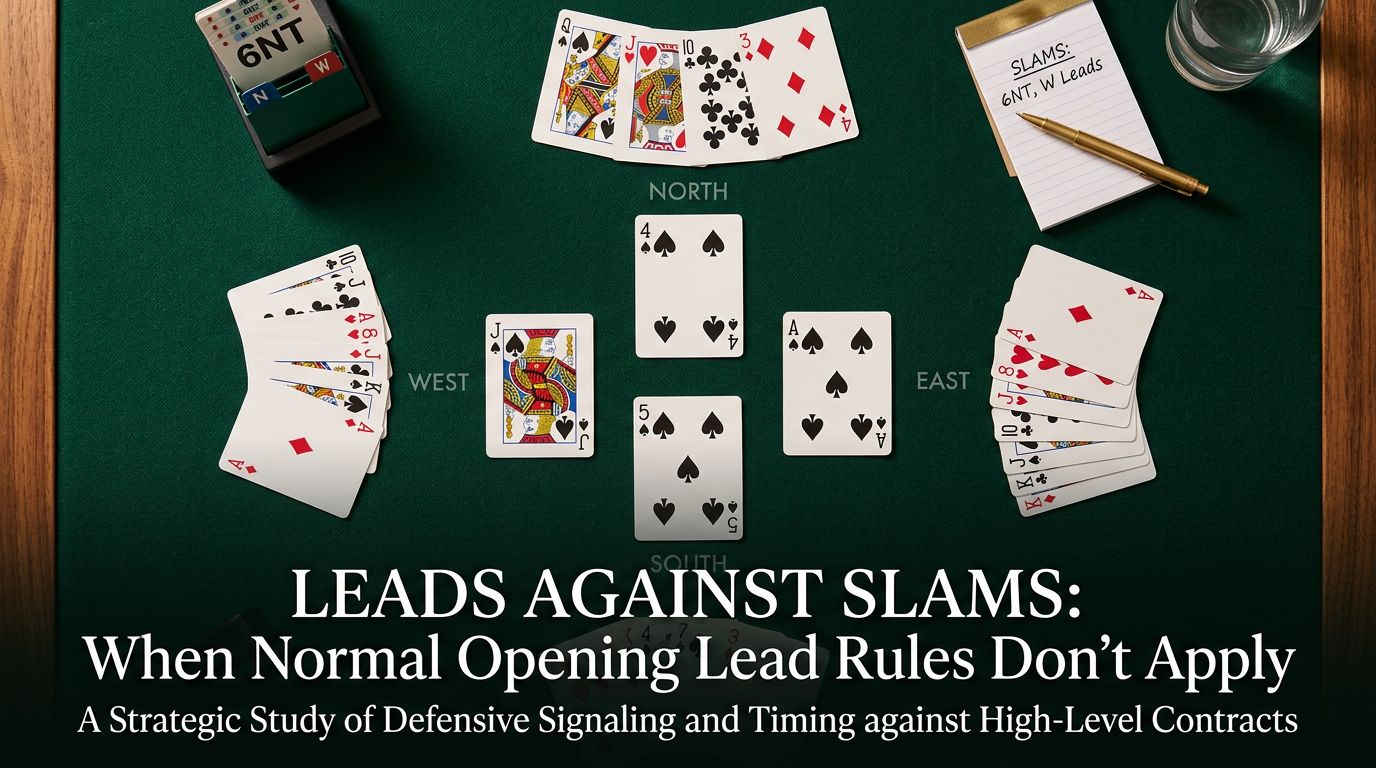
Leads Against Slams: When Normal Opening Lead Rules Don't...
You’ve heard declarer confidently bid 6NT or 7♠, and suddenly you’re on lead with your heart pounding. Leading against slams is one of bridge’s most nerve-wracking moments—and for good reason. One wrong choice and you’ve just handed them twelve or thirteen tricks on a silver platter.
Here’s the thing: everything you learned about opening leads needs to be reconsidered when defending against slams. The principles that work beautifully at the game level can be disastrous when declarer needs almost every trick.
Why Slam Leads Are Different
When defending a game contract, you’re trying to take five tricks. You have time. You can set up winners. You can wait for declarer to make a mistake. Against a slam, you need to take your tricks immediately—there’s no second chance.
This fundamental difference changes everything about your opening lead strategy.
At the game level, leading from a king is often reasonable. Against a slam, it might give away the contract. A passive trump lead that’s safe at the three-level could be exactly what declarer needs to draw trump and claim. The fourth-best from your longest suit? Probably irrelevant when declarer can discard all their losers.
The key psychological shift is this: you’re not trying to develop tricks anymore. You’re trying to cash tricks right now or prevent declarer from disposing of losers. That’s a completely different defensive mindset.
Passive vs. Aggressive Leads
Against slams, you need to make a critical decision: should you lead passively (safely) or aggressively (actively)?
Lead passively when:
- Declarer has shown a balanced hand with limited distribution
- You have natural trump tricks (like QJ10x in their suit)
- The auction suggests declarer might have to guess how to play the hand
- You have no reason to think you need quick tricks
A passive lead is typically a trump or a safe side suit where you’re not giving anything away. You’re saying “prove you can make this without my help.”
Lead aggressively when:
- The auction shows a distributional hand with possible ruffs
- You need to cash winners before they disappear on a long suit
- Partner has shown values in a suit
- You suspect declarer has losers they’re planning to pitch
Aggressive leads are aces, kings in suits you’ve bid, or leads designed to attack dummy’s entries before declarer can set up a side suit.
Here’s an example: they bid 1♠-2♥-3♥-4NT-5♦-6♥. That 2♥ response showed values, and 3♥ showed extras. This is a strong auction with both hands unlimited. Lead aggressively—cash your ace if you have one, because they might have a solid side suit ready to run.
Contrast that with 1NT-3NT-4NT-6NT. This is a flat, balanced auction. Leading an ace could easily blow a trick. Lead passively from your worst suit.
Trump Leads Against Slams
“When in doubt, lead trump” is classic advice. Against slams, it’s often terrible advice.
A trump lead against a slam is usually only right in two situations:
1. When you want to stop dummy ruffs
If the auction goes 1♥-1♠-3♣-4♣-4♥-6♥, that club support suggests dummy might have shortness elsewhere. But if your hand has four hearts and dummy rates to have two or three, there’s no ruffing going on. A trump lead accomplishes nothing.
However, if they bid 1♠-2♦-3♦-3♠-4♣-4♠-6♠ and you have reason to think dummy has diamond shortness and declarer plans to ruff diamonds in dummy, a trump lead might be critical.
2. When you have no attractive alternative
Sometimes your hand is so balanced and featureless that a trump lead is the least likely to give anything away. ♠8542 ♥J63 ♦Q74 ♣K85 against 6♠? Sure, lead a trump. You’re not helping set anything up, but at least you’re not leading from your king or giving them a ruff-sluff.
When NOT to lead trump:
- When they need to set up a side suit and trump is an entry to dummy
- When you might have a natural trump trick (leading trump can help declarer pick up your holding)
- When you need to cash aces before they vanish
The biggest mistake average players make is leading trump against slams automatically. Declarer has already shown enough strength to bid slam, they probably have trump under control. Your trump lead often just helps them by saving them a tempo.
Ace Leads and the Lightner Double
Against most contracts, leading unsupported aces is considered poor technique. Against slams, aces become your best friend.
When to lead an ace:
The old saying “aces were meant to capture kings” doesn’t apply to slam defense. If you have an ace, you probably should lead it unless you have a very good reason not to.
Why? Because aces take tricks right now. After you lead your ♦A, you can see dummy and reassess. You can switch to a heart if that looks right. You can continue diamonds if partner gives you an encouraging signal. You maintain control.
More importantly, that ace might disappear. If they bid 1♠-2♣-2NT-3NT-4♣-6♣, they’ve shown clubs and balanced values. If you have ♦A in your hand, lead it! Declarer might have a long diamond suit in hand ready to discard losers.
The Lightner double:
When partner doubles a slam for penalties, they’re almost never saying “I think we can beat this with normal defense.” They’re demanding an unusual lead.
The Lightner double asks you to make an aggressive, unexpected lead, usually:
- Your first bid suit (if you bid one and partner didn’t raise)
- Dummy’s first bid side suit
- An unbid suit if those don’t apply
The classic scenario: you open 1♥, they overcall and bid to 6♠, partner doubles. Do NOT lead a heart! Partner wants you to lead something else—probably dummy’s suit where partner is void and can ruff.
Another example: 1♠-Pass-3♣-Pass-3♦-Pass-6♠-Double. Partner is doubling and asking for the unusual lead. Lead a club (dummy’s suit). Partner probably has a void and the ♥A or something similar for the second trick.
The Lightner double is one of the most valuable defensive tools in bridge, but only if you understand it. Don’t lead your normal lead when partner doubles, that defeats the entire purpose.
Leading from Kings
Against game contracts, leading from kings is often reasonable, especially in partner’s suit or a suit where you have intermediates. Against slams, it’s usually suicide.
Consider this: you hold ♠KJ73 and they’ve bid 6NT. If you lead the ♠3, you might be giving declarer their twelfth trick if they hold ♠AQ in hand and were going to have to guess the position. You’ve just solved the hand for them.
When leading from a king IS right:
- When it’s partner’s suit and they’ve shown values there
- When you have KQ10x or better, substantial holdings where you’re not giving away a free finesse
- When every other lead looks even worse
When it’s wrong:
- In an unbid suit against notrump
- When declarer has shown a long suit that might need unblocking
- When you could lead something safer
The principle is this: declarer bid a slam with nearly enough tricks. Don’t give them the extra one they’re missing by solving their guess in a key suit.
If you hold ♠K863 ♥742 ♦KJ54 ♣93 against 6NT, lead a club (passive) or possibly a diamond (from honors). Don’t lead a spade and hand them the contract when they hold ♠AQJ and would have had to guess.
Listening to the Auction
The auction is your roadmap to the right lead. Against slams more than any other contract, the bidding tells you what to do.
What to listen for:
1. Suit agreements and splinters: If they bid 1♠-3♥(splinter)-4NT-5♣-6♠, that heart splinter showed shortness. Don’t lead hearts—that’s exactly where dummy is short. Lead something else where declarer might have losers.
2. Control-showing bids: When they cue bid 4♣ and 4♦, they’re showing controls there. Your aces in those suits are less valuable—they probably have those controlled. Focus on the unbid suits.
3. Notrump rebids: If they bid 1♥-2♣-2NT-3♣-3NT-4♣-6♣, that 2NT rebid showed a balanced hand. They’re playing in clubs but opener is balanced. This suggests fewer ruffs and more of a trick-taking approach. Lead passively.
4. Strength shown: A strong auction like 2♣-2♦-3♠-4NT-5♥-6♠ shows massive values. Lead your ace if you have one—you need tricks NOW. A weaker auction like 1♠-3♠-4♠-5♣-5♠-6♠ shows them stretching. Lead passively and make them prove they can make it.
5. Which hand is dummy: If responder bid 6♠ after opener showed extras, responder is captain and probably has the stronger hand. Dummy will be limited. Your lead should consider what dummy is likely to provide.
Example Slam Lead Decisions
Let’s work through some real scenarios:
Example 1: Auction goes 1NT(15-17)-4NT-6NT. You hold: ♠Q1074 ♥K85 ♦J963 ♣74
Lead the ♣4. This is a balanced auction against balanced hands. Don’t lead from your king. The club lead is safest and most passive.
Example 2: Auction: 1♥-1♠-3♣-3♥-4♣-4♦-4♥-6♥. You hold: ♠K4 ♥863 ♦A1074 ♣Q952
Lead the ♦A. This is a complex auction showing lots of shape. Cash your ace while you can—they might have a club suit to pitch diamonds on. After seeing dummy, you can decide what to do next.
Example 3: Auction: 1♠-3♠-4♣-4♦-4♠-4NT-5♥-6♠. You hold: ♠72 ♥AJ74 ♦8653 ♣Q104
Lead a diamond. They’ve cue bid clubs, diamonds, and hearts (showing controls), so those suits are likely controlled. Spades are trump. A diamond lead is most passive. Don’t lead the ♥A—they’ve shown control there with the 4♦ bid (likely the ♥K).
Example 4: 1♠-2♥-2♠-3♠-4♣-4♥-6♠, partner doubles. You hold: ♠Q6 ♥K1073 ♦AJ85 ♣942
Lead a club! Partner’s Lightner double asks for an unusual lead. Dummy bid hearts, so lead dummy’s other suit (clubs). Partner is likely void in clubs and has a side ace.
Common Slam Lead Mistakes
Mistake #1: Leading trump automatically
Many players reach for a trump “when in doubt” against any contract. Against slams, this often helps declarer. Only lead trump when you have a specific reason, usually to cut down ruffs.
Mistake #2: Leading passively when declarer has a long suit
If the auction shows declarer with a seven-card diamond suit and they bid 6NT, don’t lead “safe.” Lead your ♦A if you have it! That suit is about to run and your side winners will disappear.
Mistake #3: Leading from unsupported kings
Don’t gift-wrap the contract by leading from ♠K743 when declarer holds ♠AQ. Lead something else unless you have no choice.
Mistake #4: Ignoring partner’s Lightner double
If partner doubles a slam, they’re screaming at you to make an unusual lead. Don’t lead your “normal” lead, think about what partner wants.
Mistake #5: Failing to cash aces
Against game contracts, you might underlead an ace to find partner’s entry. Against slams, cash it! There might not be a later.
Mistake #6: Not visualizing declarer’s hand
Take a moment before you lead. What did the auction tell you? Where are declarer’s tricks coming from? Where might they have a problem? Your lead should be based on that analysis, not on general principles.
Mistake #7: Leading the “book” lead in the wrong situation
Fourth-best from longest and strongest works at the two-level. Against 6NT when declarer has shown a balanced 20-count, it’s often irrelevant. Think about the specific situation.
Sharpen Your Strategy with Brian
Want to put these strategic concepts into practice? Brian analyzes your bridge hands and explains the optimal line of play. Try Brian free →
Finding the Right Lead
Leading against slams requires judgment, courage, and careful attention to the auction. There’s no simple formula that works every time.
But remember these principles:
- Cash your aces unless you have a specific reason not to
- Lead passively against balanced auctions, aggressively against distributional ones
- Avoid leading from unsupported kings in unbid suits
- Listen to the auction for clues about declarer’s shape and strength
- Trump leads are overrated against slams, only lead them with purpose
- Understand Lightner doubles and make the unusual lead partner is requesting
The hardest part of leading against slams is accepting that you won’t always get it right. Even experts sometimes lead the wrong card. But with careful thought and attention to the auction, you’ll find the killing lead far more often than not.
And when you do? When you lead the ♦A and see partner’s ♦K crash under it, or lead a club into partner’s void after their Lightner double, or make the passive trump lead that forces declarer to guess wrong—there’s no better feeling in bridge.