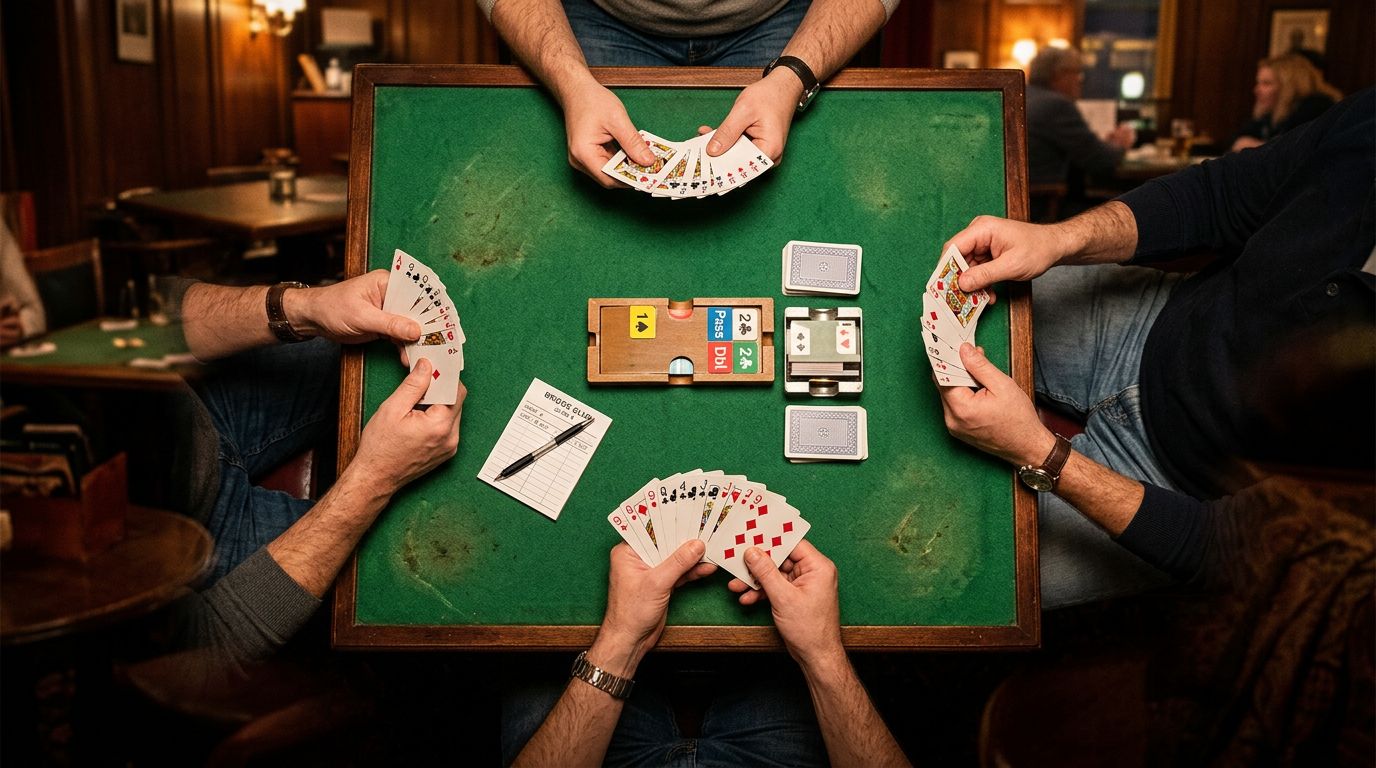
When to Finesse vs Play for the Drop
You have 8 spades between your hand and dummy, including the ace, king, and jack. You’re missing the queen.
Do you finesse or play for the drop?
Every bridge player knows the rhyme: “Eight ever, nine never.”
With 8 cards, finesse. With 9 cards, play for the drop.
It’s simple. It’s memorable. And it’s wrong about 30% of the time.
The truth is more nuanced. The right play depends on which 8 cards you have, what else is going on in the hand, and what you’ve learned from the bidding and play.
This article gives you the decision tables, the math, and the exceptions. Learn this, and you’ll make the right call more often than the rhyme-followers.
The Basic Math: Missing the Queen
Let’s start with the classic case: you’re missing only the queen (5 or 4 small cards with her).
With 8 Cards (Missing 5 Including the Queen)
Typical holding: AKJxxx opposite xx
Options:
- Finesse: Lead toward the jack. If LHO has the queen, you win. 50% success rate.
- Drop: Cash the ace and king. If the queen drops in two rounds, you win. Success rate: ~40%.
The missing 5 cards split:
- 3-2: 68% of the time
- 4-1: 28% of the time
- 5-0: 4% of the time
If the cards split 3-2 and the queen is in the 3-card holding (about half of 68%, so 34%), she drops. If the cards split 3-2 and the queen is doubleton (about 34%), she doesn’t drop under the AK, but you can finesse on the third round.
Wait, that’s confusing. Let’s break it down differently:
Playing for the drop:
- Queen is singleton: 4% (she drops)
- Queen is doubleton: 34% (she drops)
- Queen is tripleton or longer: 62% (she doesn’t drop)
Total drop rate: 38%.
Finessing:
- Queen is with LHO: 50% (finesse wins)
- Queen is with RHO: 50% (finesse loses)
Verdict: With 8 cards, finesse. 50% beats 38%.
With 9 Cards (Missing 4 Including the Queen)
Typical holding: AKJxxx opposite xxx
Options:
- Finesse: 50% (same as always)
- Drop: Cash the ace and king. Success rate: ~52%
Missing 4 cards split:
- 3-1: 50% of the time
- 2-2: 40% of the time
- 4-0: 10% of the time
If the cards split 2-2 (40%), the queen drops half the time (20%). If the cards split 3-1, the queen is in the tripleton about 38% of the time, and the doubleton about 12% of the time. The doubleton queen drops (12%). The singleton queen drops (about 2.5%).
Total drop rate: 20% + 12% + 2.5% ≈ 34.5%.
Wait, that can’t be right. Let me recalculate.
Actually, the correct calculation is:
- Queen is singleton: 2.5% (drops immediately)
- Queen is doubleton: 40% × 50% = 20% (drops on the second round)
- Queen is tripleton: Won’t drop in two rounds
But you can combine the drop with the finesse. Play the ace. If the queen doesn’t drop, play the king. If the queen still doesn’t drop, finesse on the third round.
This combined line succeeds when:
- Queen drops (34.5%), OR
- Queen doesn’t drop but you finesse correctly (~32%)
Total: about 67%, which is better than finessing immediately (50%).
Wait, that’s the same as just playing for the drop and then finessing if it fails. The point is: with 9 cards, start by playing for the drop.
Verdict: With 9 cards, play for the drop first. You can always finesse later if needed.
With 10 Cards (Missing 3 Including the Queen)
Typical holding: AKJxxxx opposite xxx
Options:
- Finesse: 50%
- Drop: Cash the ace and king. Success rate: ~78%
Missing 3 cards split:
- 2-1: 78% of the time
- 3-0: 22% of the time
If the cards split 2-1, the queen is in the doubleton about 52% of the time (drops on the second round). If she’s singleton, she drops immediately (26%).
Total drop rate: 78%.
Verdict: With 10 cards, always play for the drop. Finessing is crazy.
With 11 Cards (Missing 2 Including the Queen)
Typical holding: AKJxxxxx opposite xxx
You’re missing the queen and one small card.
Drop rate: About 87% (the queen is singleton or doubleton almost all the time).
Verdict: Drop. Don’t even think about finessing.
With 12 Cards (Missing 1: The Queen)
You’re missing only the queen.
Cash the ace. She drops. 100%.
(Unless you’re in some weird blocked position. But let’s not go there.)
The Decision Table: Missing the Queen
| Your Cards | Missing Cards | Finesse % | Drop % | Correct Play |
|---|---|---|---|---|
| 7 | 6 (including Q) | 50% | ~30% | Finesse |
| 8 | 5 (including Q) | 50% | ~38% | Finesse |
| 9 | 4 (including Q) | 50% | ~52% | Drop |
| 10 | 3 (including Q) | 50% | ~78% | Drop |
| 11 | 2 (including Q) | 50% | ~87% | Drop |
| 12 | 1 (the Q) | , | 100% | Drop |
Simple rule: With 9+ cards, play for the drop. With 8 or fewer, finesse.
But wait, there are exceptions.
Exception 1: Which 8 Cards Do You Have?
Not all 8-card holdings are created equal.
Holding A: AKJ10xx opposite xx
You have the 10. Now if the queen doesn’t drop under the AK, you can finesse the 10 (not just the jack). This gives you two finesse positions.
Correct play: Cash the ace. If the queen doesn’t drop, come back to hand and lead toward the KJ10. You can finesse twice if needed.
This picks up singleton queen (4%) plus any 2-3 split where you can finesse (additional ~50%), for a total success rate over 50%.
Verdict: Still finesse, but with more flexibility.
Holding B: AKJxx opposite xxx
You have 3 cards in one hand, 5 in the other. This is standard.
Verdict: Finesse (50% vs 38%).
Holding C: AKJ109 opposite xxx
You have the 10 and 9. Now you can finesse twice (the 10, then the 9).
Correct play: Lead toward the AKJ109. Finesse the 10. If it loses to the queen, you were always losing a trick. If it wins, repeat with the 9.
Verdict: Finesse, but you’re picking up more layouts.
Exception 2: Entry Considerations
Sometimes you can’t afford to finesse because you’ll use up your entries.
Example:
Dummy: ♠ AKJxxx
You: ♠ xx
You’re in 3NT. Dummy has no other entries. You need to establish spades.
If you lead toward dummy and finesse the jack, and it loses to the queen, you’re stuck in hand. You can’t get back to dummy to cash the established spades.
Correct play: Cash the ace and king. If the queen drops, great. If not, you’ve still established 4 spade tricks and dummy’s suit is good. You can use your one remaining entry (the spade ace already cashed, wait, no, you cashed it) to get back to dummy.
Actually, this example is tricky. Let me rethink it.
If dummy has AKJxxx and no outside entries, you need the spades to split 3-2 to run the suit. Playing for the drop (cashing the AK) uses up your entries too. So you’re stuck either way.
The real lesson: plan your entries before deciding how to play the suit.
If you have only one entry to dummy, you might be forced to finesse (lead from hand, finesse the jack, and hope it wins so you can cash the suit).
Exception 3: Restricted Choice
You cash the ace, RHO plays the queen.
Should you finesse on the next round (playing RHO for a singleton queen) or play for the drop (playing RHO for Qx)?
Answer: Finesse (by Restricted Choice).
If RHO had Qx, they chose to play the queen (they could have played small). If RHO had Q alone, they were forced to play it. The fact that they played it makes it more likely they were forced to.
Correct play: Come back to hand and lead toward the king-jack. If LHO plays low, finesse the jack.
This is covered in detail in the Restricted Choice article.
Exception 4: Vacant Places
LHO opened 1♠ and has shown 6 spades and 4 clubs. RHO has shown 2 spades and 2 clubs.
You’re in a different suit (hearts) and need to locate the queen.
Count vacant places:
- LHO: 6 spades + 4 clubs = 10 cards. Vacant places: 3
- RHO: 2 spades + 2 clubs = 4 cards. Vacant places: 9
RHO is 3:1 more likely to hold the ♥Q.
Correct play: Finesse through LHO (playing RHO for the queen).
Vacant places can override the standard finesse-vs-drop percentages.
Exception 5: Safety Plays
You’re in 6♠ with AKJxxx opposite xxx. You can afford to lose 1 spade, but not 2.
If you finesse the jack and it loses to the queen, you’re fine. If RHO has Qxxx, you lose 2 tricks and go down.
Correct play: Cash the ace. If the queen doesn’t drop, cash the king. If the queen still doesn’t drop, concede a spade. You lose 1 trick, but you make the contract.
This is a safety play. You give up the chance of 0 losers (by finessing) to guarantee no more than 1 loser (by playing for the drop).
Safety plays are covered in detail elsewhere, but the principle is: when you can afford to lose X tricks but not X+1, play safe.
Missing the King: A Different Story
Sometimes you’re missing the king (not the queen).
With AQJxx opposite xxx (9 cards, missing the king)
Options:
- Finesse the queen: 50%
- Play the ace (hoping the king is singleton or doubleton): ~52%
Same logic as missing the queen with 9 cards. Play the ace first.
But here’s the difference: if you finesse the queen and it wins, you know the king is with RHO. You can finesse again.
If you cash the ace and the king doesn’t drop, you’ve gained no information. You’re stuck.
Verdict: With 9 cards missing the king, the drop is still slightly better, but the finesse gives you more control.
Missing Two Honors: KQ or QJ
With AJ10x opposite xxxx (8 cards, missing KQ)
This is a double finesse. Lead toward the AJ10 and finesse the 10. If it loses to the king or queen, come back and finesse the jack.
Success rate:
- LHO has both K and Q: 25% (you win all the tricks)
- LHO has one honor: 50% (you win 2 tricks)
- RHO has both honors: 25% (you win 1 trick)
You get at least 2 tricks 75% of the time. That’s way better than playing for the drop.
Verdict: Finesse.
With AJ9x opposite xxxx (8 cards, missing KQ10)
This is harder. You can finesse the 9 (hoping LHO has the 10), but it’s not a clean double finesse.
Correct play: Lead toward the AJ9. Finesse the 9. If it loses to the 10, finesse the jack next time. If it wins, cash the ace (hoping the king or queen drops).
Verdict: Finesse, but it’s messy.
The “Nine Never” Exception: When to Finesse With 9 Cards
Even with 9 cards, there are situations where finessing is correct:
Situation 1: You Need All the Tricks
You’re in 7NT. You have AKJxxx opposite xxx. You need 6 tricks.
If you cash the ace and king, you get 6 tricks only if the suit splits 3-3 (36%) or the queen drops (52% total including 2-2 splits).
Wait, no. If you’re missing 4 cards including the queen, and you cash the AK, you get 6 tricks if:
- The suit splits 2-2 (40%), OR
- The queen is doubleton or singleton (34.5%)
Actually, if the suit splits 2-2, you get 6 tricks regardless of where the queen is. So the drop rate for making all 6 tricks is 40% + some additional cases.
This is getting confusing. The point is: in a grand slam, you sometimes need a higher percentage line, which might mean finessing immediately (if combining the drop with the finesse gives you better odds).
Situation 2: You Can’t Afford to Lose the Lead
You’re in 3NT. If you lose the lead, opponents cash 5 hearts and set you. You need all your spade tricks without losing the lead.
If you play for the drop (cash AK), you lose the lead if the queen doesn’t drop. If you finesse, you lose the lead if the finesse loses.
Verdict: Finesse (50% to not lose the lead) vs drop (52% to not lose the lead immediately, but if it fails, you’re down).
Actually, both lines lose the lead 50% of the time. The drop is very slightly better, but the difference is marginal.
Situation 3: You Have a Two-Way Finesse
Dummy: ♥ AJ10xx
You: ♥ KQxx
You can finesse either direction (lead toward the AJ10, or lead toward the KQ). This gives you more flexibility than the standard “play for the drop.”
Verdict: Use vacant places or bidding clues to decide which way to finesse.
The Practical Decision Chart
Here’s the simple version:
| Your Holding | Missing | Best Play | Why |
|---|---|---|---|
| AKJxx vs xx | Q + 4 | Finesse | 50% > 38% |
| AKJxxx vs xxx | Q + 3 | Drop | 52% > 50% |
| AKJxxxx vs xxx | Q + 2 | Drop | 78% beats finesse |
| AKJ10x vs xxx | Q + 3 | Drop, then finesse | Combine chances |
| AQJxx vs xxx | K + 3 | Drop | Same as missing Q |
| AJ10x vs xxxx | KQ + 2 | Finesse (double) | 75% to win 2 tricks |
Common Mistakes
Mistake 1: Blindly Following “Eight Ever, Nine Never”
The rhyme is a starting point, not a law. Adjust for entries, safety plays, vacant places, and the specific holding.
Mistake 2: Not Combining Chances
You have 9 cards. You cash the ace, the queen doesn’t drop. You cash the king, she still doesn’t drop.
Now you finesse. You’ve given yourself two chances: the drop (52%) and the finesse if it fails (~24%, which is 48% of the 50% finesse × the percentage the drop fails).
Combined: 52% + 24% = 76%. Way better than finessing immediately (50%).
Mistake 3: Finessing When You Can’t Afford to Lose
You’re in 6♠. You have 11 top tricks. You have 9 spades missing the queen.
If you finesse and it loses, you’re down. If you play for the drop and it fails, you’re down.
But wait, with 9 spades, the drop is 52%. The finesse is 50%. Play for the drop.
Unless…you have some other information (vacant places, bidding) that suggests the finesse is better.
Mistake 4: Ignoring Restricted Choice
You cash the ace, RHO plays the queen. You think, “Great, the queen is falling!” You cash the king, expecting it to drop.
But RHO had only Q. The king is still out. You’ve wasted your chances.
Correct: After the queen appears, use Restricted Choice. Finesse on the next round.
The Principle: Combine Your Chances
The best players don’t just finesse or drop. They do both.
- Cash one high honor. See if the queen (or king) drops singleton.
- If not, cash the second high honor. See if she drops doubleton.
- If not, finesse on the third round.
This combined line is almost always better than committing to one play or the other.
The math: You get the drop (34.5%), plus the finesse if the drop fails (50% of the remaining 65.5%), for a total of ~67%.
Sharpen Your Strategy with Brian
Want to put these strategic concepts into practice? Brian analyzes your bridge hands and explains the optimal line of play. Try Brian free →
The Deep Lesson
“Eight ever, nine never” is a memory trick for beginners. But bridge isn’t about memory tricks, it’s about thinking.
Before you decide to finesse or drop, ask:
- How many cards do I have?
- Which cards do I have? (Do I have the 10? The 9?)
- What have I learned from the play? (Restricted Choice? Vacant places?)
- What can I afford to lose? (Safety play?)
- Can I combine chances? (Drop first, finesse later?)
Answer those questions, and you’ll make the right play far more often than the rhyme-followers.
That’s the real skill.