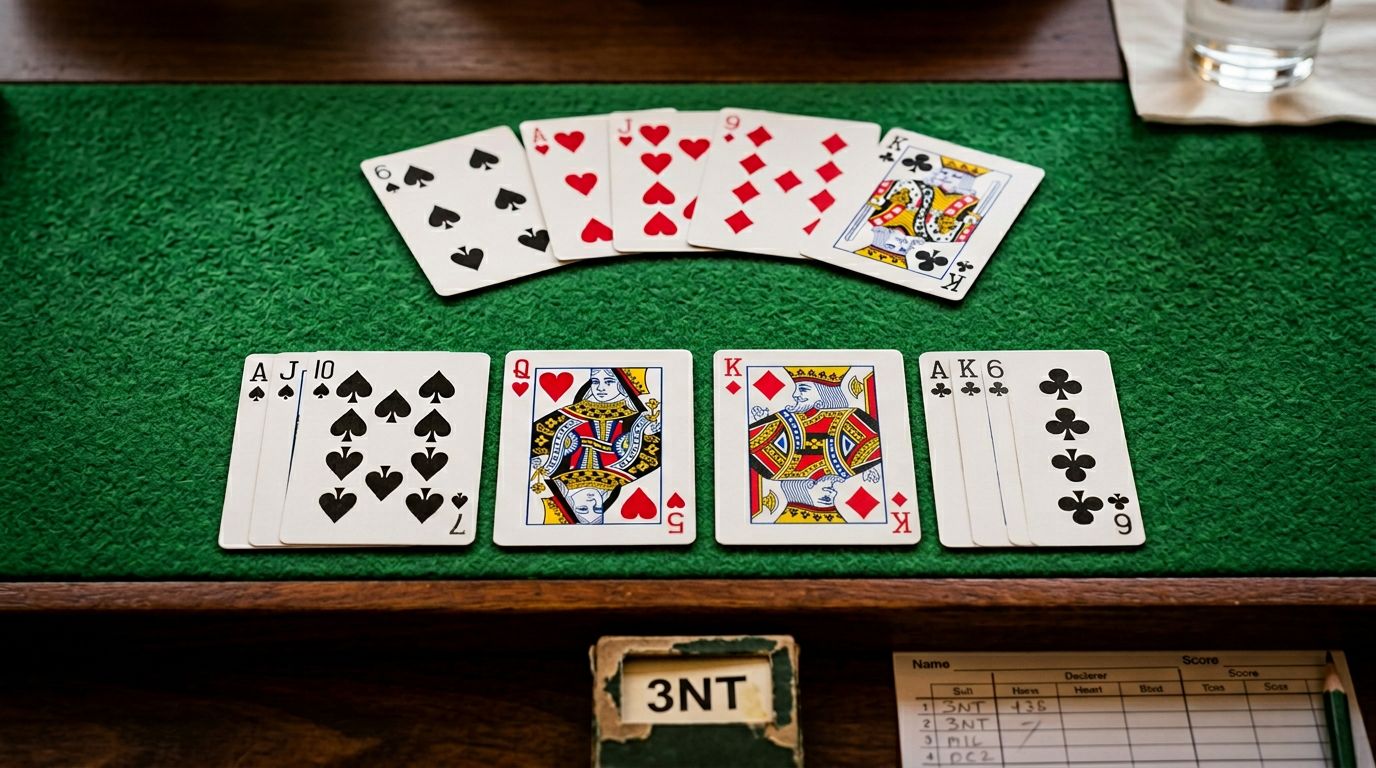
The Duck Play: When Losing a Trick Wins the Contract
Sometimes in bridge, the smartest play is to lose a trick on purpose. Sounds crazy, right? But the duck play, deliberately conceding a trick when you could win it, is one of the most powerful weapons in a declarer’s arsenal. Master this technique, and you’ll start making contracts that look impossible at first glance.
What Is a Duck in Bridge?
A bridge duck play happens when you deliberately refuse to win a trick with a higher card, choosing instead to play low and concede the trick to your opponents. You’re essentially playing a small card when you have the ability to win.
Think of it like this: You hold ♠A-Q-2 in your hand and dummy has ♠7-5-3. When an opponent leads a spade, instead of winning with the queen or ace, you play low from both hands and let them take the trick. That’s ducking.
The name comes from the image of ducking your head, you’re avoiding the trick rather than winning it. In some bridge circles, you’ll also hear it called a “hold-up play,” though technically that term is broader and includes other delayed-winning tactics.
Here’s what makes ducking counterintuitive: bridge is about taking tricks, right? So why would you purposely give one away? The answer lies in what happens after you duck.
Why Duck? The Strategic Purpose
Every duck has a purpose. You’re not just throwing away a trick for fun, you’re making a calculated sacrifice to gain something more valuable. The bridge duck play typically serves three main goals:
Preserving entries to the weaker hand. This is the classic reason. If dummy has a long suit but only one entry, you might need to duck early to ensure you can get back to cash those winners later.
Rectifying the count for a squeeze or endplay. Advanced players use ducks to set up the precise timing needed for squeeze plays. You need to lose exactly the right number of tricks at exactly the right time.
Breaking opponents’ communication. In defensive situations, ducking can sever the link between defenders, preventing them from establishing and cashing their suit.
The key insight: Bridge isn’t just about how many tricks you win, it’s about when and how you win them. A trick won at the wrong moment might cost you three tricks later.
Ducking to Establish a Suit
Let’s start with the most common ducking scenario: establishing a long suit in dummy when entries are limited.
Suppose you’re in 3NT and dummy has this club holding:
Dummy: ♣K-Q-J-6-5
Declarer: ♣3-2
You have eight top tricks and need one more. Those clubs in dummy can provide multiple tricks—but only if you can reach them. Dummy has the ♥A as its only outside entry.
Here’s what happens if you lead a club and immediately win with the king: You’ll play club queen, club jack, and now you’re stuck. The ♣6-5 are both winners, but you can’t reach them. You’ve used your only entry too early.
Now watch the duck in action:
- Lead ♣3 from your hand, play low from dummy. Opponents win.
- Regain the lead in your hand.
- Lead ♣2, win dummy’s ♣K.
- Cash ♣Q, ♣J, ♣6, ♣5—four club tricks total.
You’ve still got the ♥A as an entry to those established clubs. By ducking the first round, you kept communications open.
The principle: When you need to establish a long suit but have limited entries, duck until you’re ready to run the whole suit. Count your tricks carefully. With five clubs headed by the K-Q-J, you can afford to lose one round and still have four winners waiting.
Here’s another layout where ducking is essential:
Dummy: ♦A-7-6-5-4-2
Declarer: ♦8-3
That’s six diamonds, but only the ace is a sure trick. If entries are tight, you should duck the first two rounds of diamonds. Let the opponents win with their honors. When you finally win the ♦A, assuming diamonds split 3-3, you’ve got three small diamond winners established—and you only needed one entry to dummy to collect them all.
Ducking for Entry Preservation
Entry management is the art form of declarer play, and ducking is your finest brush. Sometimes you duck not to establish a suit, but purely to keep the right hand on lead at the right time.
Consider this common position in spades:
Dummy: ♠A-3-2
Declarer: ♠K-Q-4
You need to take three spade tricks and use them as entries to dummy for other purposes. If you carelessly win the first spade in your hand with the king or queen, you’ve lost flexibility. But if you duck the first spade trick entirely (or win with dummy’s ace), you preserve two entries to your hand for later.
The decision of where to win tricks is just as important as whether to win them. Ask yourself: “Do I need this hand to have the lead later? Am I preserving transportation?”
Here’s a full-hand example that illustrates entry-preservation ducking:
Dummy (North):
♠ K-7-5
♥ 9-4
♦ A-K-Q-J-10
♣ 8-6-3
Declarer (South):
♠ A-3-2
♥ A-K-8
♦ 6-5
♣ A-Q-J-10-9
Contract: 6NT. Lead: ♥Q
You’ve got eleven tricks on top (two spades, two hearts, five diamonds, two club tricks minimum), and the club finesse will give you the twelfth. But here’s the problem: You need to take that finesse twice (to establish all five club tricks if it works), which means you need to be in dummy twice.
You’ve got five diamond entries to dummy, way more than you need for the clubs. But what about getting back to your hand to repeat the club finesse?
The solution: Duck a spade!
- Win the heart lead with ♥A.
- Lead ♠2 and play ♠5 from dummy—duck it entirely.
- Win the return in your hand.
- Cross to dummy with ♦A.
- Take the club finesse with ♣Q—it wins.
- Lead ♠7 from dummy to your ♠A (entry to hand).
- Cross to dummy with ♦K.
- Finesse ♣J—it wins again.
- Cash the remaining diamonds and clubs.
By ducking that first spade, you created an extra entry to your hand (the ♠A). Without that duck, you’d run out of ways to get back to your hand for the second club finesse, and you’d fail in a cold contract.
Defensive Ducks: Ducking as a Defender
Ducking isn’t just for declarers. Defenders duck too, and for similar reasons, usually to cut declarer’s communications or to preserve a critical entry for partner.
The most famous defensive duck is the hold-up play with an ace. Suppose declarer is in 3NT and leads a long suit from dummy. You hold the ace in that suit. Should you grab it immediately?
Often, no. By ducking once or twice, you might exhaust partner’s cards in that suit. Then when declarer tries to return to dummy to cash the established winners, partner can’t follow, and you can pitch away your losing cards safely.
Example position:
Dummy: ♠K-Q-J-7-6
Declarer (unseen): ♠2
Your hand (East): ♠A-8-5-4
Partner (West): ♠10-9-3
Declarer leads ♠2 and plays ♠K from dummy. If you win the ace immediately, declarer later leads to dummy’s ♠Q, and now dummy has three more spade winners. Even if partner started with three spades, declarer can reach dummy with an outside entry and run the suit.
But watch what happens if you duck:
- Declarer leads ♠2, dummy plays ♠K, you play ♠4 (duck).
- Declarer leads to dummy’s ♠Q, you duck again with ♠5.
- Partner is now out of spades.
- When declarer tries to reach dummy later for the remaining spades, partner can discard. You take your ♠A whenever declarer plays the suit again, and the two small spades in dummy are stranded.
The key: You’ve cut the communication. Declarer can’t enjoy those winners because partner can’t follow suit, and presumably declarer lacks the entries to get back to dummy multiple times.
Defensive ducking requires partnership trust. Your partner might not understand why you didn’t take your ace, they might even think you don’t have it. Good defenders signal count and attitude to help each other navigate these decisions.
The Obligatory Duck: When You Have No Choice
Sometimes ducking isn’t a clever play, it’s the only play. These are situations where the layout of the cards forces you to duck, or you’ll never get the tricks you’re entitled to.
Classic example: You need four tricks from this diamond combination, with no outside entries to dummy:
Dummy: ♦A-K-Q-J
Declarer: ♦5-4-3-2
Opponents hold ♦10-9-8-7-6. If the suit splits 3-2, you’re entitled to four tricks. But here’s the thing: you must duck the first round.
Why? Because if you lead ♦2 and play dummy’s ♦J, you’ll win, but now you’re in dummy with no way back to your hand to lead the suit again. The opponents will win the next three diamond tricks.
Instead: Lead ♦2, play low from dummy (ducking with the ♦A-K-Q-J sitting right there!). Opponents win. Later, you lead ♦3 and run the ♦J-Q-K-A, taking four tricks.
This is called an “obligatory duck” or “necessary duck.” The card combination itself demands it.
Another obligatory duck situation:
Dummy: ♥A-Q-10-9
Declarer: ♥3-2
You need three heart tricks, and you know the ♥K is on your left (from the bidding or play). You lead ♥2, and left-hand opponent plays low. You finesse the ♥10—it wins!
Here’s the critical moment: You’re now in dummy with ♥A-Q-9 remaining. If you immediately cash the ♥A, you’ll score three tricks total but won’t be able to get back to dummy via hearts.
Better: Lead the ♥9 and duck in your hand! Let right-hand opponent win with the ♥J or ♥K (or let it hold if they don’t have it). Now when you regain the lead, you can finesse again, and the ♥A-Q are still in dummy as entries.
The obligatory duck is often spotted by counting: “I have X cards in this suit, dummy has Y cards, opponents have Z cards. If I need to lead from my hand twice but only have two cards, I must duck once.”
Example Hands: Ducking in Action
Let’s look at some complete deals where ducking makes or breaks the contract.
Hand 1: The Basic Entry-Preserving Duck
Contract: 3NT by South
Lead: ♠Q
         North (Dummy)
         ♠ 6-4
         ♥ K-5-3
         ♦ K-7-6-5-4-2
         ♣ A-8

West                    East
♠ Q-J-10-9             ♠ 8-7-5-2
♥ J-9-7                ♥ 10-8-6-2
♦ J-9-8                ♦ Q-10
♣ Q-6-5                ♣ 7-4-3

         South (Declarer)
         ♠ A-K-3
         ♥ A-Q-4
         ♦ A-3
         ♣ K-J-10-9-2
You count eight top tricks: two spades, three hearts (after the finesse), two diamonds, one club. You need one more, and those long diamonds in dummy look promising.
If diamonds split 3-2 (68% chance), ducking one round will establish three extra diamond tricks. But dummy has only one entry outside diamonds: the ♣A.
Winning line:
- Win ♠A at trick one.
- Lead ♦3, play ♦2 from dummy (duck!). East wins ♦10.
- Win the spade return with ♠K.
- Lead ♦A, catching the ♦Q and ♦J.
- Cross to dummy with ♣A.
- Cash ♦K-7-6-5, pitching three cards from your hand.
You make eleven tricks. Without the duck, you’d score ♦A-K and have no way to reach the established diamonds—down one.
Hand 2: The Double Duck
Contract: 6♣ by South
Lead: ♠K
         North (Dummy)
         ♠ 7-5
         ♥ A-6-4-2
         ♦ A-8-7-6-5-3
         ♣ 4

West                    East
♠ K-Q-J-10             ♠ 9-8-6-3-2
♥ 9-7                  ♥ 10-5-3
♦ K-10-2               ♦ Q-J
♣ J-10-8-5             ♣ 9-6-2

         South (Declarer)
         ♠ A-4
         ♥ K-Q-J-8
         ♦ 9-4
         ♣ A-K-Q-7-3
You need twelve tricks. You have five club tricks, four heart tricks, one spade, and one diamond, that’s eleven. The twelfth must come from dummy’s long diamonds.
Dummy’s diamonds are 8-7-6-5-3 opposite your 9-4. If diamonds split 3-3, ducking two rounds will establish the suit. You have the ♦A as an entry.
Winning line:
- Win ♠A.
- Draw trumps with ♣A-K-Q.
- Lead ♦9, play ♦3 from dummy—duck! East wins ♦J.
- Win the return.
- Lead ♦4, play ♦5 from dummy—duck again! West wins ♦K.
- Win the return.
- Cross to ♦A, catching the ♦Q.
- The ♦8-7-6 are all good! Cash them, pitching spade and heart losers.
Twelve tricks. The double duck was essential—you needed to lose two diamond tricks while preserving the ♦A as your sole entry to the established winners.
Common Ducking Mistakes
Even experienced players blow duck plays. Here are the typical errors:
Ducking too late. You realize you need to duck, but you’ve already won the first round of the suit. Now it’s too late, you don’t have enough cards left to establish the suit and reach it. Duck early, not as an afterthought.
Ducking when you can’t afford to. Against 3NT, you duck to preserve entries, but you’ve forgotten that opponents now have time to establish their long suit and beat you. Always count opponent tricks too. Can you afford to give them the lead?
Ducking without a re-entry. You duck beautifully to establish dummy’s long suit, then realize you have no way to get back to dummy. Oops. Before ducking, identify your entry back.
Ducking mechanically without counting. Sometimes the “normal” duck is wrong because of the specific layout. If dummy has ♦K-J-10-9-8 opposite your ♦2, and you need four tricks with one entry, you might finesse rather than duck—it depends on the location of the ♦A and ♦Q.
Telegraphing the duck on defense. As a defender, if you duck slowly and painfully, you’ve just told declarer you have the ace. Duck smoothly and confidently (or win smoothly). Don’t give away information.
Forgetting to duck as a defender. This is the flip side: you grab your ace immediately because you’re excited to win a trick, but now declarer makes the contract because you’ve cleared the suit for them. Patience wins at bridge.
Sharpen Your Strategy with Brian
Want to put these strategic concepts into practice? Brian analyzes your bridge hands and explains the optimal line of play. Try Brian free →
Final Thoughts: The Duck as a Timing Play
The bridge duck play is ultimately about timing. You’re choosing the precise moment to take your tricks, and sometimes the right moment is “not yet.”
This concept separates intermediate players from advanced ones. Beginners count tricks: “I have eight, I need nine.” Intermediate players count tricks and entries: “I have eight, and I can establish one more in diamonds if I can get there.” Advanced players add timing: “I have eight, I can establish diamonds, I can get there, and I need to duck the first round to make the timing work.”
Every time you sit down at the bridge table, ask yourself: “Am I winning this trick at the right time? Or should I duck and win it later?” Sometimes the answer is to let them have the trick now, so you can take three tricks later.
That’s the beauty of the duck, you lose the battle to win the war.
Now get out there and start ducking. Your opponents won’t know what hit them.