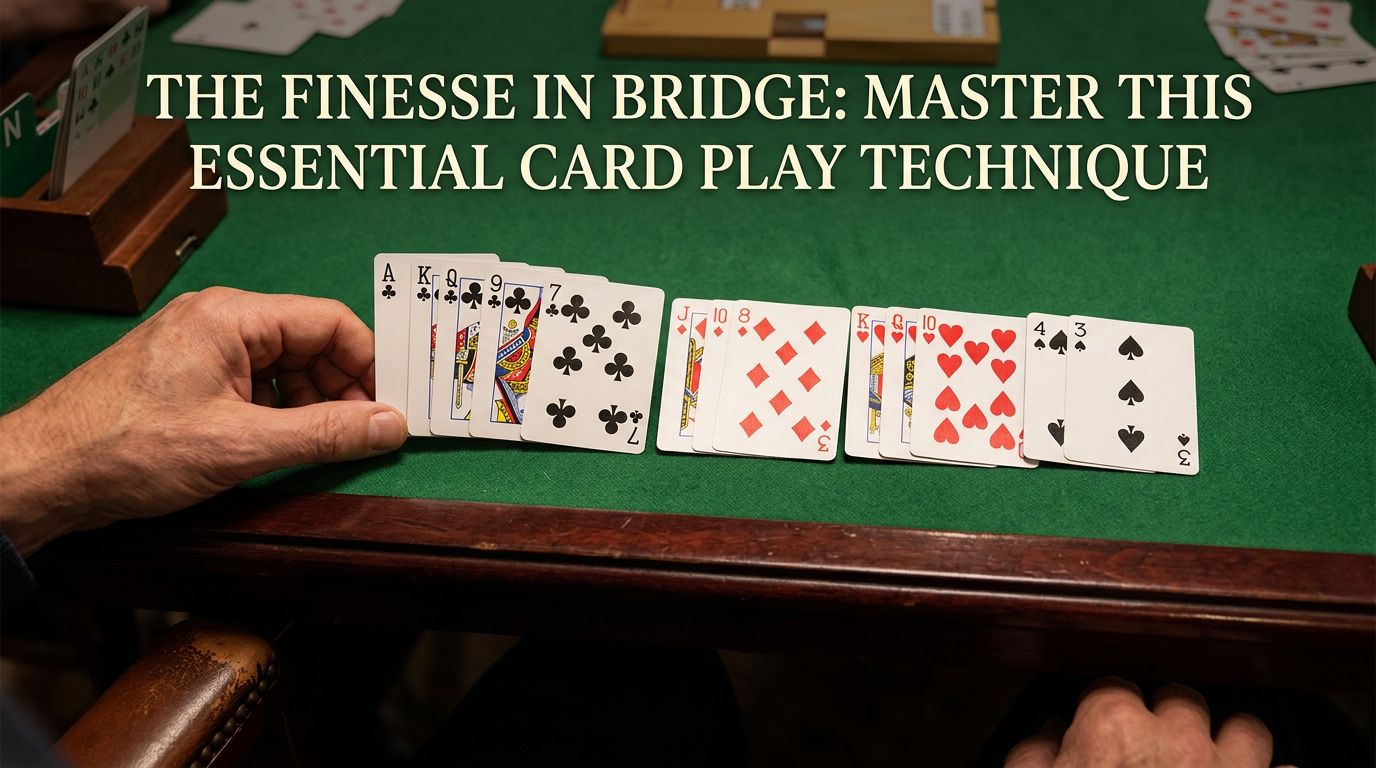
The Finesse: Master This Essential Card Play Technique
The bridge finesse is declarer’s favorite weapon. Lead toward the queen when you’re missing the king, hoping the opponent on your left has it. If they do, you steal a trick. If they don’t, well, you were probably going down anyway.
Every finesse is a trap. You’re trying to catch an opponent’s high card by leading toward your tenace, two honors with a gap between them, like AQ or KJ. The honor you’re missing sits in that gap, and you’re hoping it’s positioned where you can capture it.
What Is a Finesse?
A finesse is a card-play technique where you lead toward a combination of honors, playing a lower honor and hoping the missing higher honor is favorably placed.
The classic setup:
Dummy: ♥ AQ3
You: ♥ 542
Lead the 2 from your hand toward dummy. If left-hand opponent plays low, you play the queen from dummy. If LHO has the king, your queen wins the trick. If RHO has the king, it will capture your queen, but at least you still have the ace.
The key principle: You’re leading toward the combination, not away from it. By leading toward dummy, you force LHO to play before your queen, giving you a 50% chance to trap the king.
Finesses work because of position. Bridge is a game of who plays first. When you lead from your hand toward dummy’s AQ, LHO must play before you choose whether to play the ace or queen. That’s your edge.
Simple Finesses
The simple finesse is the building block. You’re missing one key card, and you’re trying to trap it.
The AQ Combination
Dummy: ♠ AQ5
You: ♠ 432
Lead toward dummy, and when LHO plays low, finesse the queen. Success rate: 50%—the king is equally likely to be in either defender’s hand.
The KJ Combination
Dummy: ♦ KJ4
You: ♦ 632
Missing the ace. If LHO has it, you can score both the king and jack. Lead the 2 toward dummy and play the jack. If it wins, come back and lead toward the king. Success rate: 50%
The Two-Way Finesse
Dummy: ♠ AJ3
You: ♠ KQ2
You can finesse either direction. Lead toward the jack (finessing West for the queen) or toward the queen (finessing East for the queen).
Which way? It depends on entries, the bidding, and the rest of the hand. If you need entries to dummy, finesse toward the jack. If one opponent showed length, finesse through them. This is where bridge becomes detective work.
The Double Finesse
You’re missing two key cards and can finesse for both. This is one of the most powerful techniques in declarer play.
The AQ10 Combination
Dummy: ♦ AQ10
You: ♦ 432
Lead the 2 toward dummy and play the 10. If it loses to the jack, come back and finesse the queen.
The outcomes:
- LHO has both K and J: You win 3 tricks (25%)
- LHO has K, RHO has J: You win 2 tricks (25%)
- LHO has J, RHO has K: You win 2 tricks (25%)
- RHO has both K and J: You win 1 trick (25%)
Success rate: 75% to win 2+ tricks. Three out of four layouts give you at least 2 tricks. You’re not putting all your eggs in one basket, you’re giving yourself multiple chances.
The AJ10 Combination
Dummy: ♥ AJ10
You: ♥ 432
Same technique: finesse the 10, and if it loses, come back and finesse the jack. Success rate: 75% for 2+ tricks.
Deep Finesses
Sometimes you’re missing so many honors that the finesse goes deep into your intermediates.
The AJ9 Combination
Dummy: ♠ AJ9
You: ♠ 432
You’re missing K, Q, and 10. Lead toward dummy and finesse the 9. If it loses to the 10, come back and finesse the jack. If LHO has K10 or Q10, you can trap those cards with your 9. You might score 2 tricks from this poor holding with the right sequence.
Deep finesses require multiple entries, but they can rescue seemingly hopeless suits when you have strong clues about the position.
When to Finesse vs. Play for the Drop
This is the crucial decision: finesse or play top honors and hope the missing honor drops?
Eight Cards: Finesse
Dummy: ♠ AQ432
You: ♠ 765
You’re missing five cards including the king. Finesse. With eight cards, the missing five split 3-2 about 68% of the time. If the king is in the 3-card holding, it won’t drop in two rounds. The finesse (50%) is better than the king being doubleton (32%).
Old saying: “Eight ever” (eight cards, always finesse)
Nine Cards: Usually Drop
Dummy: ♠ AQ432
You: ♠ 8765
Now you have nine cards, missing only four including the king. Usually play for the drop. The missing four split 2-2 about 40% of the time. If the king is doubleton, it drops when you cash the ace. That’s competitive with the 50% finesse, and the drop has other winning layouts.
Old saying: “Nine never” (nine cards, never finesse)
But “never” is too strong. If an honor appears on the first round, restricted choice changes the calculation.
Ten Cards: Always Drop
With ten cards, you’re missing only three. Play the ace, and if both follow, play the queen. The king will drop about 78% of the time. Don’t finesse, the drop is much better.
Restricted Choice and Finessing Decisions
Restricted choice is one of the most powerful principles in bridge, and it changes how you handle finesses after an honor appears.
The Classic Situation
Dummy: ♥ AK1032
You: ♥ 9654
You’re missing QJ. You cash the ace, and LHO plays the jack. On the next round, do you finesse the 10 (playing for singleton jack), or cash the king (playing for QJ doubleton)?
Restricted choice says: Finesse the 10.
When LHO played the jack, one of two things happened:
- LHO had J alone and had to play it (no choice)
- LHO had QJ doubleton and chose to play the jack instead of the queen
Both holdings were equally likely before the jack appeared. But once the jack appears, situation #1 is twice as likely, because in situation #2, LHO might have played the queen instead.
The math: Finesse is about 2-to-1 favorite (roughly 67% vs. 33%)
This feels wrong. Your instinct says “they played the jack, so they probably have the queen too.” But probability says the opposite.
When to Apply Restricted Choice
Use restricted choice when:
- You’re missing two or more equivalent honors (usually Q and J)
- One of those honors appears from a defender
- You can finesse on the next round
Don’t apply it when:
- You have nine or more cards and the drop is still better
- The bidding places both honors in one hand
- You can’t afford to lose the finesse
Example Hands with Finesse Plays
Example 1: The Double Finesse in 4♥
Contract: 4♥
Opening lead: ♠K
Dummy:
♠ 432
♥ A65
♦ AQ10
♣ 8654
You:
♠ A65
♥ KQJ109
♦ 432
♣ A2
Count losers: 1 spade, 0 hearts, potentially 2 diamonds, 1 club = 4 losers. You can afford 3.
Win the ♠A, draw trumps, then take the double finesse in diamonds. Lead a diamond toward dummy, finesse the 10. If it loses to the jack, come back and finesse the queen. You have a 75% chance to lose only one diamond trick, making your contract comfortable.
Example 2: When NOT to Finesse
Contract: 6NT
Dummy:
♠ K32
♥ AQ3
♦ AK32
♣ 654
You:
♠ A54
♥ K42
♦ QJ4
♣ AK32
Count winners: 3 spades, 3 hearts, 4 diamonds, 2 clubs = 12 tricks. You’re in a slam with 12 top tricks.
Don’t finesse the ♥Q. Don’t get cute. Just cash your 12 winners and claim. When you have enough tricks, take them. Greed kills slams.
Example 3: Restricted Choice in Action
Contract: 4♠
You have nine trumps: ♠ AK1032 in dummy, ♠ 8765 in hand. Missing QJ43.
You cash the ace, and LHO plays the jack. Now what?
Normally with nine cards, you’d play for the drop. But LHO played the jack. Restricted choice says finesse the 10 on the next round: LHO is twice as likely to have singleton jack than QJ doubleton. Come back to hand and lead toward dummy, finessing the 10. You’ll make your contract 2 out of 3 times.
Common Finesse Mistakes
Mistake 1: Finessing from the Wrong Side
You have ♠AQ in dummy but no entry to your hand. Don’t lead the queen from dummy—RHO will cover with the king and you lose both honors.
Fix: Always lead toward your tenace, never away from it. Plan entries before you start.
Mistake 2: Finessing Too Early
You’re in 6♥ with 11 top tricks. Don’t finesse immediately. Draw trumps first—maybe someone discards the key suit and gives away the position. Don’t take a 50% finesse when waiting might make it 100%.
Mistake 3: Finessing for Overtricks
You’re in 4♠ with 10 tricks. Don’t finesse for an 11th trick if losing the lead means going down. When you’re already making, take your tricks and go home.
Mistake 4: Ignoring Restricted Choice
You cash the ace, the jack appears, and you play for the drop on the next round anyway. You go down when a finesse would have made. When an honor appears and you’re missing two equivalent honors, consider finessing.
Mistake 5: Finessing When the Drop Is Better
You have nine cards. You finesse anyway. The finesse loses when the king was doubleton and would have dropped. Remember “eight ever, nine never.”
Mistake 6: Not Counting Entries
You want a double finesse but only have one entry to your hand. You take the first finesse, it loses, and now you’re stuck. Count entries before starting a finesse sequence.
Mistake 7: Ignoring the Bidding
LHO opened 1NT showing 15-17 HCP. You can see 18 HCP between your hand and dummy. LHO can’t have both missing kings. Use the bidding to place high cards before you finesse, opponents tell you where their strength is.
Mistake 8: Not Looking for Better Lines
You see a finesse and take it without thinking. Maybe there’s a strip-and-endplay. Maybe you can make the opponents break the suit. Before you finesse, ask: “Is there a better line?”
Special Finesse Types
The Backward Finesse
Sometimes you finesse the “wrong” way, leading an honor toward the missing honor.
Dummy: ♠ 432
You: ♠ AJ10
You have strong evidence from bidding that RHO has the queen. Lead the jack from your hand. If RHO covers, win the ace and your 10 is good. If RHO doesn’t cover, let it ride.
When to use: Only when you have strong evidence placing the missing honor in a specific hand. This fails spectacularly when you’re wrong.
The Ruffing Finesse
In suit contracts, use trumps to enhance your finesses.
Contract: 4♠
Dummy: ♥ KQJ10
You: ♥ 3 (and trumps)
Lead the ♥K from dummy. If RHO has the ace and plays it, you ruff and the remaining hearts are good. If RHO doesn’t play the ace, discard a loser from your hand. Even when RHO doesn’t have the ace, you’ve pitched a loser.
The Marked Finesse
Sometimes the bidding tells you where a missing honor is. LHO opened 1♠ showing 12+ HCP and has already shown up with 11 points. They almost certainly have the missing king. Finesse with confidence. Success rate: 90%+ when you have bidding information.
Finesse Percentages: Quick Reference
| Holding | Finesse Type | Success Rate |
|---|---|---|
| AQ vs K | Simple finesse | 50% |
| AQ10 vs KJ | Double finesse | 75% for 2+ tricks |
| With 8 cards | Finesse vs drop | Finesse (50% > ~32%) |
| With 9 cards | Finesse vs drop | Close call |
| With 10 cards | Finesse vs drop | Drop much better (~78%) |
| After honor appears | Restricted choice | Finesse 2:1 favorite (~67%) |
Sharpen Your Strategy with Brian
Want to put these strategic concepts into practice? Brian analyzes your bridge hands and explains the optimal line of play. Try Brian free →
The Deep Principle
A finesse is an educated guess. Before you finesse, run through this checklist:
- Do I have to finesse? (Maybe the drop is better, or there’s an endplay)
- Can I afford to lose the finesse? (Maybe losing the lead is fatal)
- Is this the best percentage? (Combine odds with bidding and restricted choice)
- Have I used all available information? (Bidding, signals, distribution)
- Do I have the entries? (Can I get back and forth as needed?)
If all answers point to “yes,” finesse with confidence. If any answer is “no,” find a different line.
The best declarers finesse less than average players, not because they’re afraid, but because they’ve found something better. Sometimes that’s an elimination play. Sometimes it’s a squeeze. Sometimes it’s just cashing out.
The real skill isn’t knowing how to finesse. It’s knowing when to finesse, and when to walk away and find a better line. That separates decent declarers from good ones.