Finding Bridge Games: Clubs, Online Play, and Partner Hun...
You’ve learned the basics. You can bid a hand without your brain melting. Now you need the one thing books and apps can’t provide: actual opponents.
Finding bridge games is easier than it used to be, but it’s not always obvious where to look. Here’s your complete guide to finding games, whether you want to play in person or online, casually or competitively.
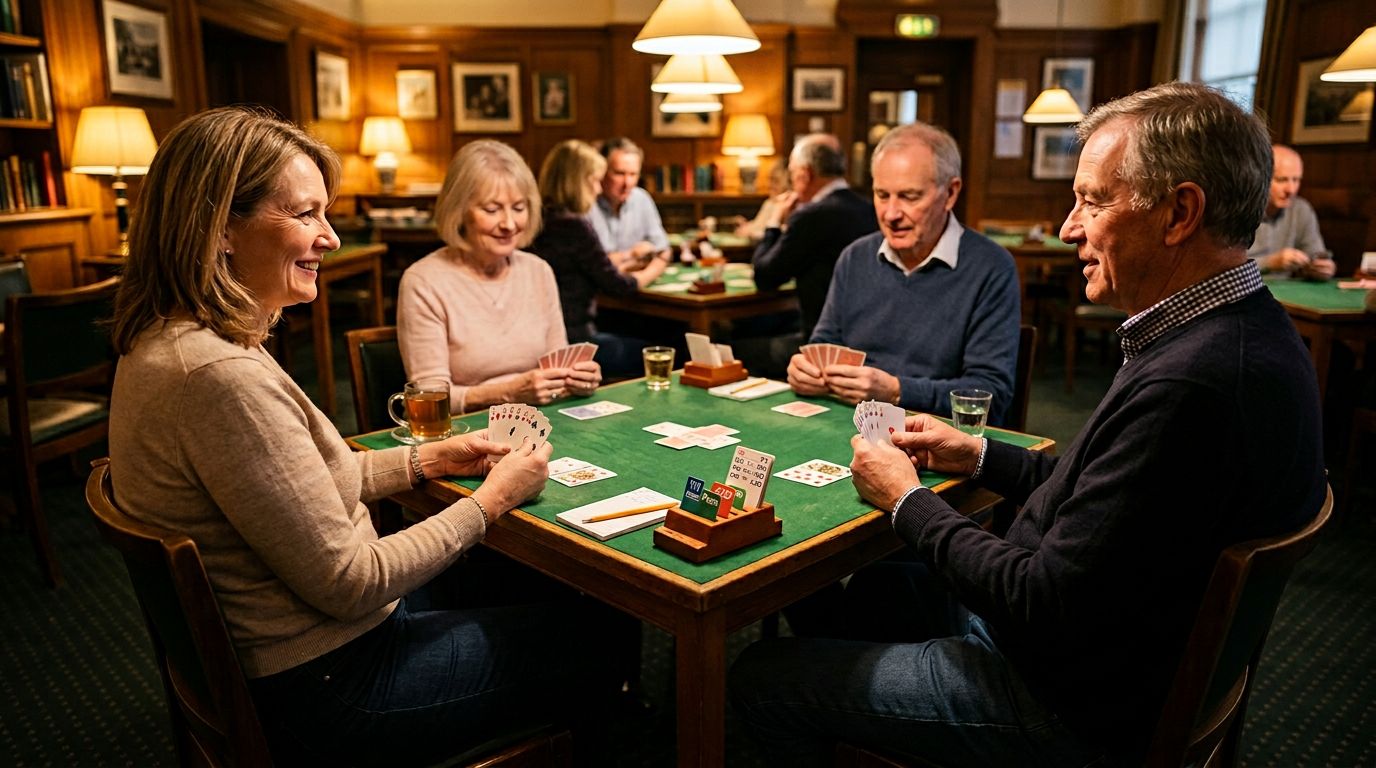
Local Bridge Clubs: Your Best Starting Point
Finding a Club Near You
The ACBL (American Contract Bridge League) maintains a club directory at acbl.org/clubs. Type in your zip code, get a list of every sanctioned club within 50 miles. Simple.
Most cities with 50,000+ people have at least one club. Smaller towns might not have a dedicated space, but they often have weekly games at community centers, libraries, or someone’s house.
Don’t assume the closest club is the best one for you. If you have 3-4 options, visit all of them. Clubs have different personalities.
What to Expect at Your First Club Visit
Walk in, tell the director (the person running the game) that you’re new. They’ll either pair you with another newer player or find you a partner if you came alone.
Most clubs charge $5-10 per session. Some include coffee and cookies. Some include passive-aggressive comments about your defense. You’ll figure out which type you’re at pretty quickly.
Typical club schedule:
- Afternoon games: 12:30pm or 1pm start
- Evening games: 7pm or 7:30pm start
- Most games run 3-4 hours
Don’t schedule dinner plans right after your first club game. Games run long when you’re still figuring things out.
The Different Types of Club Games
Newcomer/Beginner Games These exist specifically for people with fewer than 20 masterpoints (bridge’s experience metric). The pace is slower, the director explains things, and nobody expects perfection. Start here if you can find one.
Open Games Anyone can play. You’ll sit across from someone with 40 years of experience who knows 83 conventions you’ve never heard of. This sounds terrifying but it’s usually fine. Most experienced players remember being new.
Stratified Games One game, but awards are separated into skill levels. The A players compete against each other, the C players (0-300 masterpoints) compete against each other. You play the same hands, just scored separately. This is ideal for beginners.
999er Games For players with fewer than 1000 masterpoints. The pace is faster than newcomer games but more forgiving than open games. Good middle ground once you’ve played 20-30 sessions.
Club Culture (What Nobody Tells You)
Some clubs are welcoming. Some are cliquey. Some are friendly but disorganized. Some run like military operations.
Red flags to watch for:
- People complaining about your play during the hand
- Director who talks down to newer players
- Zero social interaction between rounds
- “We’ve always done it this way” energy
Green flags to look for:
- Director welcomes newcomers by name
- Post-game hand discussions
- Mix of ages (not just retirees)
- Someone offers to answer questions
You’re looking for a club where you want to come back. If the first one doesn’t feel right, try another. The bridge world is big enough that you can find your people.
Online Bridge: Play Anytime, Anywhere
Bridge Base Online (BBO)
This is the mothership. Free to play, runs on everything (web, iOS, Android, even works on old computers), and there’s always a game available. The interface is ugly and confusing, but you get used to it.
What BBO offers:
- Casual games (free, instant matchmaking)
- Tournament games (small entry fee, win masterpoints)
- Robot games (practice against AI)
- Teaching tables (supervised games for beginners)
How to start on BBO:
- Create a free account
- Click “Play or Watch Bridge”
- Choose “Casual”
- Click “Humans” (not Robots, not yet)
- You’ll be seated at a table within 30 seconds
Your first few games will be chaotic. Everyone plays fast, nobody explains anything, and the partnership might fall apart if you make a bad bid. Don’t take it personally. Just finish the round and start another.
BBO tips for beginners:
- Set your profile to show “Beginner” skill level
- Turn on “Confirm Bids” in settings (prevents misclicks)
- Use the “Undo” button if you fat-finger a bid
- Mute players who get nasty (yes, this happens)
Other Online Platforms
Funbridge Good for solo practice and learning. You play the same hands as thousands of others and see how you compare. Not great for finding regular partners, but excellent for building skills.
Shark Bridge Subscription-based ($5/month), better AI than BBO’s robots, nice clean interface. Good if you want to practice without dealing with human opponents just yet.
RealBridge Video-based platform that simulates in-person play. You see your partner and opponents on camera. Feels more social than BBO, costs money for most games ($2-6 per session). Popular during COVID and still going strong.
Trickster Cards Casual platform with a younger crowd. Good for learning with friends, less serious than BBO. Free version is fine.
The Online vs. In-Person Question
Play online if:
- Your schedule is unpredictable
- You want to play 3 hands at lunch
- Local clubs have inconvenient times
- You’re building confidence before facing humans
Play in person if:
- You want to meet actual people
- You learn better with face-to-face feedback
- You enjoy the social aspect of cards
- You want to earn ACBL masterpoints faster
Most serious players do both. Online for practice and convenience, in person for tournaments and community.
Home Games: Starting Your Own
Can’t find a club? Don’t like the ones you found? Start your own game.
What You Need
- 4 people (8 is better, 12 is ideal)
- A table and chairs
- Two decks of cards (same back design)
- A basic understanding of duplicate scoring
You don’t need bidding boxes, dealing machines, or fancy equipment. People played bridge in living rooms for 80 years without any of that.
How to Find Players
Start with people you know Friend who plays bridge? Their spouse probably does too. Ask if they know another couple. Now you have eight.
Post in local groups Facebook, Nextdoor, community bulletin boards. “Starting a casual bridge game, beginners welcome.” You’ll get responses.
Library or community center Ask if they’d host a weekly game. Some places will help promote it.
Bridge clubs Ironically, bridge clubs are great places to find people for home games. Not everyone loves the club environment, but they still want to play.
Home Game Formats
Chicago (Four-Deal Bridge) Each set is exactly four deals, partnerships rotate, everyone plays with everyone. Quick, social, no complex scoring. Perfect for home games.
Rubber Bridge The original format. You play until one partnership wins two games (gets to 100 points below the line). Can take 45 minutes or two hours, you never know. More old-school.
Party Bridge Simplified scoring, progressive partnerships, very casual. Good for mixing experienced and new players.
Duplicate at Home If you have 8+ people, you can run a mini duplicate game. Deal pre-made hands (buy them or print them from websites), score matchpoints. More work to organize but feels more “real.”
The Social Contract
Home games work when everyone agrees on the vibe. Are you serious or casual? Do you discuss hands after? Is drinking allowed? Do you play for money?
Decide this stuff upfront. Nothing kills a home game faster than expectations mismatch.
The Partner Problem
Finding games is easier than finding partners. Here’s the reality: showing up alone to a club game works fine. Showing up alone to a tournament is harder. And if you want to improve, you need someone to practice with.
Where Partners Come From
Club games Play with different people each week. Eventually you’ll click with someone. After three or four good sessions, suggest playing together regularly.
Partner finder sites BBO has a partner finder. So does the ACBL. Post your skill level, location, and availability. Check back weekly. It’s like dating but for bridge.
Bridge classes Everyone taking a class together is looking for partners. This is possibly the easiest way to find someone at your exact skill level.
Friends and family The partner you teach yourself is the partner who plays the way you play. If you have a spouse, sibling, or friend willing to learn, that’s gold.
Red Flags in Potential Partners
- Blames you for every bad result
- Wants to play 15 conventions before you’ve mastered 5
- Cancels frequently
- Talks during opponents’ bidding
- Never asks what you think
You’re looking for someone reliable, patient, and at roughly your skill level. Chemistry matters more than expertise.
What If You Can’t Find a Regular Partner?
Play anyway. Lots of people show up to club games solo and get paired with another solo player. You won’t build partnership understanding this way, but you’ll improve your individual skills.
Some of the best players in the world met their long-term partners because they both showed up alone to a game one day.
Masterpoints, Sanctioned Games, and Why It Matters
ACBL masterpoints are bridge’s experience system. You earn fractions of a point for club games, more for regional tournaments, even more for nationals.
Why you might care about masterpoints:
- Track your progress (hitting 5, 20, 100 points feels good)
- Required for some events (some games are “499er” or “99er” only)
- Life Master status (500 points) is a real achievement
Why you might not care:
- You play for fun, not competition
- Don’t want to pay ACBL membership ($35/year)
- Your local game isn’t sanctioned
Both approaches are fine. Bridge doesn’t require masterpoints to be enjoyable.
Your Action Plan
If you’re ready to play this week:
- Find your nearest ACBL club
- Call ahead, ask about beginner-friendly games
- Show up 15 minutes early
- Tell the director you’re new
- Play the session, make mistakes, learn
If you’re not quite ready:
- Play 20-30 hands on BBO or Funbridge
- Get comfortable with the bidding flow
- Then find a club game
- Still show up even if you’re nervous
If you want to start a home game:
- Find 3-7 other people interested
- Pick a regular day/time
- Start with Chicago bridge
- Keep it casual for the first month
- Add structure if the group wants it
Learn Bridge with Brian
New to bridge? Brian is an AI bridge coach that explains concepts in plain language and helps you practice with real hands. No judgment, infinite patience. Try Brian free →
The Real Secret
The best bridge game is the one you’ll actually attend regularly. Doesn’t matter if it’s online at midnight or at a club on Thursday afternoons or in someone’s kitchen on Sundays.
Consistent play beats perfect conditions every time.
Find your game. Show up. Play cards. Everything else figures itself out.