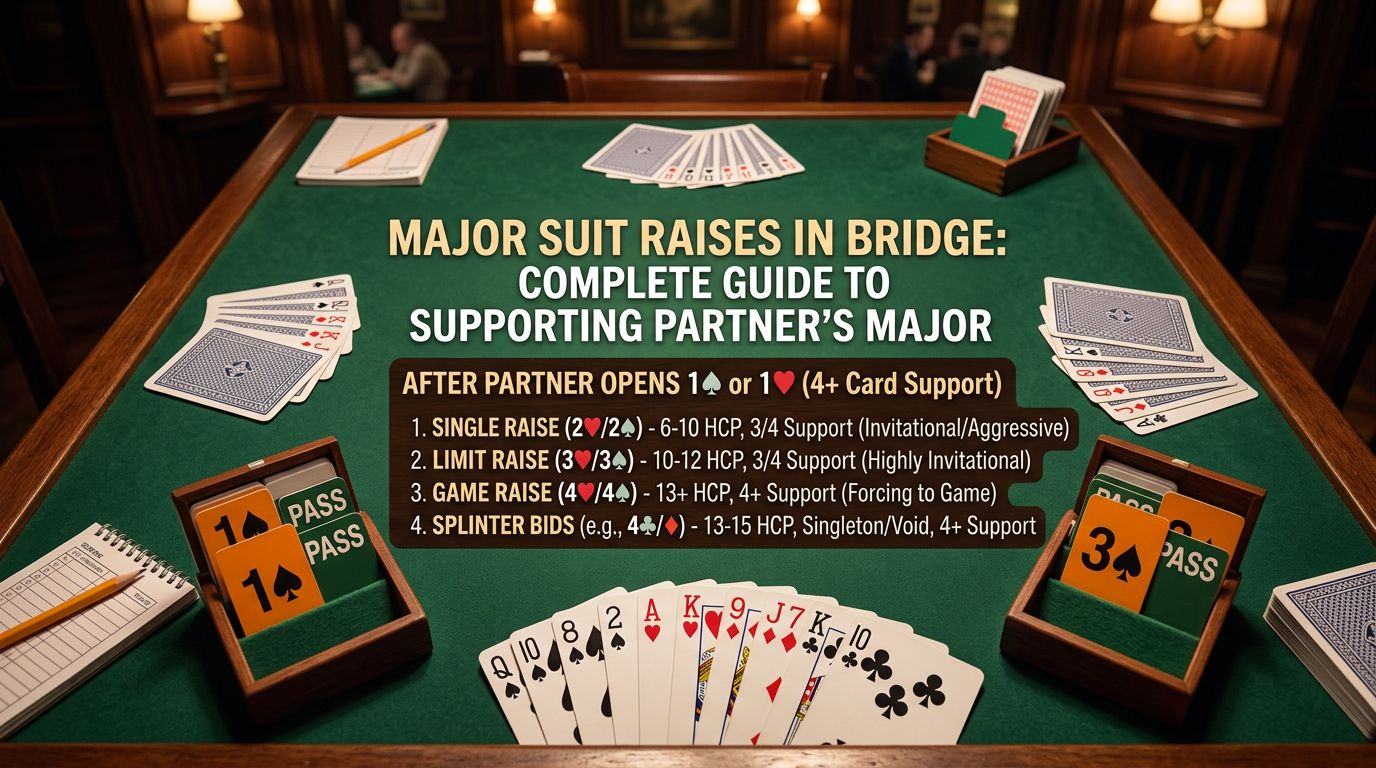
Major Suit Raises, How to Support Partners Major
When partner opens 1♥️ or 1♠️ and you’re holding support, your heart should skip a beat. You’ve found a fit—and in bridge, a major suit fit is gold. The difference between struggling at 3NT and cruising to a comfortable 4♥️ often comes down to one simple fact: major suits score game at the 10-trick level instead of the brutal 9-trick requirement for notrump.
This guide breaks down everything you need to know about raising partner’s major suit opening, from the humble simple raise to the aggressive preemptive jump to game.
Why Major Suit Raises Matter
Game in a major suit requires 10 tricks. Game in notrump requires 9 tricks. Why does this matter? Because when you have an 8-card trump fit, you can score extra tricks through ruffs and control the hand more easily than playing in notrump where the opponents can run their long suit.
Consider the points: you need roughly 25-26 combined points for game. In notrump, you need to take 9 tricks with those 25 points while the opponents attack your weak suit. In a major, you need 10 tricks, but your trump suit provides protection, ruffs, and extra tricks. The math works in your favor.
Finding a major suit fit also helps you make competitive decisions. When both sides have a fit, the Law of Total Tricks suggests that the combined number of trumps equals the total tricks available. If you know you have an 8-card spade fit and they have an 8-card heart fit, you can compete more confidently because 16 total tricks means there’s room for both sides to bid.
So when partner opens 1♥️ or 1♠️, your first job is to evaluate whether you have support. Three cards is adequate, four or more is fantastic. With support, your hand gets better—aces and kings in side suits are worth more, short suits become valuable for ruffing, and those worthless doubletons suddenly have purpose.
The Simple Raise: Showing 6-9 Points with Three-Card Support
The simple raise is your bread-and-butter response with a modest hand and at least three-card support. Partner opens 1♠️, you hold:
♠️ K 7 4
♥️ Q 8 6
♦️ J 9 5 3
♣️ 10 8 2
You have 6 high-card points and three spades. Bid 2♠️. Simple, direct, effective.
The simple raise tells partner:
- You have 6-9 support points (count extra for short suits once you have a fit)
- You have at least three-card trump support
- You don’t have enough for game unless partner has extra values
- You like their suit and want to play there
Partner can now pass with a minimum opener (12-14 points), invite game with 16-18 points, or jump to game with 19+ points. You’ve given them room to make the decision.
One key point: with 3-card support, your hand should be relatively flat. If you have 6-9 points and a singleton or void, you might have more potential than a simple raise shows. Some players upgrade these hands or make different calls, but the simple raise is standard when you’re balanced.
With four-card support, your hand is worth more. That 6-point hand with four trumps is really worth about 7-8 points because of ruffing potential. Don’t be shy about raising, trump support is incredibly valuable.
Limit Raise: Inviting Game with 10-12 Points
You have more than a minimum but not quite enough to insist on game. That’s where the limit raise comes in. After partner opens 1♥️, you hold:
♠️ K 8 5
♥️ Q J 7 4
♦️ A 9 6 2
♣️ 8 3
You have 10 high-card points, four hearts, and a doubleton. That’s a textbook limit raise. Bid 3♥️.
The limit raise shows:
- 10-12 support points
- At least three-card support (usually four)
- Invitational values, you want partner to bid game with anything extra
Partner will evaluate their hand in context. With a rock-bottom minimum (12-13 points and no extra shape), they’ll pass. With 14-15 points or good controls, they’ll accept the invitation and bid 4♥️.
The limit raise is crucial because it uses up bidding space. By jumping to 3♥️, you make it harder for opponents to enter the auction. This pre-emptive effect is a bonus—you describe your hand and crowd the opponents simultaneously.
Some partnerships use other methods to show limit raises (like Jacoby 2NT or Bergen raises, which we’ll cover), but the jump to three of partner’s major is the traditional and straightforward approach.
One tactical note: with game-invitational values and only three-card support, consider whether a different call might work better. If you have a balanced 11 count with three hearts, maybe 2NT is right. But with four-card support, always prefer the limit raise, trump fits are precious.
Game Raise: Jumping Straight to Game with 13+ Points
When you have opening-hand values facing partner’s opening bid, you know you have the points for game. Partner opens 1♠️, you hold:
♠️ K Q 8 4
♥️ A 7 2
♦️ K J 6 3
♣️ 9 5
You have 13 high-card points and four spades. Bid 4♠️ directly.
The immediate game raise shows:
- 13+ points in support of partner’s suit
- At least four-card trump support
- No interest in slam (with slam interest, you’d bid more slowly to explore)
- A balanced or semi-balanced hand
This bid ends the auction for your side. Partner will usually pass unless they have a powerhouse with 19+ points and slam aspirations.
Why jump directly to game instead of exploring? Several reasons:
First, you pre-empt the opponents. By jumping to 4♠️, you leave no room for them to enter the auction cheaply. This is especially valuable when opponents might have a fit of their own.
Second, you avoid giving away information. Slow auctions like 1♠️-2♣️-2♠️-4♠️ tell the opponents about your club suit and give them clues for defense. The direct 1♠️-4♠️ sequence reveals minimum information.
Third, you have limited slam interest. If you had great controls, a strong side suit, or 16+ points, you’d explore slam possibilities. The direct game raise says “let’s collect our game bonus and move on.”
The shape matters here. With a very distributional hand (say, 5-4-3-1 shape), you might make a forcing bid in your side suit first to show your shape before supporting spades. The direct game raise typically shows a flatter hand.
Preemptive Raises: Weak Hands with Four or More Trumps
Sometimes you have great trump support but almost nothing else. These hands are perfect for preemptive raises. Partner opens 1♥️, you hold:
♠️ 8 4
♥️ Q 9 7 6 3
♦️ 8 6 5
♣️ J 4 2
You have 3 high-card points and five hearts. This hand is terrible for anything except playing in hearts. Bid 4♥️.
Wait—didn’t we just say 4♥️ shows 13+ points? Not when you have weak values and exceptional trump support. Context matters. The preemptive game raise shows:
- 5+ card trump support (occasionally four with perfect shape)
- Weak hand, usually 5-8 points
- Distributional values, points in short suits don’t count for much
- No defensive tricks
This bid is pure obstruction. You’re trying to make it hard for opponents to find their fit or gauge the strength of the hand. Maybe they have a game in spades. Maybe they can double you. But you’ve made their life difficult.
The key is trump length. With five hearts, you know the opponents can’t have more than three hearts each. They probably have a fit somewhere else (in spades, diamonds, or clubs). Your jump to 4♥️ uses up four levels of bidding space before they can explore.
Partner knows what you have based on the auction and your lack of action. If you had 13+ points, you’d have some high cards to show in the play. When you show up with a weak hand, they’ll understand you were pre-empting.
This is a tactical weapon. Don’t overuse it, but when you have the right shape (5-card or longer support and a weak hand), the preemptive raise causes maximum chaos for minimum risk.
Bergen Raises: A Modern Convention
Many tournament players use Bergen raises, a conventional method developed by Marty Bergen to handle raises more precisely. After a major suit opening, Bergen raises work like this:
- 2♠️ over 1♥️ (or 2NT over 1♠️): Limit raise with 10-12 points and 3+ card support
- 3♣️: 7-10 points with exactly four-card support
- 3♦️: 10-12 points with exactly four-card support
- 3♥️/♠️: Preemptive, weak hand with four-card support
The idea is to distinguish between three-card and four-card support, and between weak and invitational raises. This helps partnership accuracy.
For example, if you know partner has four-card support when they bid 3♦️, you can bid game more confidently with a minimum opening. The fourth trump makes a huge difference.
Bergen raises also free up the direct raise to three (3♥️ over 1♥️) for preemptive use, showing a weak hand with four trumps instead of invitational values.
The downside? Bergen raises are conventional, so opponents can double for lead-directing purposes. If you bid 3♣️ (showing a good raise), they might double to ask for a club lead. You’ve given them information.
Is Bergen worth it? Many players think so. The precision in defining trump length and strength helps avoid game misses and phantom saves. But it requires partnership agreement and practice.
A related convention is Jacoby 2NT, where 2NT over a major opening shows a game-forcing raise with four-card support. This allows slow exploration for slam. Jacoby 2NT is popular because it leaves room to find out about opener’s distribution and controls.
Example Raising Auctions
Let’s see how these raises work in practice.
Auction 1: Simple Raise Leading to Part-Score
West opens 1♠️ with: ♠️ A Q 9 6 3 ♥️ K 8 ♦️ Q J 5 ♣️ 10 8 2 (12 points)
East holds: ♠️ K 7 4 ♥️ 9 6 3 ♦️ A 8 4 2 ♣️ J 5 4 (8 points)
Auction:
West: 1♠️
East: 2♠️
West: Pass
East shows 6-9 points with spade support. West has a minimum with no extra distribution, so passes. They play 2♠️, which should make easily with 20 combined points and an 8-card fit.
Auction 2: Limit Raise Accepted
West opens 1♥️ with: ♠️ A 8 ♥️ K Q J 6 4 ♦️ K 9 2 ♣️ Q 8 3 (14 points)
East holds: ♠️ K 7 3 ♥️ A 9 7 2 ♦️ J 8 6 ♣️ 10 5 4 (9 points, but worth 10-11 in support)
Auction:
West: 1♥️
East: 3♥️
West: 4♥️
East makes a limit raise showing 10-12 support points. West has 14 points with good hearts and accepts the invitation. They reach the excellent 4♥️ game with 24 combined points.
Auction 3: Direct Game Raise
West opens 1♠️ with: ♠️ A J 9 6 5 ♥️ K 8 ♦️ K 7 3 ♣️ Q 9 2 (13 points)
East holds: ♠️ K Q 7 3 ♥️ A 6 2 ♦️ Q J 4 ♣️ 8 5 3 (12 points, worth 13+ in support)
Auction:
West: 1♠️
East: 4♠️
West: Pass
East jumps to game with four-card support and 13 points. No reason to go slow—they have the values, they have the fit. West passes and they play 4♠️. This also keeps South-North out of the auction.
Auction 4: Preemptive Raise
West opens 1♥️ with: ♠️ K Q ♥️ A K 9 6 3 ♦️ J 8 5 ♣️ Q 7 2 (13 points)
East holds: ♠️ 8 4 ♥️ Q 10 7 5 2 ♦️ 9 6 3 ♣️ J 8 4 (4 points)
Auction:
West: 1♥️
East: 4♥️
All Pass
East’s jump is preemptive with five hearts and minimal values. South-North might have a spade fit, but they can’t find it anymore. West knows East is weak from the weak dummy that appears, but 4♥️ might still make with good breaks. Even down one isn’t terrible if opponents have a game.
Common Mistakes in Raising
Mistake #1: Raising with Two-Card Support
Never raise partner’s major with only two cards. You need at least three. With two cards, explore other options like bidding a new suit or bidding notrump.
Mistake #2: Undervaluing Trump Support
Many players forget to count distributional values. With four-card support, add a point for a doubleton, two for a singleton, three for a void. That 8-point hand with four spades and a singleton is worth 10 in support, make a limit raise, not a simple raise.
Mistake #3: Raising with Unsuitable Shape
A classic error is raising with 4-4-3-2 shape when you have only three-card support. If you hold four cards in another suit, consider bidding that suit first. Raising should show interest in playing that trump suit, not just tolerance.
Mistake #4: Slow-Playing Game Values
When you have 13+ points and four-card support, don’t mess around. Jump to game. Players sometimes bid a new suit first “to show values,” but this risks missing the best spot and helps the opponents defend.
Mistake #5: Preempting with Defense
The preemptive raise works because you have no defense. If you have 7 points including an ace and king, that’s not a preempt, you have defensive tricks. Bid constructively instead.
Mistake #6: Forgetting About Vulnerability
The preemptive 4-level raise is most effective when non-vulnerable. If you’re vulnerable and go down two or three doubled, that’s a disaster. Be more conservative when vulnerable.
Mistake #7: Ignoring Partner’s Likely Shape
When partner opens 1♥️, they promise five hearts (in most modern systems). When you raise with three hearts, you guarantee an 8-card fit. Trust the math and support aggressively. Some players “wait to see” if partner rebids hearts—don’t. Support immediately.
Ask Brian About Your Bidding
Not sure what to bid? Describe your hand and the auction to Brian, the Bridgetastic AI, and get instant feedback on the right call. Try Brian free →
Putting It All Together
Major suit raises are the foundation of constructive bidding. When partner opens a major and you have support, you have a gift, an 8-card or better fit that can generate game or even slam.
The key is accuracy. Use the simple raise (2-level) with modest values, the limit raise (3-level) with invitational values, and the game raise (4-level) with either game values or preemptive distribution. Each bid serves a purpose.
Remember that trump fits make hands better. That scattered 11-count becomes powerful when you have four spades opposite partner’s five. Add points for short suits, value your trumps properly, and support partner aggressively.
And when you have that weak hand with five-card support, don’t be shy about the preemptive blast to game. Your opponents will curse you, which means you’re doing something right.
The bridge major suit raise isn’t just about showing points. It’s about recognizing fit, evaluating your hand in context, and making tactical decisions that help you reach the right contract while making life difficult for the opponents. Master these raises, and you’ll win more games and have more fun doing it.