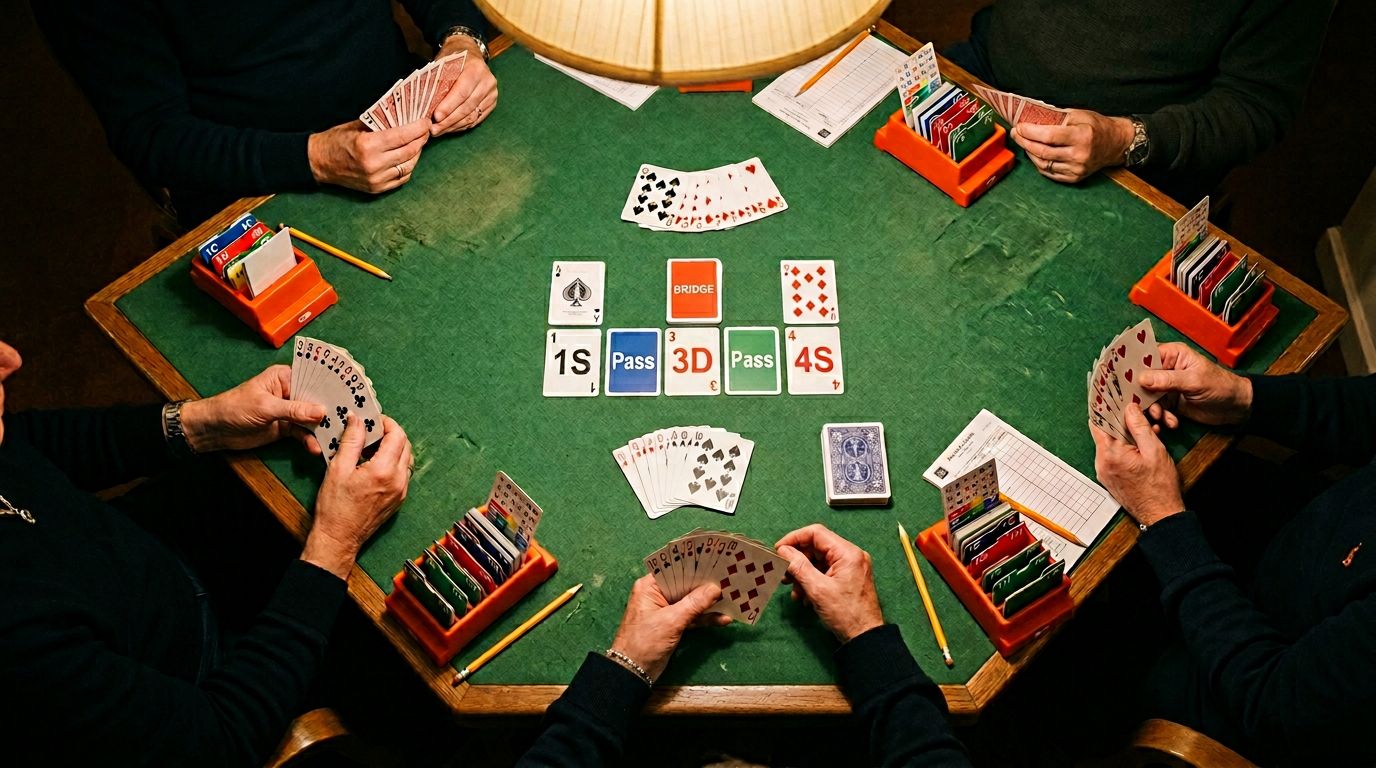
Bergen Raises — Show Major Suit Support with 3♣ & 3♦ Raises
Bergen Raises are artificial 3-level responses that show 4-card support for partner’s major suit opening. Instead of jumping directly to 3♥ or 3♠, you bid 3♣ or 3♦ to tell partner both your point range and your exact trump length.
Developed by Marty Bergen (one of bridge’s most influential teachers and theorists), this convention solves a problem: when partner opens 1♥, how do you show exactly four hearts with different hand strengths? Bergen Raises give you precision tools for that job.
The Basic Structure
After partner opens 1♥ or 1♠, Bergen Raises work like this:
3♣ = Limit raise (10-12 points, exactly 4-card support)
This shows a hand that wants to invite game. You have opening-hand values but not quite enough to force to game. Partner can pass with a minimum, accept the invitation with extras, or even make a slam try with a maximum.
3♦ = Constructive raise (7-9 points, exactly 4-card support)
This is weaker than the limit raise but stronger than a simple raise to 2♥/2♠. You’re saying “I have a decent hand, not garbage, but we’re probably stopping short of game unless you have extras.”
3♥/3♠ = Weak raise (5-7 points, usually 4 trumps)
This is preemptive. You’re jumping to make life harder for the opponents, not because you have a strong hand. Think of it as advanced obstruction with trump support.
2♥/2♠ = Simple raise (6-9 points, exactly 3-card support)
With Bergen on, this promises exactly three trumps. You can’t have four, because you’d have bid 3♦ instead.
The beauty here is that opener knows your exact trump length immediately. That’s huge for competitive decisions and slam exploration.
Point Ranges and Hand Requirements
Let’s get specific about what hands qualify for each bid.
3♣ (Limit Raise)
Points: 10-12 HCP
Trumps: Exactly 4 cards
Quality: Should have something useful beyond just scattered points
Example after partner opens 1♠:
♠ K J 7 4
♥ A 8 3
♦ Q J 9
♣ 8 6 2
Perfect. 11 HCP, four spades, solid values. Bid 3♣.
3♦ (Constructive Raise)
Points: 7-9 HCP
Trumps: Exactly 4 cards
Quality: Not completely broke, has some values
Example after 1♥:
♠ A 7
♥ J 9 7 4
♦ Q 8 6 2
♣ 10 5 3
Only 7 HCP, but you have an ace and a queen. This qualifies as constructive rather than preemptive.
Opener’s Rebids After a Bergen Raise
After you open 1♥ and partner bids 3♣ (limit raise), you’re captain. Here’s how to proceed:
After 3♣ (Limit Raise, 10-12)
3♥/3♠: Minimum opening. You’re declining the game invitation.
4♥/4♠: Accepting the invitation. You have 14-15 points or a distributional hand that likes the fit.
New suit at the 3-level: Showing a control and slam interest. Partner should cue-bid if interested or just bid game if not.
3NT: Rare, but shows a balanced hand that thinks 3NT might play better than 4 of the major.
After 3♦ (Constructive Raise, 7-9)
3♥/3♠: Sign-off. Most common rebid. You need more than 7-9 opposite a minimum to make game.
4♥/4♠: Maximum opening (16-17 HCP) or great distribution. You’re bidding game opposite what might be only 7 points.
Bergen vs. Other Raise Structures
Jacoby 2NT
Jacoby 2NT shows 4+ trumps and game-forcing values (13+ points). Most pairs play both conventions together: Bergen for sub-game-forcing hands (7-12) and Jacoby 2NT for game-forcing hands (13+). This gives you precision across all ranges.
Splinter Bids
Splinters (like 4♣ after 1♠) show 4-card support, game-forcing values, and shortness. Bergen shows point range precisely, while splinters show distribution for slam evaluation. Use both.
Standard Limit Raise
In standard methods, 3♥ after 1♥ shows 10-12 points. Bergen flips this: 3♥ becomes weak/preemptive, and 3♣ becomes the limit raise. The advantage is you can preempt opponents when they’re about to balance in.
Common Variations
Reverse Bergen
Some pairs flip the meanings (3♣ = constructive, 3♦ = limit). The memory aid is “3♦ = Dimes” for 10-12 points. The downside is that 3♦ takes up more bidding space when you want to explore slam with your better hand.
Adjusted Point Ranges
Some pairs adjust the ranges (like 9-11 for limit, 6-8 for constructive). Others use 7-10 and 11-12. Talk to your partner about where you draw the lines.
Example Auctions
Let’s see Bergen Raises in action.
Auction 1: Accepting the Limit Raise
Opener          Responder
♠ K Q J 8 4     ♠ A 9 6 2
♥ A 6           ♥ K 10 3
♦ K J 9         ♦ 7 5 2
♣ Q 10 3        ♣ A 8 4

1♠              3♣ (limit raise, 10-12, 4 spades)
4♠              Pass
Opener has 14 HCP and a fifth spade. Responder shows 10-12 with four spades. That’s 24-26 combined with a nine-card fit. Easy game.
Auction 2: Declining the Limit Raise
Opener          Responder
♠ A 10 7 5 3    ♠ K J 6 2
♥ K 8           ♥ 9 5 3
♦ J 9 4         ♦ K Q 8
♣ Q 6 2         ♣ 10 7 4

1♠              3♣ (limit raise, 10-12, 4 spades)
3♠              Pass
Opener has only 11 HCP and flat shape. Even opposite 12, you’re stretching for game. Sign off at 3♠.
Auction 3: Constructive Raise
Opener          Responder
♠ 8 2           ♠ 6
♥ A K J 6 3     ♥ Q 10 8 4
♦ K Q 4         ♦ A 7 6 2
♣ A 9 5         ♣ 8 7 3 2

1♥              3♦ (constructive, 7-9, 4 hearts)
4♥              Pass
Opener has 17 HCP with good hearts. That’s a maximum, worth bidding game even opposite only 7 points. Responder has the ace of diamonds and a fourth trump. 4♥ has a good shot.
Auction 4: Slam Try After Bergen
Opener          Responder
♠ A K Q 8 4     ♠ J 10 6 3
♥ A 7           ♥ K 9 4
♦ K Q 10        ♦ A J 6
♣ 9 5 2         ♣ K 10 4

1♠              3♣ (limit raise, 10-12, 4 spades)
3♦              4♣ (cue-bid, club control)
4♥              4♠
Pass
Opener has 18 HCP and wants to explore slam. 3♦ shows diamond values and slam interest. Responder cooperates with 4♣, showing the club king. When opener bids 4♥ (heart control), responder signs off at 4♠, denying a club control beyond the king and no extra values. Opener respects that decision.
This auction shows the space Bergen creates for slam exploration. If responder had jumped directly to 3♠ (standard limit raise), you’d have less room to exchange information.
Partnership Agreements
Before you play Bergen with a new partner, nail down these details:
When is Bergen on? Most pairs turn off Bergen after opponent overcalls (1♠ - 2♥), but keep it on after doubles.
Trump length requirements: Exactly four trumps, or will you use it with three or five?
Point ranges: Standard is 10-12 for 3♣, 7-9 for 3♦, but some pairs adjust these.
Standard or Reverse? Are you playing 3♣ = limit (standard) or 3♦ = limit (reverse)?
What does 3♥/3♠ show? Typically preemptive with Bergen on, but some pairs use it as a mixed raise (8-9 points).
When Should You Play Bergen?
Bergen works best for aggressive pairs who like preempting opponents while showing good raises precisely. It’s valuable at matchpoints where precision in the 22-24 point zone matters. Bergen pairs naturally with Jacoby 2NT and splinters to create a complete system.
The downside is you need solid partnership memory. If someone forgets 3♣ is artificial and passes, you’re playing a 5-2 fit at the 3-level. Skip Bergen with pickup partners or if you prefer simple, natural bidding.
Related Articles
Practice This Convention with Brian
Want to test your understanding of this convention in realistic hands? Brian, the Bridgetastic AI, can deal you practice hands, walk you through the bidding, and explain when this convention applies, and when it doesn’t. Try Brian free →
The Bottom Line
Bergen Raises turn your major suit raises into precision tools. Instead of lumping everything from 6 to 12 points into two bids (simple raise and limit raise), Bergen gives you four distinct bids that separate by both strength and trump length.
The cost is giving up natural 3♥/3♠ raises and adding artificial meanings to 3♣ and 3♦. For most improving pairs, that’s a trade worth making. You gain clarity in competitive auctions, better game decisions, and more space for slam exploration.
Just make sure your partner remembers that 3♣ isn’t natural. Otherwise you’ll end up in some weird contracts.