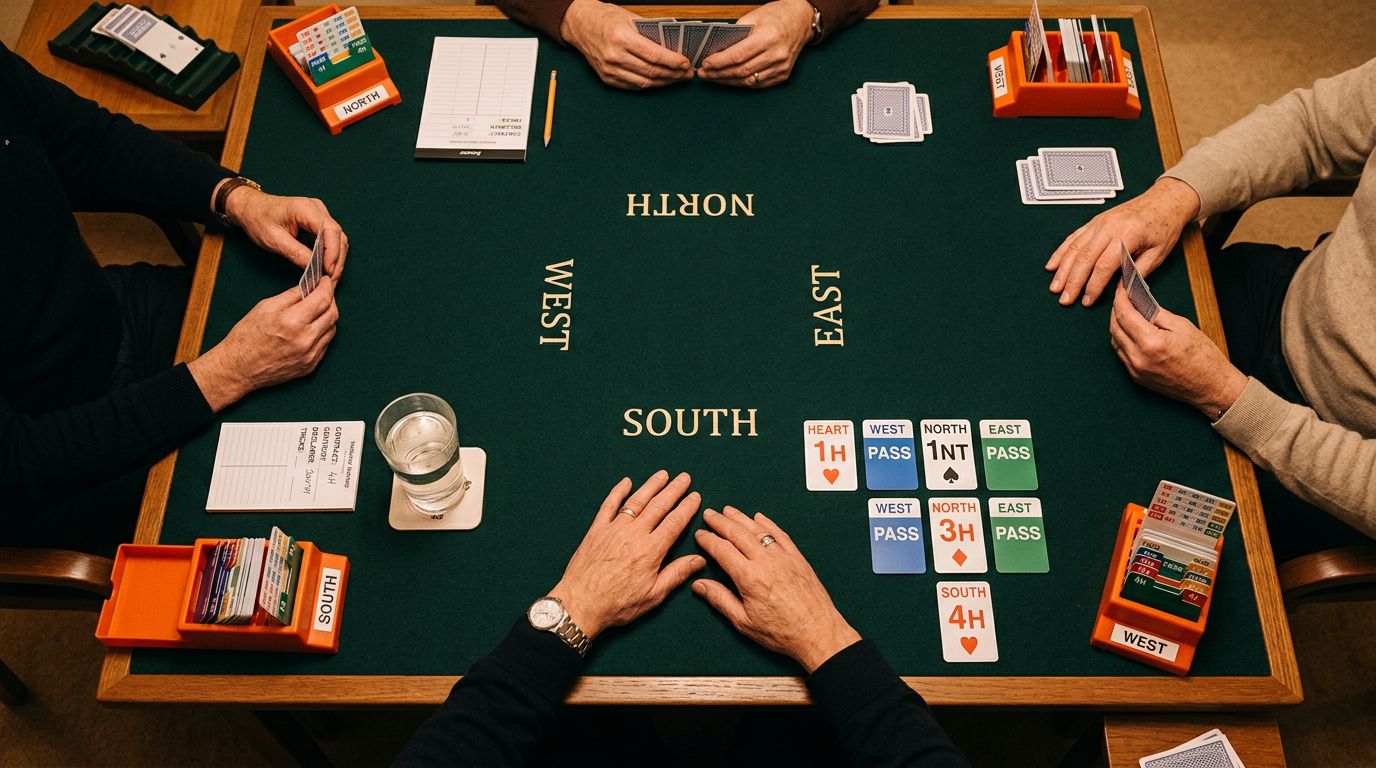
Responding to 1NT Opening, Complete Response Guide
Partner opens 1NT (15-17 HCP). You’ve got 10 HCP and a five-card heart suit. What do you bid?
The 1NT opening is one of the most common and well-defined bids in bridge. Responder’s job is to figure out where to play: what level (partscore, game, or slam) and what strain (notrump or a suit). You’ve got a whole system of conventional bids to help you get there.
This is the complete guide to responding to 1NT. Learn this, and you’ll never butcher another notrump auction.
The Basic Structure
After partner opens 1NT (15-17 HCP), responder’s bids mean:
- 2♣ = Stayman (asking for 4-card majors)
- 2♦ = Jacoby Transfer to hearts
- 2♥ = Jacoby Transfer to spades
- 2♠ = Minor suit signoff or invite (varies by partnership)
- 2NT = Invitational (11-12 HCP, balanced)
- 3♣ / 3♦ = Signoff (weak with 6+ card minor)
- 3♥ / 3♠ = Invitational (6-card major, 9-10 HCP)
- 3NT = To play (usually 10-15 HCP, balanced)
- 4♣ / 4♦ = Gerber or Texas Transfer (depends on partnership)
- 4♥ / 4♠ = To play (6+ card major, game values but no slam interest)
- 4NT = Quantitative (inviting slam, 16-17 HCP)
Let’s break down each one.
Stayman: Finding the 4-4 Major Fit
Stayman (2♣) asks opener if they have a four-card major. Opener responds:
- 2♦ = No four-card major
- 2♥ = Four hearts (might also have four spades)
- 2♠ = Four spades, denies four hearts
When to use Stayman:
You need at least one four-card major and enough points to handle any answer. Usually 8+ HCP.
Example 1:
♠KJ84
♥Q732
♦A5
♣943
Partner opens 1NT. You’ve got 9 HCP and both majors. Bid 2♣ (Stayman). If partner bids 2♥, you raise to 3♥ (invitational). If partner bids 2♠, you raise to 3♠. If partner bids 2♦ (no major), you bid 2NT (invitational).
Example 2:
♠KJ84
♥Q73
♦A52
♣943
Partner opens 1NT. You’ve got 9 HCP and four spades. Bid 2♣ (Stayman). If partner bids 2♠, raise to 4♠ (you’ve got 25 points total and a 4-4 fit). If partner bids 2♦ or 2♥, bid 2NT (invitational).
Garbage Stayman:
With a weak hand (0-7 HCP) and both majors, you can use Stayman planning to pass any major suit response. If opener bids 2♦, you pass (yuck) or bid 2♥ (pass or correct, showing hearts and spades).
This is called Garbage Stayman. It’s risky. Some pairs don’t play it.
Jacoby Transfers: Getting to the Right Major
Jacoby Transfers let you show a five-card major and make opener the declarer.
- 2♦ = Transfer to hearts (shows 5+ hearts)
- 2♥ = Transfer to spades (shows 5+ spades)
Opener must accept the transfer by bidding the next suit: 2♥ over 2♦, 2♠ over 2♥.
Why transfer?
It makes opener the declarer, so the strong hand is hidden. The opening lead comes up to the strong hand instead of through it.
After the transfer:
Responder can pass (weak hand, 5+ card major), invite (11-12 HCP), or bid game (13+ HCP).
Example 1 (weak):
♠J8
♥KQ842
♦J95
♣763
Partner opens 1NT. You’ve got 5 HCP and five hearts. Bid 2♦ (transfer). Opener bids 2♥. Pass. Playing 2♥ is better than 1NT.
Example 2 (invitational):
♠A8
♥KQ842
♦J95
♣763
Partner opens 1NT. You’ve got 9 HCP and five hearts. Bid 2♦ (transfer). Opener bids 2♥. Now bid 2NT (invitational with 5 hearts). Opener passes with 15, bids 3♥ or 3NT with 16, or bids 4♥ with 17 and three-card support.
Example 3 (game):
♠A8
♥KQ842
♦AJ5
♣763
Partner opens 1NT. You’ve got 12 HCP and five hearts. Bid 2♦ (transfer). Opener bids 2♥. Now bid 3NT (game with 5 hearts, but not sure if hearts is better than notrump). Opener will correct to 4♥ with three-card support.
Or just bid 4♥ directly if you’re sure you want to play in hearts.
Super-accept:
If opener has a maximum (17 HCP) and four-card support for responder’s major, opener can “super-accept” by jumping to the three-level. This shows extras and invites responder to bid game if they were just inviting.
After 2♦ (transfer to hearts), opener can bid 3♥ with 17 HCP and four hearts. This is rare but helpful.
Texas Transfers: Jumping to Game
Texas Transfers (4♦ and 4♥) are used to jump directly to game in a major.
- 4♦ = Transfer to 4♥
- 4♥ = Transfer to 4♠
Opener must accept by bidding the major at the four level.
When to use Texas:
You have a six-card major and game values (10+ HCP), but no slam interest. You just want to play 4♥ or 4♠.
Example:
♠KQJ842
♥73
♦A95
♣63
Partner opens 1NT. You’ve got 10 HCP and six spades. Bid 4♥ (Texas Transfer to spades). Opener bids 4♠. Done.
If you had slam interest, you’d use Jacoby Transfer (2♥) and then make a slam try over opener’s 2♠ bid.
Minor Suit Stayman (2♠)
Some pairs play 2♠ as a minor suit ask or puppet to 3♣. This varies a lot. Discuss with partner.
One common treatment: 2♠ shows a weak hand with a long minor. Opener bids 3♣, and responder passes or corrects to 3♦.
Another treatment: 2♠ is invitational or better, showing both minors or interest in a minor suit slam.
There’s no universal standard here. Many pairs don’t play 2♠ as anything special.
Invitational Bids
2NT: Shows 11-12 HCP (some play 11-12, others play 8-9). Balanced hand, no four-card major worth investigating. Opener passes with 15, bids 3NT with 16-17.
3♥ or 3♠: Shows a six-card major and invitational values (9-10 HCP). Not forcing. Opener can pass with 15 and doubleton support, or bid 4♥/4♠ with a fit and a maximum.
Some pairs play this as showing five cards instead of six. Discuss.
After Stayman: If you use Stayman and then bid 2NT or three of a major, that’s invitational.
Signoff Bids
3♣ or 3♦: Shows a weak hand (0-7 HCP) with a six-card or longer minor. Not forcing. Opener is expected to pass.
Example:
♠73
♥82
♦QJ9742
♣J63
Partner opens 1NT. You’ve got 4 HCP. Bid 3♦ (signoff). Playing 3♦ is way better than 1NT.
Slam Tries
4NT: Quantitative, inviting 6NT. Shows 16-17 HCP (some play 15-16). Balanced, no interest in a suit contract. Opener passes with 15, bids 6NT with 17, uses judgment with 16.
Not Blackwood after 1NT! Blackwood would be jumped to after some other bid. 4NT directly over 1NT is quantitative.
After Jacoby Transfer:
You can make a slam try by using Jacoby Transfer, then bidding a new suit or jumping.
Example:
Partner opens 1NT. You hold:
♠AKJ84
♥A3
♦KQ95
♣72
You’ve got 16 HCP and five spades. Slam is very possible. Bid 2♥ (transfer to spades). Opener bids 2♠. Now bid 4NT (quantitative) or 3♦ (showing diamonds and slam interest).
This is more advanced, but the idea is: transfer first, then explore slam.
Direct Game Bids
3NT: To play. Shows 10-15 HCP, balanced, no four-card major or interest in a major suit game. Most common response to 1NT.
4♥ or 4♠ (if not playing Texas): Shows a six-card major and game values, but no slam interest.
6NT: Shows 18-19 HCP, balanced. Just bid it.
7NT: Shows 21+ HCP. You’re counting to 33+ combined, you’re bidding it.
When to Just Raise to 3NT
If you have 10-15 HCP, balanced shape, no four-card major, and no five-card major, just bid 3NT.
Don’t overthink it. 3NT is the most common contract in bridge, and it’s usually the right spot when both hands are balanced.
Example:
♠KJ4
♥Q73
♦AJ95
♣842
Partner opens 1NT. You’ve got 11 HCP. Bid 3NT. Don’t use Stayman (you’ve only got three hearts and three spades). Don’t invite with 2NT (you’ve got enough for game). Just bid 3NT and make it.
Common Mistakes
Using Stayman with a five-card major: Don’t. Use Jacoby Transfer instead. Stayman is for four-card majors.
Using Stayman without a plan: You bid 2♣, partner bids 2♦, and now you’re stuck. Before using Stayman, know what you’ll do if partner denies a major.
Forgetting to transfer: You bid 2♥ thinking “I have five hearts,” but 2♥ is a transfer to SPADES. 2♦ transfers to hearts.
Not inviting with 11-12 HCP: If you’ve got 11 HCP and partner’s got 15, you’re borderline for game. Invite with 2NT. Let opener decide.
Jumping to game without exploring: With 13 HCP and a five-card major, you want to be in game. But is it 3NT or 4♥? Transfer, then bid 3NT. Let opener choose with three-card support.
Interference Over 1NT
Opponents double or bid over 1NT? Your system changes.
Most pairs play:
- Redouble: Shows 10+ HCP, no five-card suit, wants to penalize.
- Suit bids: Natural, to play.
- Transfer bids: Still on, but now you can pass if their bid takes away your transfer.
This gets complicated. Discuss with partner. The key is: don’t panic. You still want to find your fit or play in your best suit.
Special Conventions
Some pairs play additional toys:
- Smolen: After Stayman, jump in your four-card major to show five cards in the other major. Advanced.
- Four-suit transfers: 2♠ transfers to clubs, 3♣ transfers to diamonds. Rarely used.
- Gerber: 4♣ asks for aces (like Blackwood). Some play this, some don’t.
These are optional. The core system (Stayman and Jacoby Transfers) is enough for 95% of hands.
Putting It Together
Partner opens 1NT (15-17 HCP). Here’s your decision tree:
- Do I have 0-7 HCP? Transfer to a five-card major and pass, or bid 3♣/3♦ with a long minor.
- Do I have 8-9 HCP? Use Stayman or transfer, then invite.
- Do I have 10-15 HCP and balanced? Bid 3NT.
- Do I have 10-15 HCP and a five-card major? Transfer and decide between 3NT and 4♥/4♠.
- Do I have 16+ HCP? Think slam. Use quantitative 4NT or transfer then explore.
Most of the time, you’re picking between 3NT, 4♥, and 4♠. Find the 5-3 or 4-4 major fit if it exists. Otherwise, play 3NT.
Ask Brian About Your Bidding
Not sure what to bid? Describe your hand and the auction to Brian, the Bridgetastic AI, and get instant feedback on the right call. Try Brian free →
Final Thoughts
The 1NT structure is the most important system in bridge. You’ll see it multiple times every session. Master Stayman and Jacoby Transfers, know when to invite vs bid game, and don’t overthink the simple hands.
When in doubt, bid 3NT and make it. Finding a major suit game is great, but 3NT works most of the time. And please, for the love of bridge, remember: 2♦ transfers to hearts, 2♥ transfers to spades. Don’t mix them up.
Now go find those major suit fits and bid some games.