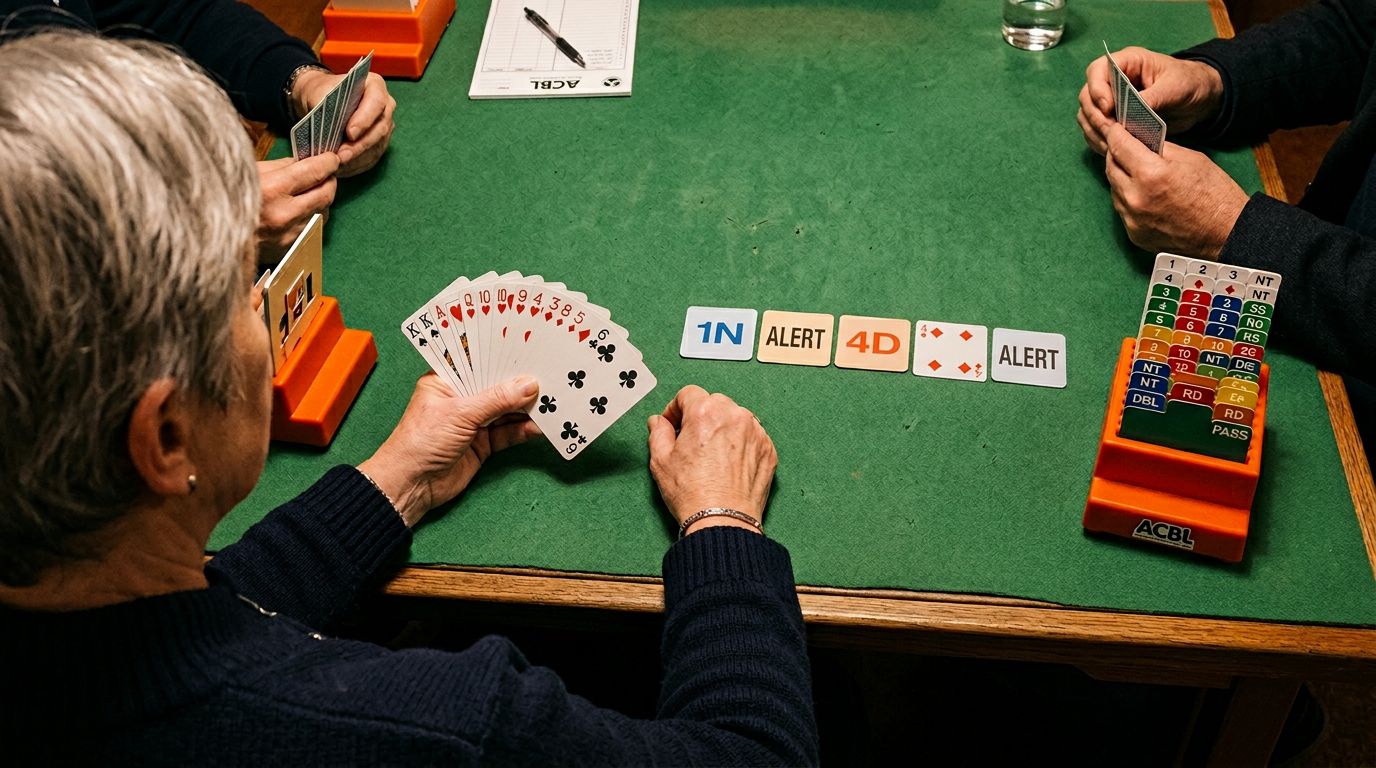
Texas Transfer, Jump to 4-Level After 1NT for 6-Card Majors
Texas Transfers let you jump straight to game in a major after partner opens 1NT. Bid 4♦ to transfer to 4♥, or 4♥ to transfer to 4♠. Partner accepts, and you’re done. No fuss, no follow-up bidding.
This is a companion to Jacoby Transfers. Where Jacoby handles five-card majors with various hand strengths, Texas handles six-card majors with game values and no slam interest.
The Basics
After partner opens 1NT:
- 4♦ = Transfer to 4♥ (shows 6+ hearts, game values, no slam interest)
- 4♥ = Transfer to 4♠ (shows 6+ spades, game values, no slam interest)
Partner’s response is simple: complete the transfer. Bid 4♥ over 4♦, or 4♠ over 4♥. That’s it. You’re in game, and the strong hand is declarer.
Requirements
You need three things:
1. Six or more cards in the major
With only five cards, use Jacoby Transfers (2♦ or 2♥) instead. Texas promises six.
2. Game-going values (10-14 HCP)
You have enough for game opposite partner’s 1NT opening. Not slam interest, but enough to make 4♥ or 4♠ a decent contract.
3. No slam interest
This is key. If you’re thinking about slam, don’t use Texas. Start with Jacoby Transfers at the 2-level so you have room to explore. Texas says “I want to play game in this major, nothing more.”
Texas vs Jacoby: When to Use Each
Use Jacoby Transfers (2♦/2♥) when:
- You have five cards in the major
- You have any hand strength (weak, invitational, game values)
- You have slam interest
- You want to offer partner a choice between 3NT and 4 of the major
After Jacoby, you have room to bid 3NT, invite, or show a second suit. You have options.
Use Texas Transfers (4♦/4♥) when:
- You have six or more cards in the major
- You have game values (10-14 HCP)
- You have no slam interest
- You’re certain 4♥ or 4♠ is the right contract
Texas is a sign-off. You’re declaring what the final contract is, not asking partner’s opinion.
Why Use Texas at All?
Good question. You could use Jacoby Transfers and then jump to game. So why have Texas?
1. It saves a round of bidding
Minor, but it prevents the opponents from exchanging information. In a competitive auction, less bidding room for them is better.
2. It’s clearer to partner
When you use Jacoby and jump to 4♥, partner might wonder if you have slam interest or just a signoff. Texas removes the ambiguity. It says “I have six cards, we’re playing game, don’t look for slam.”
3. It differentiates hand types
Some partnerships use the distinction this way:
- Jacoby then 4♥/4♠ = Five cards, mild slam interest
- Texas = Six cards, no slam interest
This lets you communicate more precisely. Partner knows your exact hand type.
Opener’s Response: Just Accept
Unlike Jacoby Transfers where opener can super-accept or occasionally break the transfer, Texas Transfers are non-negotiable. Opener always completes the transfer.
Why? Because responder already said they’re not interested in slam and they have six cards. Opener’s opinion doesn’t matter. Just bid 4♥ or 4♠ and move on.
Never break a Texas Transfer. Even with a maximum 1NT opening and excellent support, you complete the transfer. Responder promised no slam interest. Respect that.
Example Hands
Hand 1: Perfect Texas Hand
Partner opens 1NT. You hold:
♠ 85
♥ AQJ1064
♦ K7
♣ 1053

Bid 4♦ (Texas Transfer to hearts)
Partner bids 4♥
Done
You have six solid hearts and 11 HCP. Game is right, slam is unlikely. Texas gets you there cleanly, with partner as declarer.
Hand 2: Use Texas, Not Jacoby
Partner opens 1NT. You hold:
♠ J108652
♥ 7
♦ AQ6
♣ K94

Bid 4♥ (Texas Transfer to spades)
Partner bids 4♠
Done
You have six spades and 10 HCP. You want to play 4♠, and you don’t need partner’s input. Texas Transfer gets you there.
Hand 3: Don’t Use Texas (Slam Interest)
Partner opens 1NT. You hold:
♠ KQ10654
♥ A3
♦ AJ82
♣ 7

Don't bid 4♥ (Texas)
Bid 2♥ (Jacoby Transfer to spades)
Partner bids 2♠
Bid 3♦ (natural, forcing)
You have 15 HCP and six good spades. Slam is possible if partner has the right cards. Use Jacoby so you have room to explore. Texas would shut down the auction too early.
Hand 4: Don’t Use Texas (Only Five Cards)
Partner opens 1NT. You hold:
♥ AKJ85
♠ 73
♦ KQ4
♣ 1062

Don't bid 4♦ (Texas)
Bid 2♦ (Jacoby Transfer to hearts)
Partner bids 2♥
Bid 3NT
You have only five hearts. Texas promises six. Use Jacoby instead, then bid 3NT to give partner a choice between 3NT and 4♥.
Hand 5: The Full Auction
West           East
1NT            4♦
4♥            Pass

West holds:
♠ KJ5
♥ K83
♦ AQ104
♣ AJ7

East holds:
♠ 74
♥ AQJ1052
♦ K6
♣ 965
West opens 1NT with a balanced 16 HCP. East has six hearts and 10 HCP, perfect for game. East bids 4♦ (Texas Transfer). West completes to 4♥. The opening lead comes into West’s hand, protecting the king of hearts. Contract makes.
Common Situations
What if you have seven or eight cards?
Still use Texas. The requirements are “six or more,” not exactly six. With a long major and game values but no slam interest, Texas works fine.
What if you have game values but a weak suit?
Use Texas anyway if you have six cards. Even if your suit is J109xxx, having six of them opposite partner’s 1NT opening means the major should play well. Trust the length.
What if opponents interfere?
Texas is off after interference. If they double or overcall after 1NT, you lose your transfer bids (or use a different system like Lebensohl). Just bid naturally.
Can you use Texas with a side four-card major?
Yes. Texas doesn’t deny a four-card side suit. It just says “I have six cards in this major, we’re playing game here.” If you have both majors 6-4, use Texas for the six-card suit.
Variations and Alerts
Standard Texas:
- 4♦ = Transfer to 4♥
- 4♥ = Transfer to 4♠
This is the most common version. It’s straightforward and mirrors Jacoby Transfers (bid the suit below your suit).
South African Texas (less common):
- 4♦ = Transfer to 4♠
- 4♥ = Transfer to 4♥
Some pairs play this reversed version. Check your card before playing.
Alerting:
Texas Transfers are alertable in most jurisdictions. When partner bids 4♦ or 4♥, alert and explain if asked: “Transfer to 4♥” or “Transfer to 4♠.”
In online bridge, the system will usually auto-alert this for you.
Partnership Agreements
Discuss these with your partner:
Do we play Texas Transfers at all?
Not everyone does. Some pairs use 4♦ and 4♥ as natural bids or for other conventions (like Gerber variants). Make sure you’re on the same page.
If so, which version?
Standard (4♦ → 4♥, 4♥ → 4♠) or South African? Write it on your convention card.
What does Jacoby-then-game mean?
If Texas shows no slam interest, does transferring at the 2-level and jumping to game show mild slam interest? Some pairs use this distinction. Clarify whether:
- 1NT - 2♦ - 2♥ - 4♥ = Mild slam interest
- 1NT - 4♦ - 4♥ = Signoff
Or both just mean “I want to play 4♥.” Decide as a partnership.
What about after 2NT opening?
Some pairs use Texas Transfers after 2NT openings as well (with adjustments). Discuss if you want this.
Common Mistakes
1. Using Texas with five cards
You have five spades and 12 HCP. You bid 4♥ (Texas Transfer).
Wrong. Texas promises six cards. With five, use Jacoby Transfers (2♥).
2. Using Texas with slam interest
You have six hearts, 15 HCP, and a side suit. You bid 4♦ (Texas).
Wrong. Texas denies slam interest. Use Jacoby (2♦) to keep the bidding low and explore slam.
3. Opener breaking the transfer
Responder bids 4♦. Opener has a maximum with four hearts and bids 4NT (inviting slam).
Wrong. Responder said no slam interest by using Texas. Complete the transfer to 4♥. Don’t override their decision.
4. Forgetting which suit is which
You have six spades. You bid 4♠ (thinking it’s natural).
Wrong. In Standard Texas, 4♠ is something else (maybe Gerber or natural clubs if you play that). To show spades, bid 4♥. Double-check your convention card.
Related Articles
Practice This Convention with Brian
Want to test your understanding of this convention in realistic hands? Brian, the Bridgetastic AI, can deal you practice hands, walk you through the bidding, and explain when this convention applies, and when it doesn’t. Try Brian free →
Why This Matters
Texas Transfers clarify your intentions. When you jump straight to 4♦ or 4♥, partner knows:
- You have six cards
- You want to play game
- Slam is not on your radar
This prevents partner from wasting time looking for slam when you don’t want it. It also gets the strong hand as declarer, which protects tenaces and conceals strength from the opponents.
Texas is simple. Learn the requirements (6+ cards, game values, no slam interest), remember the bids (4♦ for hearts, 4♥ for spades), and you’re set. Use it when appropriate, and it’ll make your notrump auctions cleaner and more precise.
Just don’t confuse it with Jacoby. Five cards? Jacoby. Six cards and done bidding? Texas. Keep that straight, and you’ll be fine.