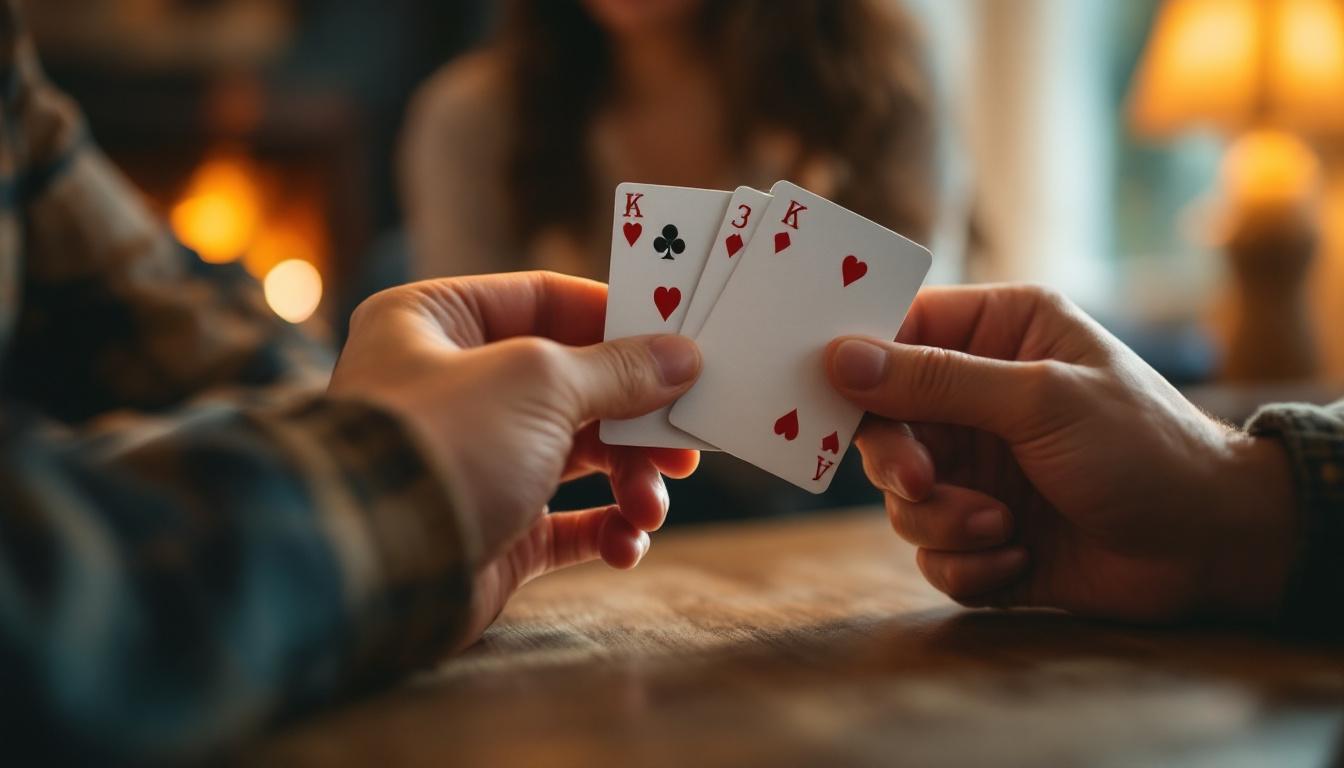
Blackwood & Roman Keycard Blackwood (RKCB), Slam Bidding
You’re bidding toward slam. You think you have the points and the fit. But do you have enough controls? Are you missing two aces?
That’s what Blackwood is for. Bid 4NT, ask about aces, and decide if slam is safe.
Simple version: Blackwood asks for aces. Modern version: Roman Keycard Blackwood (RKCB) asks for aces and the king of trump. Most serious players use RKCB.
Basic Blackwood
The original convention, invented by Easley Blackwood in 1933 (read the history of Blackwood):
4NT = How many aces do you have?
Responses:
- 5♣ = 0 or 4 aces
- 5♦ = 1 ace
- 5♥ = 2 aces
- 5♠ = 3 aces
After hearing the response, you can ask for kings with 5NT:
- 6♣ = 0 or 4 kings
- 6♦ = 1 king
- 6♥ = 2 kings
- 6♠ = 3 kings
Simple. Clean. But it has a problem: it doesn’t ask about the king of trump, which is almost as good as an ace.
That’s why most players switched to RKCB.
Roman Keycard Blackwood (RKCB)
RKCB treats five cards as key cards:
- The four aces
- The king of trump
So when you ask 4NT, partner tells you how many of these five key cards they have.
4NT = How many key cards?
Most common response structure (1430):
- 5♣ = 1 or 4 key cards
- 5♦ = 0 or 3 key cards
- 5♥ = 2 key cards without the queen of trump
- 5♠ = 2 key cards with the queen of trump
(Some pairs play 0314, where 5♣ shows 0 or 3, and 5♦ shows 1 or 4. Discuss with your partner.)
After the key card response, you can ask about the queen of trump (if not already shown) or specific kings.
5NT = Do you have the queen of trump? (Only asked if 5♥ was the response, showing 2 without the queen)
- Return to trump suit at 6-level = No queen
- Bid a king = Yes, queen, plus this king
- Bid 7 of trump = Yes, queen, all relevant kings
When to Use Blackwood
Use Blackwood when:
- You have a good trump fit (8+ cards)
- You have enough points for slam (33+ combined)
- You need to know about aces/key cards to decide between 5, 6, or 7
Don’t use Blackwood when:
- You have a void (it doesn’t handle voids well)
- You have two fast losers in a side suit (aces won’t help)
- You’re not sure about trump fit yet
- You don’t have the values for slam
The classic mistake: bidding Blackwood when you have a weak doubleton in a side suit. Partner shows you all the aces, but you’re still off the K-Q in a suit. Slam fails.
Common Mistakes
1. Using Blackwood with a void
You have a void in clubs and want to ask for aces. You bid 4NT. Partner shows one ace. Is it the ace of clubs (worthless to you) or a useful ace?
You can’t tell. Blackwood doesn’t work well with voids. Use control-bidding instead.
2. Forgetting the trump suit
You bid 4NT without agreeing on a trump suit. Now what? In standard methods, if no suit has been agreed, 4NT is regular Blackwood (asking for aces), and the last bid suit is assumed to be trump for RKCB purposes.
But this gets messy. Agree on trump first, then ask for key cards.
3. Asking when you don’t have the points
You have 12 HCP. Partner has shown 15-17. You bid 4NT to ask for aces.
Bad idea. Even if partner has three aces, you don’t have 33 points for slam. Don’t ask questions you don’t want answers to.
4. Ignoring the queen of trump
You’re playing RKCB. You ask 4NT, partner bids 5♥ (2 key cards without the queen). You bid 6♠ anyway.
Sometimes the queen matters. If you have only eight trumps, you need the queen to avoid a trump loser. Pay attention to the response.
Example Hands
Hand 1: Basic Blackwood
You hold:
♠ AKQ1065
♥ K3
♦ AQ4
♣ 87

Partner opens 1♠, you bid 4NT (RKCB).
Partner bids 5♥ (2 key cards, no queen).
You have all five key cards between you (four aces plus the king of spades). Bid 6♠. You don’t need the queen because your spades are solid.
Hand 2: Missing Key Cards
You hold:
♠ KJ1064
♥ AK3
♦ AQ
♣ K82

Partner opens 1♠, you bid 4NT (RKCB).
Partner bids 5♣ (1 or 4 key cards).
If partner has 1 key card, you’re missing two (an ace and the king of spades). Sign off in 5♠. If partner actually has 4, they’ll correct to 6 or 7.
Hand 3: Don’t Use Blackwood
You hold:
♠ AKQ1065
♥ 84
♦ AQ4
♣ K7

Partner opens 1♠.
Don’t bid 4NT yet. You have a weak doubleton in hearts. Even if partner has all the key cards, you might lose two heart tricks if they have something like ♥J63.
Instead, control-bid first. Bid 3♦ or 3♣ to show controls, and see if partner can bid hearts. If they show heart control, then use Blackwood.
Hand 4: Asking About the Queen
You hold:
♠ AJ10654
♥ K3
♦ AQ
♣ K82

Partner opens 1♠, you bid 4NT (RKCB).
Partner bids 5♥ (2 key cards, no queen).
You have nine spades between you, but not the queen. Bid 5NT to ask. If partner bids 6♣ or 6♦ (showing that king but no queen), sign off in 6♠. If they bid 6♠ (no queen), play it there. If they show the queen, consider 7.
Control-Bidding vs Blackwood
Sometimes Blackwood isn’t the right tool. If you have a weak suit, you need to know if partner can cover it. That’s what control-bidding is for.
A control bid shows first- or second-round control (ace, king, void, or singleton) in a suit. You bid suits up-the-line below game, showing controls.
Example:
You: 1♠
Partner: 3♠ (limit raise)
You: 4♣ (control)
Partner: 4♦ (control)
You: 4♥ (control)
Partner: 4NT (RKCB)
Now you’ve shown controls in all side suits. Blackwood is safe to use.
Control-bidding is more flexible than Blackwood. It handles voids, weak suits, and grand slam tries better. But it requires partnership trust and experience.
Asking for Specific Kings
After a key card response, you can ask for specific kings:
5NT = Do you have extra values? Bid kings up-the-line.
This promises all five key cards. Partner bids their cheapest king, or returns to trump at the 6-level with no extra kings.
If you bid 5NT, you’re committed to at least a small slam. Don’t ask unless you’re ready to hear any answer.
Interference After Blackwood
If an opponent bids over your 4NT, standard agreements:
DOPI (Double = 0, Pass = 1):
- Double shows the first step (1 or 4 key cards in RKCB)
- Pass shows the second step (0 or 3 key cards)
- Bidding shows higher steps
ROPI (Redouble = 0, Pass = 1):
- Redouble shows the first step
- Pass shows the second step
- Bidding shows higher steps
Discuss with your partner. DOPI is more common.
Related Articles
- [Gerber convention](/encyclopedia/conventions/gerber)
- cue bids
- slam bidding
- control bids
Practice This Convention with Brian
Want to test your understanding of this convention in realistic hands? Brian, the Bridgetastic AI, can deal you practice hands, walk you through the bidding, and explain when this convention applies, and when it doesn’t. Try Brian free →
Why This Matters
Slam bidding is about controls, not just points. You can have 35 HCP and still fail in slam if you’re missing two aces.
Blackwood asks the right question: “Do we have enough controls?” RKCB improves it by including the king of trump.
Learn it. Use it when you have a fit and enough values. Don’t use it when you have voids or weak side suits. And remember: asking is only useful if you’re prepared to act on the answer.