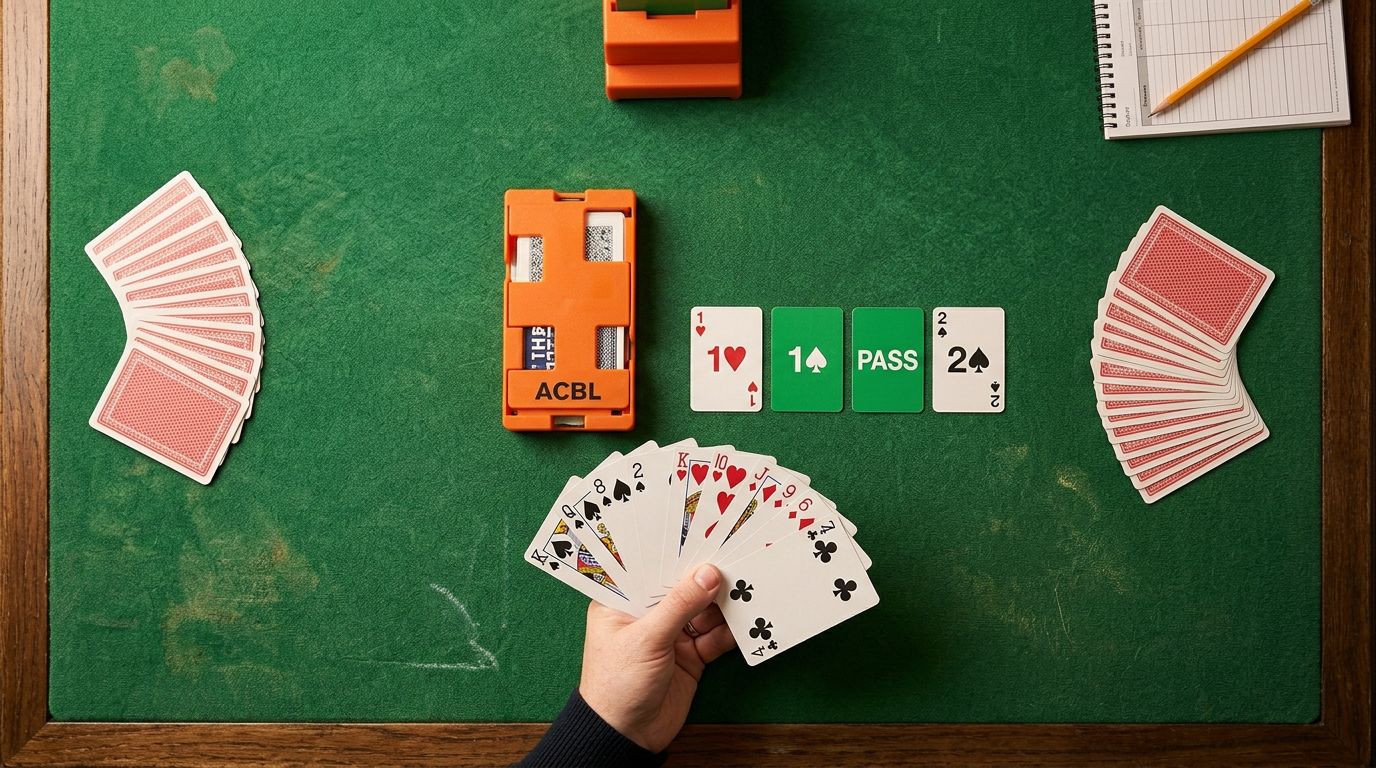
Transfer Bids: Jacoby, Texas, Minor Suit & Advanced Trans...
Your partner opens 1NT. You’re holding five spades and 8 HCP. You want to play in spades, but if you bid 2♠ directly, you become declarer. That puts the strong hand in dummy and lets the opponents see exactly where all the honors are before they lead.
There’s a better way: bid 2♥.
This isn’t a mistake. It’s a transfer bid. You bid 2♥ to show spades, partner bids 2♠, and suddenly the 1NT opener is declaring. The strong hand is hidden, the opening lead comes around to their honors, and you’ve just improved your chances of making.
Transfer bids are one of the smartest conventions in bridge. They’re simple, they’re powerful, and once you start using them, you’ll wonder how you ever played without them.
What Are Transfer Bids?
A transfer bid shows a different suit than the one you’re actually bidding. You bid one suit to tell partner to bid another suit.
The most common transfers happen after a 1NT opening:
- 2♦ = Transfer to hearts (shows 5+ hearts)
- 2♥ = Transfer to spades (shows 5+ spades)
When you bid a transfer, partner almost always “accepts” by bidding the suit you’re showing. This makes them declarer instead of you.
Example:
Partner: 1NT
You: 2♥ (showing spades)
Partner: 2♠ (accepting the transfer)
You’ve successfully gotten partner to declare spades. Now your hand is dummy, and partner’s strong notrump hand is hidden from the opponents.
Jacoby Transfers: The Basic Tool
Jacoby Transfers (named after Oswald Jacoby) are the standard transfer bids used after 1NT openings. They work for the majors:
After partner opens 1NT:
- 2♦ = Shows 5+ hearts, asks partner to bid 2♥
- 2♥ = Shows 5+ spades, asks partner to bid 2♠
Partner is expected to accept the transfer almost always. They bid the suit you’re showing at the next level up.
Requirements to transfer:
- 5+ cards in the major you’re showing
- Any point count (0-15+ HCP)
- Partner opened 1NT with no interference
That’s it. Unlike Stayman, which requires 8+ HCP, you can transfer with zero points. If you have a terrible hand with five spades, transferring to 2♠ is way better than languishing in 1NT.
Why Use Transfer Bids?
Transfers give you three huge advantages:
1. Right-Siding the Contract
This is the main reason. When the strong hand declares:
- The opening lead comes up to their honors (not through them)
- Opponents can’t see dummy’s honors before they lead
- Hidden honor combinations are more likely to win tricks
Example: Partner has 1NT with ♠AQ6. You have ♠J10753.
If you declare, opponents lead through the AQ and might win the king. If partner declares, the opening lead comes to the AQ, and the finesse is protected. That’s a full trick difference.
2. Describing Your Hand in Stages
After partner accepts your transfer, you have room to describe your strength:
- Pass = Weak hand (0-7 HCP), wanted to play 2♥/♠
- 2NT = Invitational (8-9 HCP) with exactly 5 cards
- 3NT = Game values (10-14 HCP) with exactly 5 cards
- 3♥/♠ = Invitational (8-9 HCP) with 6 cards
- 4♥/♠ = Game values with 6+ cards
You’ve used the transfer to handle declarer placement, then continued to show your exact strength and shape. That’s way more precise than blasting to 4♠ directly.
3. Handling Weak Hands
Without transfers, a weak hand with a five-card major is stuck. You can’t pass 1NT and you can’t bid 2♥ (that would be a game force in 2/1 or natural but wrong-sided in Standard).
With transfers, you bid 2♦ or 2♥, partner accepts, and you pass. Problem solved.
How Jacoby Transfers Work
Let’s walk through the mechanics:
Step 1: You transfer
Partner opens 1NT. You bid 2♦ (hearts) or 2♥ (spades).
Step 2: Partner accepts
Partner bids the suit you showed: 2♥ or 2♠.
Step 3: You describe your strength
Now you tell partner whether you’re weak, invitational, or game-forcing by passing, bidding 2NT/3NT, raising, or introducing a new suit.
Complete auction example:
Partner: 1NT (15-17 HCP)
You: 2♥ (transfer to spades, 5+ spades)
Partner: 2♠ (accepting)
You: Pass (weak hand, 0-7 HCP)
You’re in 2♠ with partner declaring. Perfect.
Responder’s Continuations After Transfer Accepted
After partner accepts your transfer, here’s what your rebids mean:
With Exactly 5 Cards in Your Major
| Your Rebid | Meaning | HCP |
|---|---|---|
| Pass | To play, weak hand | 0-7 |
| 2NT | Invitational, exactly 5 cards | 8-9 |
| 3NT | To play, exactly 5 cards | 10-14 |
| 3♣/3♦ | Natural, game-forcing, slam interest | 15+ |
| 4♥/4♠ | Rare (usually you’d bid 3NT) | 10+ |
With 6+ Cards in Your Major
| Your Rebid | Meaning | HCP |
|---|---|---|
| Pass | To play, weak hand | 0-7 |
| 3♥/3♠ | Invitational, 6 cards | 8-9 |
| 4♥/4♠ | To play, 6+ cards | 10-14 |
| New suit | Natural, game-forcing, slam try | 15+ |
The key principle: raising your major shows 6+ cards. With only 5, you bid 2NT or 3NT if you’re inviting or forcing.
Showing a Second Suit
After transferring, you can show a second suit at the 3-level to show game-forcing values and slam interest:
1NT - 2♥ (transfer to spades)
2♠ - 3♦ (5+ spades, 4+ diamonds, game-forcing)
This shows 5-4 or better distribution with 15+ HCP. Partner can now evaluate whether slam is likely based on fit.
Super-Accepts by Opener
Here’s where transfers get even more powerful. When opener has maximum values (17 HCP or good 16) AND four-card support for your major, they can “super-accept” by jumping.
Instead of bidding 2♥ or 2♠, opener bids:
- 2♠ (over 2♦ transfer) = Maximum with 4 hearts
- 2NT (over 2♥ transfer) = Maximum with 4 spades
- 3♥ (over 2♦) = Maximum with 4 hearts (some pairs)
- 3♠ (over 2♥) = Maximum with 4 spades (some pairs)
Why super-accept? It tells responder immediately that opener has fitting cards. With a borderline invitational hand (8-9 HCP), responder can now bid game knowing there’s a nine-card fit and maximum values.
Example:
Opener: 1NT with 17 HCP and four hearts
Responder: 2♦ (transfer to hearts)
Opener: 2♠ (super-accept: max with 4 hearts)
Responder: 4♥ (accepts, knowing of 4-4 fit + max)
Partnership agreement required: Some pairs use 2♠/2NT as super-accepts. Others use 3♥/3♠. Some don’t use super-accepts at all. Discuss this with partner and mark it on your convention card.
Minor Suit Transfers
Some partnerships extend transfers to the minors using 2♠ for clubs or 3♣ for diamonds. These are typically used with weak hands (long minor, want to play 3♣/3♦ instead of 1NT) or strong slam-going hands.
Warning: Minor suit transfers are NOT standard. Many partnerships don’t use them. Discuss with partner or you’ll have disasters.
Texas Transfers: The Power Jump
Texas Transfers are four-level transfers used with strong hands and six-card majors:
- 4♦ = Transfer to hearts (6+ hearts, game values)
- 4♥ = Transfer to spades (6+ spades, game values)
Partner accepts by bidding 4♥ or 4♠.
Why use Texas instead of Jacoby?
Texas Transfers are used when you know you want to play 4♥ or 4♠ and don’t want to explore slam. It’s faster and ends the auction.
Comparison:
Jacoby route:
1NT - 2♥ (transfer to spades)
2♠ - 4♠ (to play)
Texas route:
1NT - 4♥ (transfer to spades, to play)
4♠ - Pass
Same result, but Texas tells opponents less. They have less room to exchange information before the opening lead.
When responder transfers then bids game vs. uses Texas:
Some pairs use the distinction to show slam interest:
- Texas transfer (4♦/4♥) = No slam interest, just signoff
- Jacoby transfer then 4♥/4♠ = Mild slam interest (gives opener option to continue)
Discuss this with partner. Some pairs don’t differentiate.
Example Hands and Auctions
Hand 1: Weak Hand with Five-Card Major
Partner opens 1NT. You hold:
♠ J9643
♥ 82
♦ 1054
♣ 763
Auction:
1NT - 2♥ (transfer to spades)
2♠ - Pass
You have 2 HCP and five spades. Transfer and pass. 2♠ will play better than 1NT.
Hand 2: Invitational with Five-Card Major
Partner opens 1NT. You hold:
♥ KQ1065
♠ 84
♦ A73
♣ Q62
Auction:
1NT - 2♦ (transfer to hearts)
2♥ - 2NT (invitational, exactly 5 hearts)
You have 9 HCP and five hearts. Transfer, then bid 2NT to invite. Partner will pass with minimum (15 HCP) or bid 3NT/4♥ with maximum (17 HCP).
Hand 3: Game-Forcing with Six-Card Major
Partner opens 1NT. You hold:
♠ AJ9742
♥ K6
♦ Q83
♣ 95
Auction:
1NT - 2♥ (transfer to spades)
2♠ - 4♠ (to play, 6 spades)
You have 10 HCP and six spades. Transfer then jump to game. With six-card majors, the major usually plays better than 3NT.
Hand 4: Texas Transfer
Partner opens 1NT. You hold:
♥ KQJ1086
♠ 94
♦ A72
♣ 63
Auction:
1NT - 4♦ (Texas transfer to hearts)
4♥ - Pass
You have 10 HCP and six hearts. You know you want to play 4♥. Use Texas to get there directly.
Common Mistakes with Transfer Bids
1. Transferring with only four cards
You need five cards minimum to transfer. With four cards, use Stayman instead.
2. Raising your major with only five cards
After 1NT - 2♥ - 2♠, bidding 3♠ shows SIX spades, not five. With five spades and invitational values, bid 2NT.
3. Forgetting transfers after interference
If opponents overcall or double, transfers are usually off. You need special agreements (like transfer lebensohl) to handle this.
4. Using Texas with slam interest
Texas Transfers are signoffs. If you want to explore slam, use Jacoby and then continue. Don’t use Texas and then bid again.
5. Not discussing super-accepts
Some pairs super-accept by bidding 2♠ over 2♦. Others jump to 3♥. Some don’t super-accept at all. Write it on your convention card or you’ll have disasters.
6. Breaking the transfer
Opener should accept the transfer 95% of the time. Breaking the transfer requires specific partnership agreement. Don’t break transfers without a clear reason.
7. Confusing Texas suits
4♦ transfers to HEARTS. 4♥ transfers to SPADES. They’re one step below, just like Jacoby. Don’t mix them up.
Why Transfer Bids Matter
Transfer bids solve multiple problems: they protect the strong hand, create bidding room to describe strength and shape, handle weak hands, and allow precise slam exploration. Before transfers, responding to 1NT meant either blasting to game or playing from the wrong side. Now you can handle anything from a weak 0-count to an 18-count powerhouse, all while keeping partner as declarer.
Partnership Agreements Needed
Before using transfers, discuss and write down:
- Do you play Jacoby Transfers? (almost everyone does)
- Do you play Texas Transfers? (common but not universal)
- Do you use super-accepts? How? (2NT/2♠ or 3-level jumps?)
- Do you play minor suit transfers? (less common)
- What does 2♠ mean over 1NT? (minor transfer or something else?)
- What happens after interference? (transfers on or off?)
- Texas vs. Jacoby-then-game: any difference? (slam interest?)
Write these on your convention card. Transfers are too important to guess about.
Related Articles
Practice This Convention with Brian
Want to test your understanding of this convention in realistic hands? Brian, the Bridgetastic AI, can deal you practice hands, walk you through the bidding, and explain when this convention applies, and when it doesn’t. Try Brian free →
The Bottom Line
Transfer bids are essential modern bridge. They’re played at every level from club games to world championships.
The basic version (Jacoby Transfers for the majors) is simple:
- 2♦ shows hearts
- 2♥ shows spades
- Partner accepts by bidding your suit
- You then describe your strength
That’s 90% of what you need. Texas Transfers and super-accepts add sophistication, but master the basics first.
Start using transfers at your next game. After a few sessions, they’ll feel automatic. And you’ll win more tricks by having the strong hand declare and by describing your hands more precisely.
That’s the magic of transfer bids: simple idea, powerful results.