Complete Guide to Bridge Scoring
Bridge scoring isn’t just math, it’s the invisible force shaping every bid and play at the table. The same 25 high-card points that demand a game bid in matchpoint strategy might warrant caution in IMPs and conservatism in rubber bridge. Understanding your scoring system is as fundamental as knowing how many points you need to open.
Trick Scoring: The Foundation
Every bridge score starts with trick points, what you earn for the tricks you contracted to make. These values are identical across all forms of bridge.
Per-Trick Values
Clubs (♣) and Diamonds (♦): 20 points per trick over six
Hearts (♥) and Spades (♠): 30 points per trick over six
Notrump (NT): 40 points for the seventh trick, 30 points for each subsequent trick
The “over six” language reflects bridge’s structure, your side gets six automatic book tricks. Bidding is about tricks beyond those six.
Examples:
| Bid | Tricks Needed | Calculation | Points |
|---|---|---|---|
| 2♥ | 8 total | 30 × 2 | 60 |
| 3NT | 9 total | 40 + 30 + 30 | 100 |
| 5♣ | 11 total | 20 × 5 | 100 |
| 4♠ | 10 total | 30 × 4 | 120 |
Why Values Matter Strategically
The unequal trick values create bridge’s strain hierarchy:
- Notrump: Fastest to game (9 tricks for 3NT)
- Majors: Second fastest (10 tricks for 4♥/4♠)
- Minors: Hardest (11 tricks for 5♣/5♦)
This is why finding an 8-card major fit is worth contorting your auction. And why experienced players sometimes choose 3NT over 5♦ even with an 8-card fit—nine tricks may be easier than eleven, even without a trump suit.
Game Bonuses: The 100-Point Threshold
A “game” is any contract worth 100+ trick points. Reaching game unlocks substantial bonuses that dwarf the trick points themselves.
Game Bonus Structure
Not vulnerable: 300 points
Vulnerable: 500 points
These bonuses stack on top of trick points:
3NT making exactly, not vulnerable: 100 + 300 = 400 total
3NT making exactly, vulnerable: 100 + 500 = 600 total
4♥ making exactly, not vulnerable: 120 + 300 = 420 total
4♥ making exactly, vulnerable: 120 + 500 = 620 total
Partials Get Less
Contracts under 100 trick points are “partials” or “part-scores.” In duplicate, they receive a flat 50-point bonus:
2♠ making exactly: 60 + 50 = 110 total (any vulnerability)
That 300-500 game bonus is enormous. If you have a 50% game, you risk 50-100 points (down one) to gain 300-500 points. The math strongly favors bidding close games, this drives the aggressive bidding culture in duplicate bridge.
Slam Bonuses: The Big Numbers
Slams stack their bonuses on top of game bonuses, creating massive scores.
Slam Bonus Structure
Small Slam (12 tricks)
- Not vulnerable: 500 bonus
- Vulnerable: 750 bonus
Grand Slam (13 tricks)
- Not vulnerable: 1,000 bonus
- Vulnerable: 1,500 bonus
Slams Stack Everything
6NT making exactly, vulnerable:
- 190 (trick points)
- 500 (game bonus)
- 750 (slam bonus)
- 1,440 total
7♠ making exactly, not vulnerable:
- 210 (trick points)
- 300 (game bonus)
- 1,000 (grand slam bonus)
- 1,510 total
The jump from 3NT (600 vulnerable) to 6NT (1,440 vulnerable) is 840 points. This explains why slam bidding exists, even failing occasionally, the math works out.
Overtricks and Undertricks
Overtricks (Undoubled)
Each trick beyond your contract is worth its basic trick value:
- Minors: 20 points per overtrick
- Majors/NT: 30 points per overtrick
3NT+1 (not vul): 400 + 30 = 430
4♠+1 (vul): 620 + 30 = 650
At matchpoint strategy, that 30 points can separate tops from bottoms. At IMPs, it’s worth 1 IMP, nice but not worth risking your contract.
Undertricks (Undoubled)
Not vulnerable: 50 per trick
Vulnerable: 100 per trick
3NT down one, not vul: -50
3NT down two, vul: -200
6♣ down three, vul: -300
These penalties are modest compared to available bonuses, which is why duplicate rewards aggressive bidding. Missing a 300-500 game bonus often hurts more than going down 50-100.
Doubled and Redoubled Scoring
When doubled, everything changes, dramatically, in both directions.
Making Doubled Contracts
You get:
- Double trick points
- 50-point insult bonus
- 100 per overtrick (not vul) or 200 (vul)
- Regular game/slam bonuses
3NT doubled, making exactly, not vul:
- 100 × 2 + 50 + 300 = 550 (vs. 400 undoubled)
4♥ doubled, making +1, vul:
- 120 × 2 + 50 + 200 + 500 = 990
Doubled Penalties
The penalty structure is progressive and punishing:
| Down | Not Vul | Vulnerable |
|---|---|---|
| 1 | 100 | 200 |
| 2 | 300 | 500 |
| 3 | 500 | 800 |
| 4 | 800 | 1100 |
| 5 | 1100 | 1400 |
| 6 | 1400 | 1700 |
Notice the acceleration. Down one doubled vulnerable (-200) is painful but survivable. Down three doubled vulnerable (-800) is catastrophic. This is why you rarely see doubled contracts at the table, someone usually misjudged badly.
Redoubles
Redouble doubles everything again (trick points ×4, penalties ×2, insult bonus 100). You’ll rarely see this used for scoring, redoubles are typically conventional signals (SOS, support) rather than genuine confidence statements.
Vulnerability: The Risk Modifier
Vulnerability amplifies both rewards and penalties.
Vulnerability Effects
Game bonuses: 300 (not vul) vs. 500 (vul), 67% higher
Small slam: 500 vs. 750, 50% higher
Grand slam: 1,000 vs. 1,500, 50% higher
Undertricks: 50 vs. 100 per trick, 100% higher
Doubled penalties: Roughly double
How Vulnerability Works
Duplicate bridge: Pre-assigned and rotates through None, Both, N/S, E/W across 16 boards.
Rubber bridge: Earned by winning a game. Once you win your first game, you’re vulnerable until the rubber ends.
Strategic Implications
When vulnerable, both rewards and risks increase. The bigger game bonus (500 vs. 300) justifies bidding slightly thinner games. But doubled penalties make recklessness costly.
“Favorable vulnerability” (you’re not vulnerable, they are) is prime time for aggressive overcalls and pre-empts. Your down-one penalty is 50; theirs is 100. Your down-two doubled is 300; theirs is 500. The risk/reward tilts heavily in your favor.
Matchpoint Scoring: Comparison Game
Matchpoints (pairs scoring) is the most common club duplicate format. You don’t care about absolute score, only relative performance versus others who played the same hands.
How It Works
Beat another pair’s score: 1 matchpoint. Tie: 0.5. Lose: 0.
With 13 pairs (26 players), you face 12 comparisons per board. Scores range from 0 (bottom) to 12 (top).
Matchpoint Strategy
Every point matters. The 30-point difference between 400 and 430 (one overtrick in 3NT) can separate 50% from 80%. This drives:
- Aggressive overtrick attempts
- Playing 3NT over 5♣ even with a fit
- Taking small risks for small gains
Being normal is good. If everyone’s in 4♠ making, you want to be there too. Going down in 4♠ when everyone else is down isn’t terrible—same score. But stopping in 3♠ and making overtricks while everyone makes game? Bottom board.
Bid thin games. A 50-50 game should be bid. Making it beats pairs who stopped short. Failing puts you with half the field who also bid it.
Don’t be the lone wolf. Even in a bad contract, if everyone’s there, you want to be there too. Being the only pair who “correctly” avoided 4♠ doesn’t help when everyone makes it.
IMP Scoring: The Team Game
IMPs (International Match Points) compress differences on a logarithmic scale. You compare to one other result (teammates or direct opponents).
The IMP Scale (Abbreviated)
| Point Diff | IMPs | Point Diff | IMPs | Point Diff | IMPs |
|---|---|---|---|---|---|
| 0-10 | 0 | 130-160 | 4 | 500-590 | 11 |
| 20-40 | 1 | 170-210 | 5 | 750-890 | 13 |
| 50-80 | 2 | 220-260 | 6 | 1100-1290 | 15 |
| 90-120 | 3 | 320-360 | 8 | 1500+ | 17+ |
Understanding Compression
Small differences don’t matter. One overtrick (30 points) = 1 IMP. At matchpoint strategy, it might be 20 matchpoint difference.
Medium swings are significant. Making game (+420) versus stopping in partial (+170) = 250 points = 6 IMPs.
Disasters are capped. Down 1100 when teammates make +110 is a 1210-point catastrophe, but “only” 15 IMPs. Painful but recoverable.
IMP Strategy
Protect your contract. Don’t risk down one (8 IMP swing) for one overtrick (1 IMP gain).
Bid sound games. 50% games are worth bidding (game bonus of 7-10 IMPs when making offsets 8-10 IMP loss when failing). 35% games are wrong.
Avoid disasters. Down 800 doubled instead of 100 undoubled costs 11-12 extra IMPs.
Compete carefully. At matchpoint strategy, competing to 3♥ over 3♦ when uncertain is often right. At IMPs, going down when you could defend for +110 costs 6-7 IMPs.
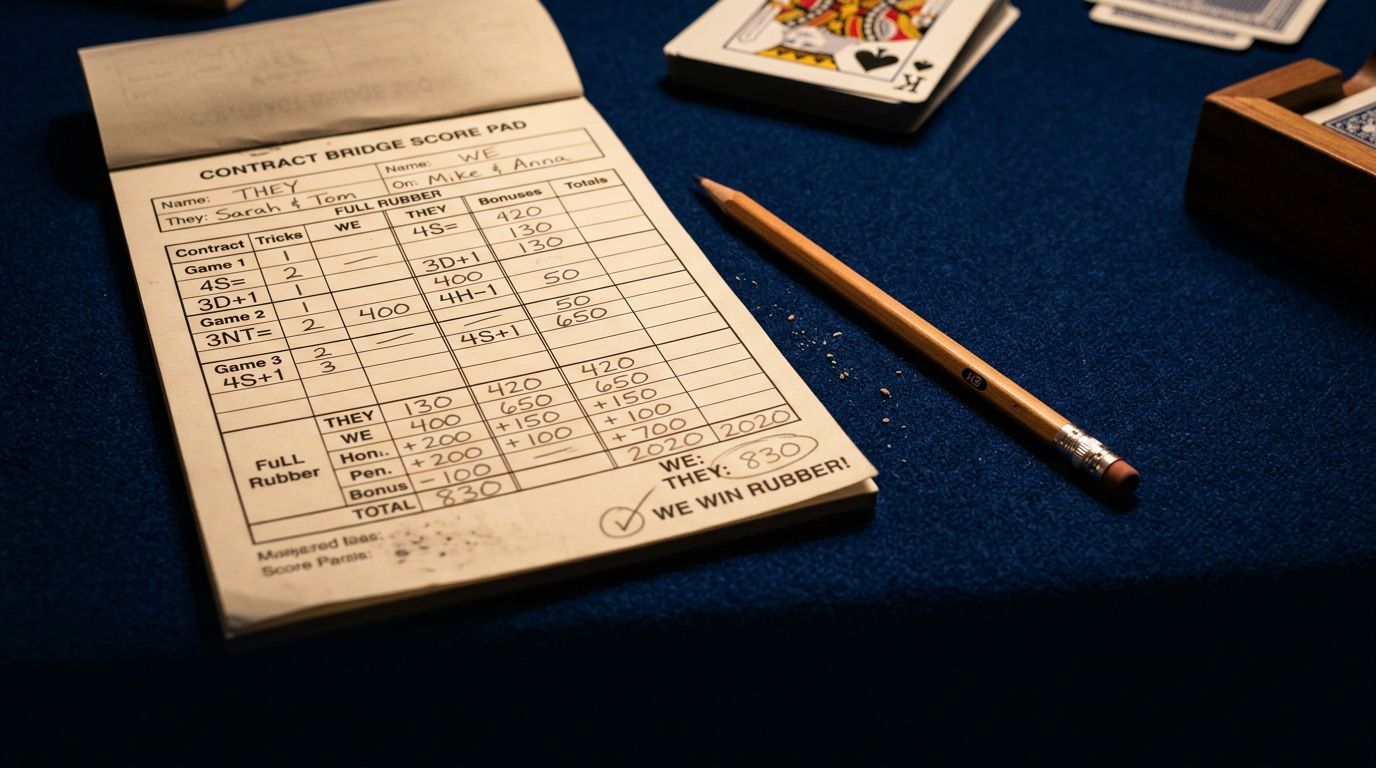
Rubber Bridge Scoring
Rubber bridge is the original form, a cumulative game where you’re trying to win two games before opponents do.
Rubber Structure
Win two games before opponents win any: 700-point rubber bonus. Win two games while they win one: 500 points.
Games are won by accumulating 100+ trick points across one or more deals. Make 3NT = one game. Make 2♥ (60) then 2♠ (60) = one game via accumulated part-scores.
Dynamic Vulnerability
- No games won yet: Neither vulnerable
- One side wins a game: That side vulnerable, other not
- Both win a game: Both vulnerable
This creates fascinating dynamics. Leading by a game puts you vulnerable with opponents not vulnerable, worst possible for aggressive action. Behind puts you at favorable vulnerability for competing.
Unique Features
Honors bonus (duplicate doesn’t have this):
- All four aces in NT: 150 points
- Five top honors (A-K-Q-J-10) in trump: 150
- Four top honors in trump: 100
Part-scores carry forward until a game is completed, creating pressure to compete when opponents have a partial.
The scoring sheet has a horizontal line. “Below the line” = trick points from bid contracts (count toward game). “Above the line” = everything else (overtricks, bonuses, penalties).
Strategy Differences
Big swings matter enormously. Down 800 in duplicate is one bad board. In rubber, it might decide the entire rubber.
Position drives strategy. Ahead by a game? Play conservatively. Behind at favorable vulnerability? Gamble to catch up.
Final game tension. At 1-1 in games, the next game wins the rubber. Single contracts can swing hundreds of points.
Common Scoring Confusion
“Do overtricks count toward game?”
No. Only bid tricks count (below the line in rubber). Bid 2♥, make +4 overtricks = still only 60 toward game.
“Slam bonus: 500 or 750?”
Depends on vulnerability. Small slam: 500/750. Grand slam: 1,000/1,500. Don’t forget to add the game bonus on top.
“3NT doubled, how to score?”
Trick points double, add 50 insult, add game bonus: (100 × 2) + 50 + 300/500 = 550 or 750.
“Should I risk my contract for an overtrick at matchpoint strategy?”
Usually no. The 20-30 points for an overtrick versus a 400-600 swing if you fail makes it a bad bet, unless you’re in a normal contract everyone reaches (then fight for overtricks because you’re not risking falling behind the field).
“What’s board-a-match?”
Like matchpoint strategy but compressed to three outcomes: win (1), lose (0), or tie (0.5). Doesn’t matter if you beat them by 10 or 1,000. Creates even more conservative play than IMPs.
Quick Reference Tables
Game Contracts Making Exactly
| Contract | Not Vul | Vul |
|---|---|---|
| 3NT | 400 | 600 |
| 4♥/4♠ | 420 | 620 |
| 5♣/5♦ | 400 | 600 |
Common Partials Making Exactly
| Contract | Points |
|---|---|
| 1NT | 90 |
| 2NT | 120 |
| 2♥/2♠ | 110 |
| 3♣/3♦ | 110 |
Small Slams Making Exactly
| Contract | Not Vul | Vul |
|---|---|---|
| 6NT | 990 | 1440 |
| 6♥/6♠ | 980 | 1430 |
| 6♣/6♦ | 920 | 1370 |
Grand Slams Making Exactly
| Contract | Not Vul | Vul |
|---|---|---|
| 7NT | 1520 | 2220 |
| 7♥/7♠ | 1510 | 2210 |
| 7♣/7♦ | 1440 | 2140 |
The Strategic Bottom Line
Scoring isn’t background mathematics, it’s the game itself. Every bid, lead, and finesse decision flows from the scoring system.
At matchpoint strategy: Be aggressive. Bid thin games, fight for overtricks when safe, avoid being the lone pair in the wrong contract. Small edges compound into tops.
At IMPs: Be sound. Bid games with 50%+ odds, protect contracts, avoid unnecessary risks. Big numbers matter, but disasters aren’t fatal thanks to the compressed scale.
At rubber bridge: Read position. Leading? Be conservative and protect your advantage. Behind? Take calculated risks to catch up. The cumulative nature rewards consistency but sometimes demands bold action.
The numbers create the strategy. Learn them, internalize them, and you’ll see what experts see, not 13 tricks to win, but a scoring optimization problem with clear mathematical incentives that reward smart risk-taking in some systems and careful consolidation in others.