Standard American Yellow Card (SAYC)
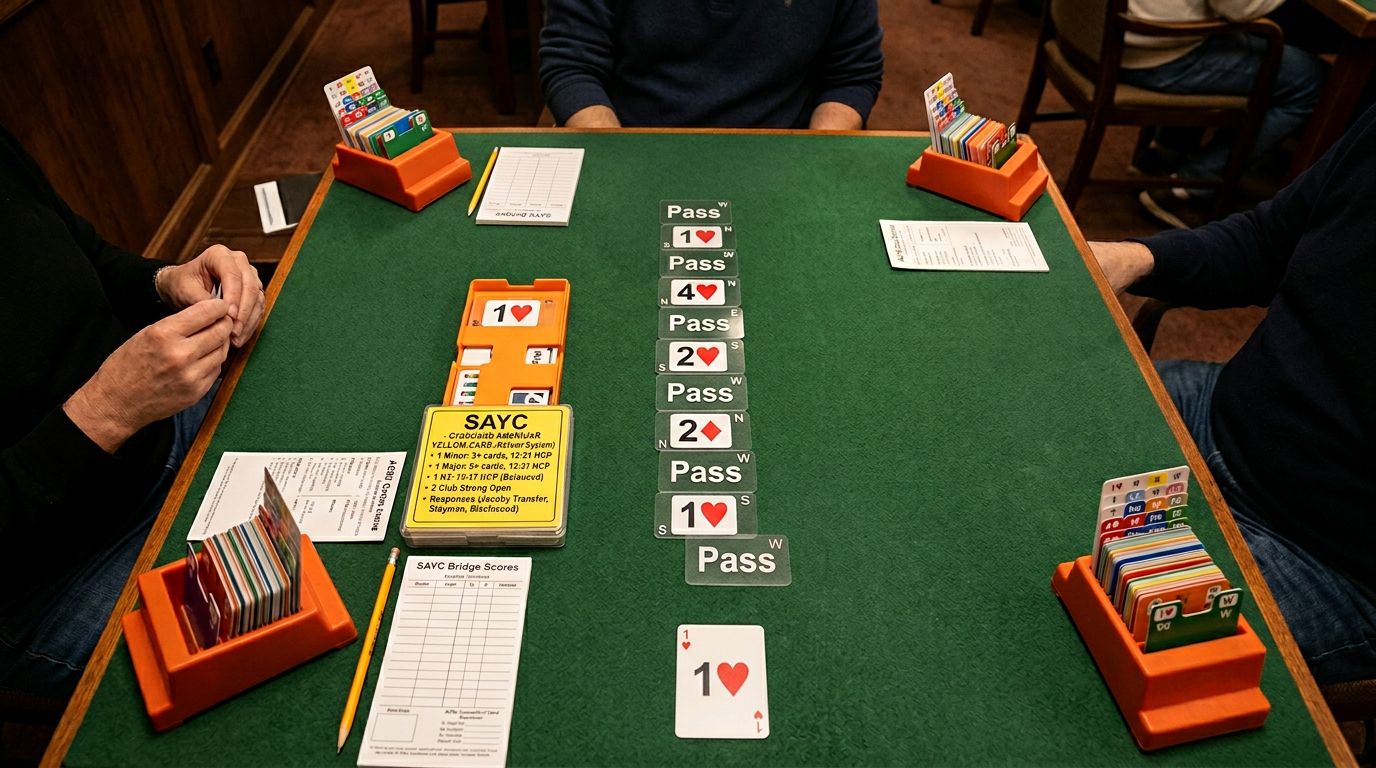
If you walk into an ACBL club game and sit down with a stranger, you’re probably playing SAYC. Standard American Yellow Card is the default bidding system in North American bridge, and for good reason. It’s straightforward, well-documented, and gets the job done.
SAYC isn’t fancy. It won’t wow anyone at a regional. But it’s solid, teachable, and thousands of players use it every day without thinking twice.
What Is SAYC?
SAYC is a natural bidding system built on Standard American with specific agreements written down by the ACBL. The “Yellow Card” name comes from the old convention cards that were printed on yellow paper.
The system uses five-card majors, strong notrumps (15-17 HCP), and a standard set of conventions that most players already know. If you learned bridge in North America in the last 30 years, you probably learned something close to SAYC.
Think of it as the bridge equivalent of learning to drive with an automatic transmission. Not the most sophisticated option, but reliable and easy to pick up.
Key Features of SAYC
Opening Bids
SAYC opens are what you’d expect from Standard American:
1♥/1♠: Five-card suit, 12-21 HCP. You need at least five cards to open a major.
1♣/1♦: Three or more cards, 12-21 HCP. Sometimes you’re opening a three-card minor because you have to bid something.
1NT: 15-17 HCP, balanced hand. The anchor of the system.
2♣: Strong and artificial, 22+ HCP or 9+ tricks. Game-forcing.
2♦/2♥/2♠: Weak twos, 6-10 HCP with a six-card suit. Standard preempts.
Responses and Conventions
SAYC includes these standard conventions:
Stayman: 2♣ over 1NT to find 4-4 major fits.
Jacoby Transfers: 2♦ transfers to hearts, 2♥ transfers to spades.
Blackwood: 4NT asks for aces (standard 1430 RKCB isn’t required in basic SAYC).
Takeout Doubles: Standard competitive bidding.
Negative Doubles: Through 2♠.
Weak Jump Overcalls: Jump overcalls show weak hands with long suits.
Limit Raises: Single raise = 6-10 points, jump raise = 10-12 points with four-card support.
That’s about it. SAYC keeps the convention card simple.
What SAYC Doesn’t Include
SAYC is deliberately basic. You won’t find:
- 2/1 Game Force (standard SAYC uses 2/1 as forcing one round, not game-forcing)
- Fourth suit forcing (it’s available but not required)
- Splinter bids (not standard, though many players add them)
- New minor forcing (some play it, but it’s not in the core system)
- Fancy slam conventions beyond basic Blackwood
You can add these later, but SAYC out of the box is bare-bones.
When to Play SAYC
Pickup games: This is what SAYC is for. You don’t need to discuss much. Fill out the card, check off the standard boxes, start playing.
Learning the game: If you’re new to duplicate bridge, SAYC gives you a clean foundation. Learn this first, then add complexity.
Club games with unfamiliar partners: Unless you’ve agreed otherwise, assume your partner plays SAYC at a club game.
Online bridge: Many online platforms default to SAYC for casual games.
Who Should Play SAYC
SAYC works best for:
New duplicate players: You’re learning the game. Don’t overcomplicate it.
Casual players: You play once a month and don’t want to memorize 40 conventions.
Pickup partnerships: You’re sitting down with someone new and need a common baseline.
Players who just want to play: Not everyone wants to study bidding theory for hours. SAYC lets you show up and compete.
Strengths of SAYC
Universally known: Almost every North American player knows SAYC basics. That’s huge for pickup partnerships.
Easy to remember: The system is simple enough that you don’t forget it between games.
Well-documented: The ACBL publishes the official SAYC conventions. No ambiguity about what’s standard.
Natural bidding: Suits mean what they say. You’re not playing a bunch of artificial bids.
Good enough for most hands: SAYC handles 90% of deals reasonably well.
Weaknesses of SAYC
Not game-forcing after 2/1: This is the big one. In standard SAYC, a 2/1 response forces one round but isn’t game-forcing. This makes it harder to explore for slam or stop in partscore when needed. Most serious players switch to 2/1 Game Force specifically because of this limitation.
Limited major suit raises: The jump raise structure (single raise = 6-10, jump = 10-12) leaves gaps. You don’t have great ways to show different types of limit raises or distinguish between minimum and maximum ranges.
Weak minor suit openings: Opening 1♣ could be three cards. That makes it harder to find minor suit fits and your 1♣ opening doesn’t promise much.
Minimal competitive bidding tools: SAYC covers the basics but doesn’t include lebensohl, responsive doubles, or other modern competitive tools.
Not optimized for serious partnerships: If you play with the same partner regularly, you’ll quickly outgrow SAYC and want more sophisticated agreements.
SAYC vs. 2/1 Game Force
The single biggest question for SAYC players is whether to switch to 2/1 Game Force. Here’s the difference:
In SAYC, if partner opens 1♠ and you respond 2♥, that’s forcing for one round but not to game. Opener can pass 3♥ if they’re minimum.
In 2/1, that same 2♥ response is game-forcing (except when responder rebids their suit at the three level). This creates more bidding room to explore for slam and makes the auction clearer.
Most tournament players use 2/1. It’s a better system once you’re past the beginner stage. But SAYC is fine while you’re learning.
Tips for Playing SAYC
Mark your card accurately: Don’t check boxes for conventions you don’t actually play. If you’re not playing new minor forcing, don’t mark it.
Discuss opener’s rebids: SAYC is clear about opening bids but less specific about rebid structure. Talk about what sequences are forcing.
Agree on Bergen Raises: The standard SAYC card doesn’t include Bergen, but many players add it. If your partner marks Bergen, make sure you know which version.
Know your negative doubles: SAYC says negative doubles through 2♠. That means a double of 3♣ is penalty, not takeout.
Don’t overthink it: SAYC is meant to be simple. If you’re spending 10 minutes discussing what 3♦ means after a 2NT overcall, you’re thinking too hard.
Practice This System with Brian
Want to practice this bidding system with realistic hands? Brian understands Standard American, 2/1, and other popular systems. Try Brian free →
Should You Stick with SAYC?
If you’re playing once a week with different partners, SAYC is perfectly fine. It does what it needs to do.
If you’re getting serious about tournament bridge or playing with a regular partner, you’ll probably want to upgrade. 2/1 Game Force is the natural next step, and it’s not that different from SAYC. Most of what you learned still applies.
SAYC is a starting point, not a destination. But it’s a good starting point. Learn it, play it, get comfortable with it. When you’re ready for more, you’ll know.
The system isn’t sexy. It won’t impress anyone. But it works, and sometimes that’s all you need.