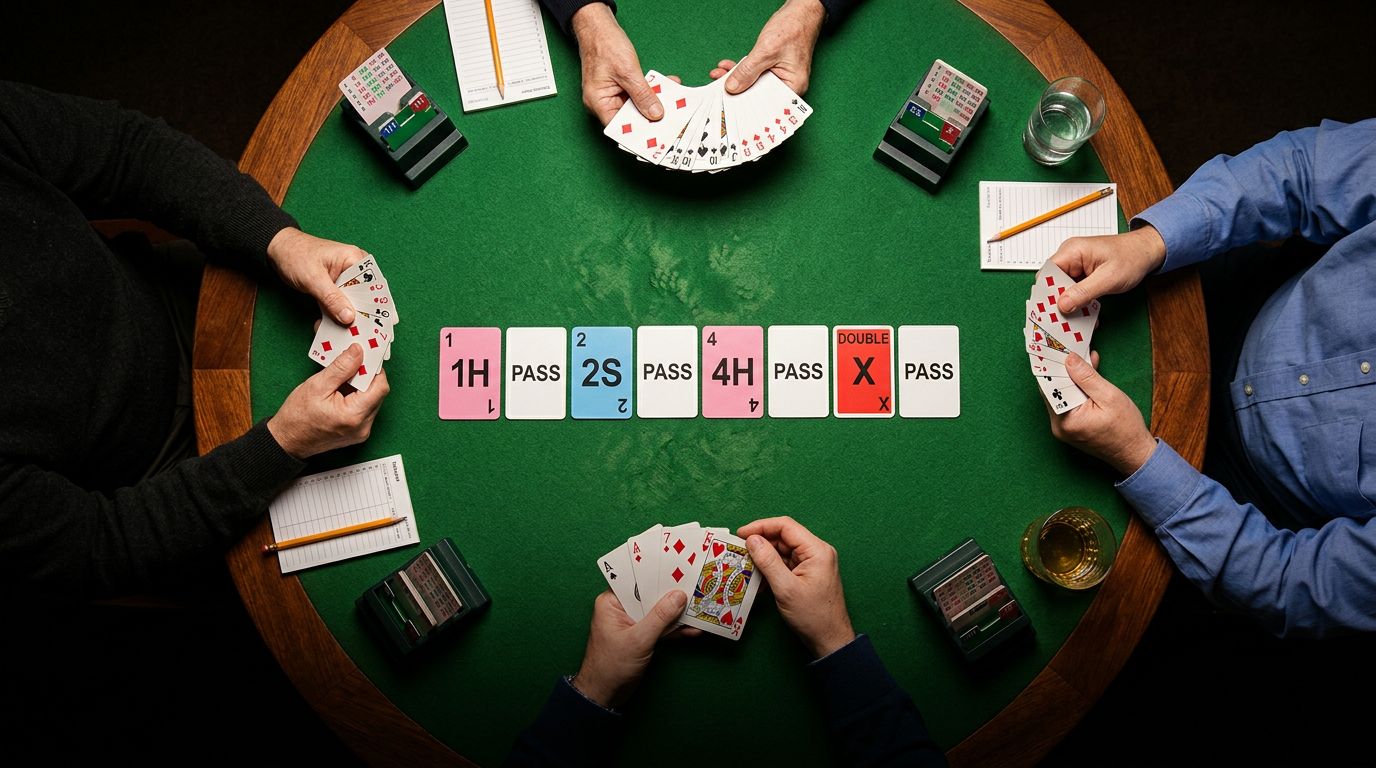
2/1 Game Force: The Modern Tournament Bidding System
Walk into any regional or nationals, and most serious pairs are playing 2/1 Game Force. It’s become the tournament standard in North America, and once you understand why, you’ll probably make the switch too.
2/1 (pronounced “two over one”) is built on one simple idea: when an unpassed responder makes a non-jump new-suit response at the two level after a major-suit opening, the partnership is going to game. No backing out, no confusion. That single change creates enough bidding space to find the right game, explore for slam, and keep control of the auction.
What Makes 2/1 Different
The core principle is right in the name. After partner opens one of a major, a non-jump new-suit response at the two level is game-forcing by agreement.
Partner opens 1♠, you bid 2♥. You’re going to game. Period. Opener can rebid 2♠ with a minimum, and that’s not a signoff. You keep bidding until you reach game.
In [Standard American](/encyclopedia/systems/standard-american-yellow-card) or SAYC, that same 2♥ bid forces one round but isn’t game-forcing. Opener can pass your next bid below game. Sounds like a small difference, but it changes everything.
Why Game-Forcing Matters
When you establish a game force early, you get breathing room. Neither player is worried about the auction dying below game, so you can:
Show your shape slowly: Bid naturally without jumping around to make sure you get to game.
Make non-forcing rebids: Opener can rebid their suit at the two level to show a minimum. In SAYC, that same rebid might end the auction too low.
Explore for slam: With game already guaranteed, you can use the three-level to show features, make help-suit tries, or start control bidding.
Use the three-level for description: Bids like 3♣ or 3♦ become descriptive rather than jumps to force game.
The extra bidding room is where 2/1 shines. You can have relaxed auctions that describe both hands accurately instead of racing to game.
The Basic Structure
Here’s how 2/1 works:
Opening Bids
Same as Standard American. Five-card majors, 15-17 notrump, 12-21 HCP for suit openings. Nothing changes here.
Game-Forcing Responses
A standard 2/1 response is a non-jump new-suit response after partner opens one of a major. Typical sequences are 1♠ - 2♣, 1♠ - 2♦, 1♠ - 2♥, 1♥ - 2♣, and 1♥ - 2♦. These calls usually show game-forcing values, often about 12+ HCP, but exact suit-quality and strength requirements are partnership agreements.
After 1♥, 2♠ is a jump shift, not an ordinary 2/1 response; its meaning is a separate partnership agreement.
A three-level rebid is not an exception to the game force: In 1♠ - 2♥ - 2♠ - 3♥, responder’s 2♥ already established an uncontested 2/1 game force. The 3♥ bid can help describe responder’s hand or set a trump direction under the partnership’s agreements, but it does not show 10-12 HCP or make the auction invitational. A hand with invitational values would not start with a 2/1 response.
The ordinary 2/1 game-force trigger applies after a major-suit opening, not to every two-level response after a minor opening. Minor-suit responses and raises have their own meanings, so confirm those agreements with your partner.
Non-Game-Forcing Responses
1NT forcing: After 1♥ or 1♠, a 1NT response is forcing for one round. Shows 6-12 HCP without three-card support or a better bid. This is different from Standard American where 1NT is often semi-forcing.
Single raise: 1♠ - 2♠ is a natural, non-game-forcing raise. Many pairs use it for roughly 6-9 HCP with three-card support, but the exact range and support promise are partnership agreements.
Limit raise: In a common 2/1 structure, a direct 1♠ - 3♠ is a weak or preemptive raise, not a limit raise. A partnership can show a limit raise by responding 1NT forcing and later raising, or by using an agreed conventional raise such as Bergen. Agree on the exact route before you play.
New suit at the one level: Still forcing one round, same as always. 1♥ - 1♠ forces opener to bid again but isn’t game-forcing.
What Else Changes
2/1 isn’t just about that one response. Most pairs playing 2/1 also add:
1NT forcing: After major openings, 1NT is forcing and opener must bid again.
Bergen Raises: Many 2/1 pairs use Bergen to show different types of major suit raises.
Jacoby 2NT: An artificial 2NT response to show a game-forcing raise of partner’s major.
New Minor Forcing: After 1♦ - 1♠ - 1NT, responder can bid 2♣ (artificial) to check back for three-card spade support or a heart stopper.
Fourth Suit Forcing: Bidding the fourth suit is artificial and forcing, used to create bidding space or check for stoppers.
These conventions work better with 2/1 because you have more room to use them. But they’re optional additions, not required parts of the system.
Key Differences from SAYC
Let’s be specific about what changes when you switch:
After 1♠ - 2♥
SAYC: Forcing one round. Opener can pass 3♥ if minimum.
2/1: Game forcing. Opener can rebid 2♠ with a minimum. Responder can pass 4♠ but not 3♠.
After 1♥ - 1NT
SAYC: Semi-forcing. Opener can pass with balanced minimum and no good rebid.
2/1: Forcing. Opener must bid again. Usually shows lack of support and denies four spades.
After 1♠ - 2♠
SAYC: Can be three-card support with 6-10 HCP.
2/1: Usually promises three-card support, but some pairs use Bergen and make this more specific.
Minor Suit Openings
SAYC: Responses work the same as major openings. 1♣ - 2♣ is natural and forcing.
2/1: Varies by partnership. Some play 1♣ - 2♣ as invitational, others as game-forcing. Discuss this early.
Advantages of 2/1
Better slam bidding: The extra space lets you show controls, make cue bids, and explore without flying past game.
Clearer auctions: Once game force is established, you know where you’re going. No ambiguity about whether a bid is forcing.
Flexible rebids: Opener doesn’t have to jump around to show strength. Minimum rebids are fine because the auction won’t die.
More accurate game selection: You have room to find out if 3NT, 4♥, or 5♣ is best.
Partnership confidence: Your partner knows you won’t let the auction stop in 2♠ when you have game values.
Disadvantages of 2/1
Game-force values need agreement: Game-force values are usually about 12+ HCP, but exact strength and suit-quality requirements are partnership agreements. Shape and opening style matter too, so agree on the threshold before treating 1NT forcing or another call as the only alternative.
More to remember: 2/1 requires learning [forcing 1NT](/encyclopedia/conventions/forcing-1nt), discussing what’s forcing and what’s not, and being clear about rebids.
Wrong-siding notrump: When a hand does not meet your partnership’s agreed 2/1 criteria, you can sometimes end up declaring 1NT from the wrong side.
Partnership coordination: Both players need to be on the same page. Playing 2/1 with someone who doesn’t know the system is a disaster.
Not universal: If you play pickup games, fewer partners know 2/1 compared to SAYC. You’ll need to stick with SAYC for those games.
Common Mistakes
Forgetting it’s forcing: Don’t pass 3♥ when partner made a 2/1 response. You’re going to game.
Bidding 2/1 without game-forcing values: Do not treat a 2/1 as a way to show a light hand unless your partnership explicitly agrees to that treatment. Evaluate shape and suit quality together with HCP, then use the range your partnership has agreed.
Treating 1NT as non-forcing: After 1♥ - 1NT, opener can’t pass. Bid something.
Not discussing minor suit raises: Partnerships get wrecked when one player thinks 1♣ - 2♣ is game-forcing and the other thinks it’s invitational.
Jumping when you don’t need to: You have a game force. Stop jumping to 3♥ to show extra values. Just bid 2♥ and describe your hand slowly.
Who Should Play 2/1
Tournament players: If you play in sectionals or higher, 2/1 is standard. Learn it.
Regular partnerships: The system works best when you play with the same partner regularly and can discuss agreements.
Players moving beyond beginner level: Once you’re comfortable with basic bidding, 2/1 is the natural next step.
Serious club players: Even at the club level, strong players use 2/1.
Making the Switch
If you’re coming from SAYC, the transition isn’t that hard. Most of your bidding stays the same. The key changes are:
- Non-jump new-suit responses at the two level after a major opening are game-forcing
- 1NT is forcing after majors
- Agree on the values and suit quality for a 2/1 response; many pairs start around a good 12+ HCP
Start by adding just those three agreements. Play some games. Get comfortable. Then add things like New Minor Forcing or Jacoby 2NT.
Don’t try to learn everything at once. The beauty of 2/1 is that the basic structure is simple. The complications come from the conventions you add on top, and you can learn those gradually.
Practice This System with Brian
Want to practice this bidding system with realistic hands? Brian understands Standard American, 2/1, and other popular systems. Try Brian free →
Is 2/1 Worth It?
Yes. If you’re serious about improving, 2/1 is worth learning. It’s not dramatically different from SAYC, but it handles slam exploration better and gives you clearer auctions.
The hardest part is finding time to discuss agreements with your partner. Once you’re both on the same page, 2/1 makes bidding easier, not harder.
Most experts play 2/1 or something even more sophisticated. If you want to compete at higher levels, you’ll need it eventually. Might as well learn it now.